Earlier this week Joshua David and Robert Hammond, co-founders of Friends of the High Line, received the prestigious Vincent Scully Prize. Awarded by the National Building Museum in Washington, it was created to recognize extraordinary practice, scholarship or criticism in architecture, historic preservation and urban design. The namesake of the award and its first recipient was an art history professor at Yale University. New Yorkers may remember Scully best for his comment about the atrocity that replaced the majestic, Beaux-Arts Penn Station that was torn down fifty years ago this month: “One entered the city like a God. One scuttles in now like a rat.”
Paul Goldberger, in introducing the co-founders, spoke about the impossibility of the High Line, and “all the reasons why it couldn’t work.” I recently re-read David and Hammond’s High Line: The Inside Story of New York City’s Park in the Sky, the tick-tock of the entire reclamation and preservation story, and “impossible” is just the right word. The book is an unlikely page-turner, and I recommend it as a tonic for these very particular days when our government is shut down and it’s hard to believe in anything good in the public realm. The existence of the High Line is a miracle, pure and simple, and it shows that innovative, creative, beautiful — and impossible — things can be done in our communities.
There are dozens of people who helped make the High Line the place that it is: early supporters, both in and out of government, who gave invaluable advice and support to the fledgling Friends of the High Line; landscape architect James Corner and his team; architects Diller Scofidio + Renfro; Dutch plantsman Piet Oudolf; and a staff of incomparably talented and dedicated staff, both in the garden and the back office. David and Hammond are like dual conductors of a symphony orchestra: not the men who make the music but the ones who enable it. It’s worth watching their speech online — click here for the video on YouTube — because it not only recaps the whole story but it also conveys the energy and optimism that have driven the entire project from its earliest days. It’ll put you in a good mood, I promise.
David closes his comments by quoting the second winner of the Vincent Scully Prize, the great Jane Jacobs, whose love of neighborhood and city were inspirations to both men. But along this urban greenway that did so much to preserve a sense of wildness in the center of our thriving, growing, city, I hear Scully’s voice resonating. In the 1960s, he testified in hearings to protest Con Edison’s plan to build a massive power plant at Storm King on the Hudson River, some 60 miles north of Gansevoort Street, “at the very threshold of New York.” The victory to preserve Storm King marked the beginning of the modern environmental movement; it was the first miracle story in New York State, and every activist since has carried a bit of the mountain in his soul. Here’s what Scully said, some 50 years before the opening of the High Line:
“Storm King…is a mountain which should be left alone. It rises like a brown bear out of the river, a dome of living granite, swelling with animal power. It is not picturesque in the softer sense of the word, but awesome, a primitive embodiment of the energies of the earth. It makes the character of wild nature physically visible in monumental form. As such it strongly reminds me of some of the natural formations which mark sacred sites in Greece and signal the presence of the Gods; it preserves and embodies the most savage and untrammeled characteristics of the wild at the very threshold of New York. It can still make the city dweller emotionally aware of what he most needs to know: that nature still exists, with its own laws, rhythms, and powers, separate from human desires.”
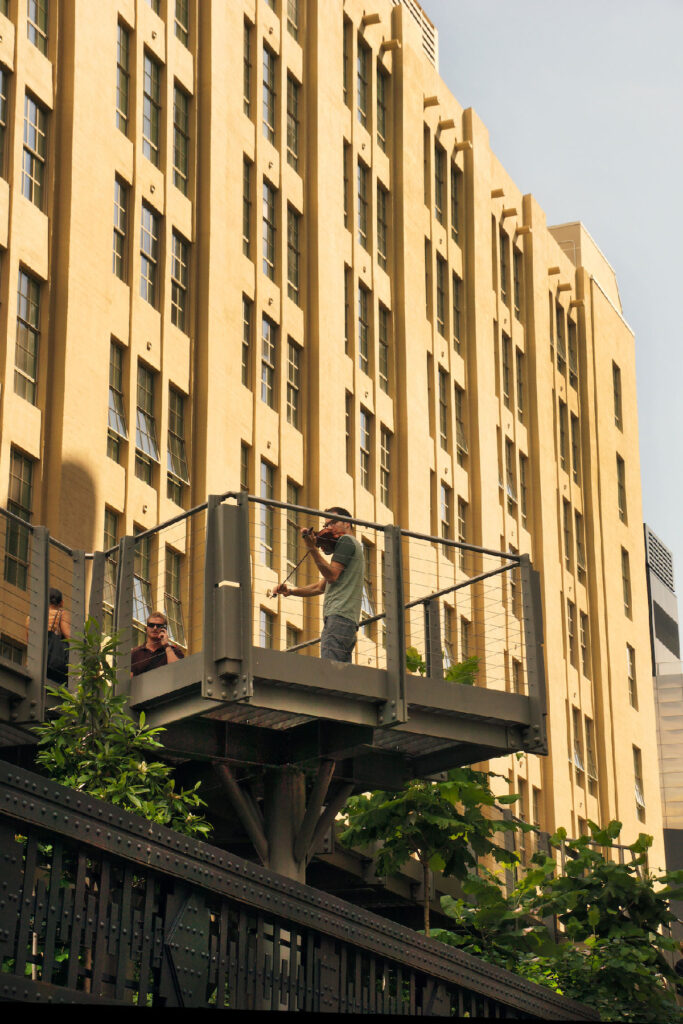
Cass Gilbert-designed warehouse, now Avenues School
The second building in my new series about architecture along the High Line is the former R.C. Williams warehouse, now Avenues School, on Tenth Avenue between 25th – 26th Streets. [Click here to read the first piece in the series, about the Westyard Distribution Center, and here for the “What’s the Building?” feature]
Just before Avenues opened last Fall I gave a lecture in the school’s cafeteria to the teachers and administrative staff. I wanted to welcome them to the neighborhood and also share some insight into the unique role their building plays in the High Line’s history. While researching the lecture I discovered a short book in the New York Public Library about R.C. Williams, the company that built this warehouse in the early 1930s. In its pages, to my great delight, I found a surprising story that makes a direct thematic link with the schoolhouse of today.
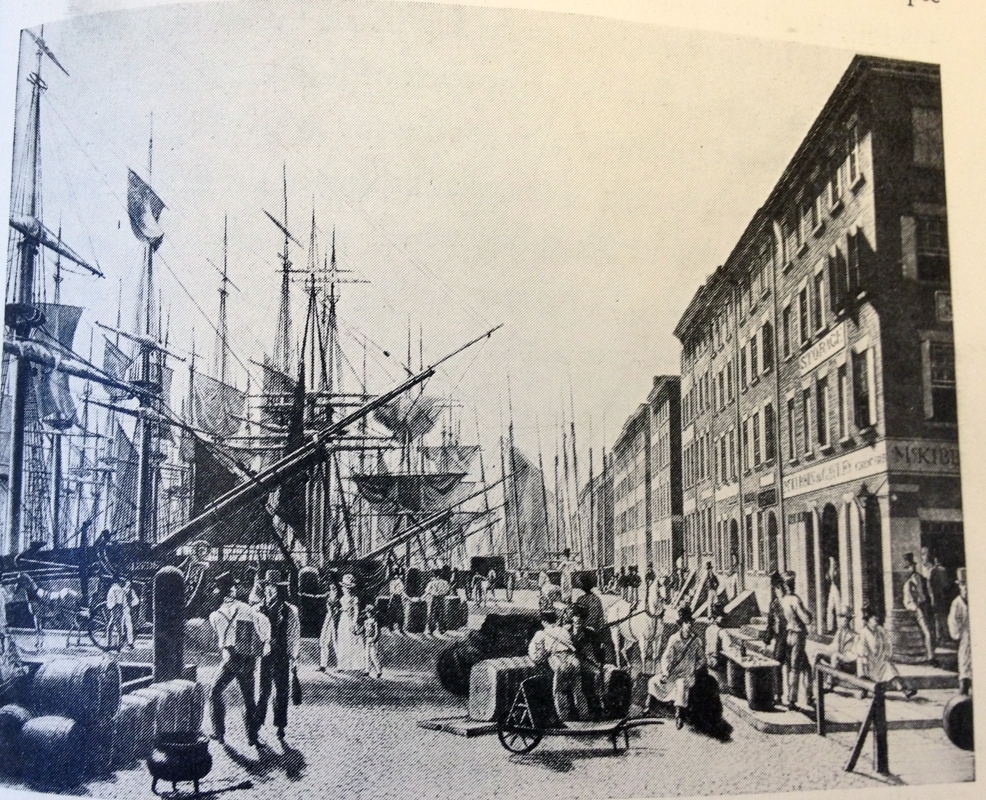
The story begins in the first decade of the 19th century when New York City had “four banks, no water supply worth mentioning, no gas, nor any of the conveniences we find so necessary today.” It did, however, have “the finest harbor on the Atlantic Coast,” and it was here, in 1807, that Robert Fulton launched the first commercial steamship and sparked a revolution in trade and commerce. At the same time, near the dock where Fulton’s vessel departed, another young entrepreneur, Cornelius Vanderbilt, was beginning to build his shipping empire. And two ambitious young men, Richard Williams and John Mott, partnered in a wholesale grocery venture that would use the modern transportation technology to forge new markets across the ocean. Like Vanderbilt, they established themselves on South Street, the red hot center of international trade. Mott & Williams became stockholder’s in Fulton’s Ferry, and located their store as near to it as they could. From their front door the two young grocers could look out and see “a forest of masts of vessels from all the ports of the world.”
The Fly Market, early 19th century, near today’s South Street Seaport
R.C. Williams was one of America’s first truly global companies, the original “supermarket to the world.” Looking back on its first few years, the author of a company history published in 1933 observes that:
“Our pride in the year 1811 was our fleet of tall clippers, our lines of packet ships, which sailed out of New York, Boston, and Charleston to all the oceans. In the tea races to China they defeated the fastest vessels of the British, the French and the Dutch. We were in many ways sovereign of the seas. Our ships carried furs, whale oil and West Indian rum and spices to Europe, returning loaded with finery, food delicacies and well-wrought articles of continental workmanship.”
During the course of its long history, R.C. Williams was constantly innovating. It was among the first to distribute food in cans, and pioneered in packaging, marketing, merchandising and retailing. They were also trendspotters, and predicted — to their enormous profit — that coffee would become king in the American home and Prohibition would be short-lived. They created one of the first international brands, Royal Scarlet, which they then franchised across a series of retail store locations. Today we see this everywhere, from Whole Foods to small regional chains; R.C. Williams was doing it back in the opening years of the 20th century.
But beyond its global reach and innovation, what I found most fascinating of all is that this company, from its very beginnings, pioneered in ideas. They saw themselves “as a medium of exchange, not only of commodities but of information and ideas.” They offered advice to customers on everything from bookkeeping to window dressing, and trained their buyers so they could advise customers on crop conditions around the world, seed production, sanitation, managing overheads, doing business in international markets, and more. Not only was this company an innovator in the food business; it was, almost a century before the age of the Internet, an information company.
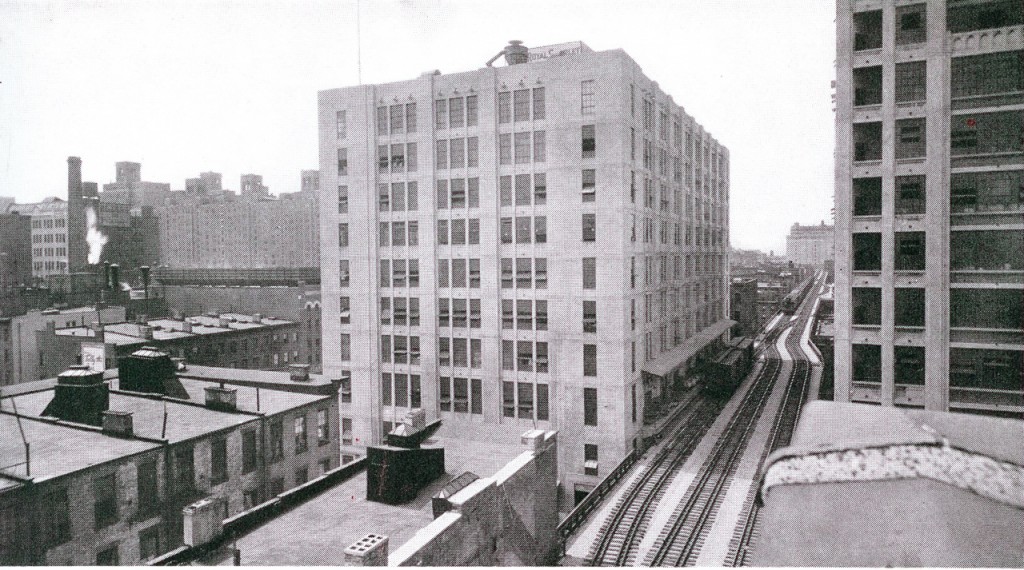
R.C. Williams Warehouse, with a locomotive at the loading dock,1930s
Over the decades R.C. Williams moved and expanded its business, and in the 1920s learned of yet another transportation innovation that was on the horizon: Robert Moses’ High Line. This elevated freight rail line promised another revolution in New York City trade and commerce: it would cut through existing buildings and enable locomotives to sail above the congested city streets, their box cars filled with every conceivable type of freight, from perishable goods like meat, dairy and vegetables to books, furniture, cigarettes and the U.S. Mail.
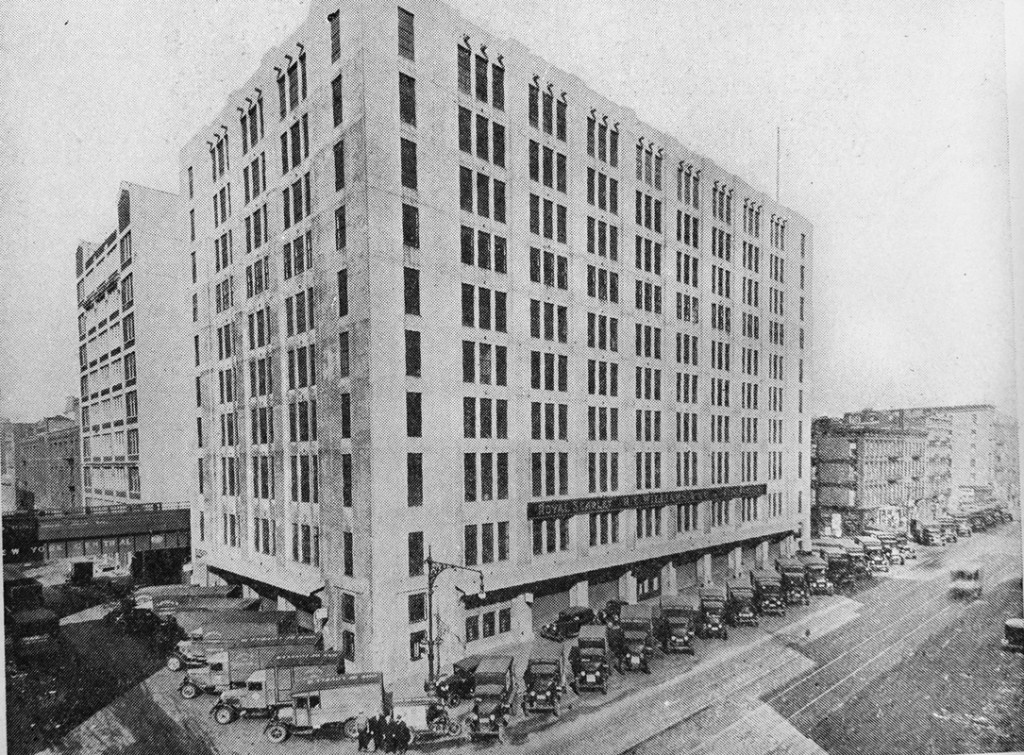
And so, a century after its founding, the R.C. Williams Company again put itself at the crossroads of the latest transportation innovation, and purchased land on Tenth Avenue for a new warehouse. They hired Cass Gilbert, one of the greatest architects of the day, to design a building that would be worthy of their position in the global food industry they had helped develop. Gilbert, architect of the U.S. Customs House and Woolworth Building, modeled the new warehouse after his Brooklyn Army Terminal, which had recently been completed. He designed it to maximize efficiency and create a seamless flow of goods from the tracks of the High Line, into the warehouse, and onto the many trucks that waited on loading docks in the street below.
Fleet of trucks at the R.C. Williams warehouse, 1930s
On August 1, 1933 — a year before the High Line officially opened — a train rumbled down the viaduct to commemorate a moment in history. Someone snapped a photo, and in it we can see an extraordinary convergence of people, industry, and the entrepreneurial spirit that has long driven this city. There, on the loading dock of his new warehouse, stands Arthur P. Williams, a direct descendent of the founder of this global enterprise. He is shaking hands with Frederick Ely Williamson, the man now running the New York Central Railroad, the line Cornelius Vanderbilt built off the profits of his shipping interests — a business begun, like the R.C. Williams Company, a few miles downtown near South Street around 120 years before. Perhaps Vanderbilt had even known, and done business with, the original Mr. Williams. It’s certainly possible.
Mr. Williams & Mr. Williamson celebrate the opening of the High Line, 1933
What drew me to dig deeper into this history is Avenues, which calls itself “the World School” and developed from a vision to create a “truly global education.” Having just completed its first academic year, Avenues is in the process of building campuses in Sao Paolo, Beijing and London. Eventually, its students will engage in the classroom live, via teleconference, with young people from other cultures around the world. The project has attracted controversy, but it’s a bold new experiment in education, and I think it’s notable that it takes root on a patch of Manhattan real estate that is rich with a history of innovation.
In 1931 Cass Gilbert accepted the Gold Medal for Architecture from the Society of Arts and Sciences, and put forth his own vision for the future. It’s one that would echo well in the halls of the building he was then designing:
“My plea is for beauty and sincerity, for the solution of our own problems in the spirit of our own age illuminated by the light of the past; to carry on, to shape new thoughts, new hopes, and new desires in new forms of beauty as we may and can; but to disregard nothing of the past that may guide us in doing so…”
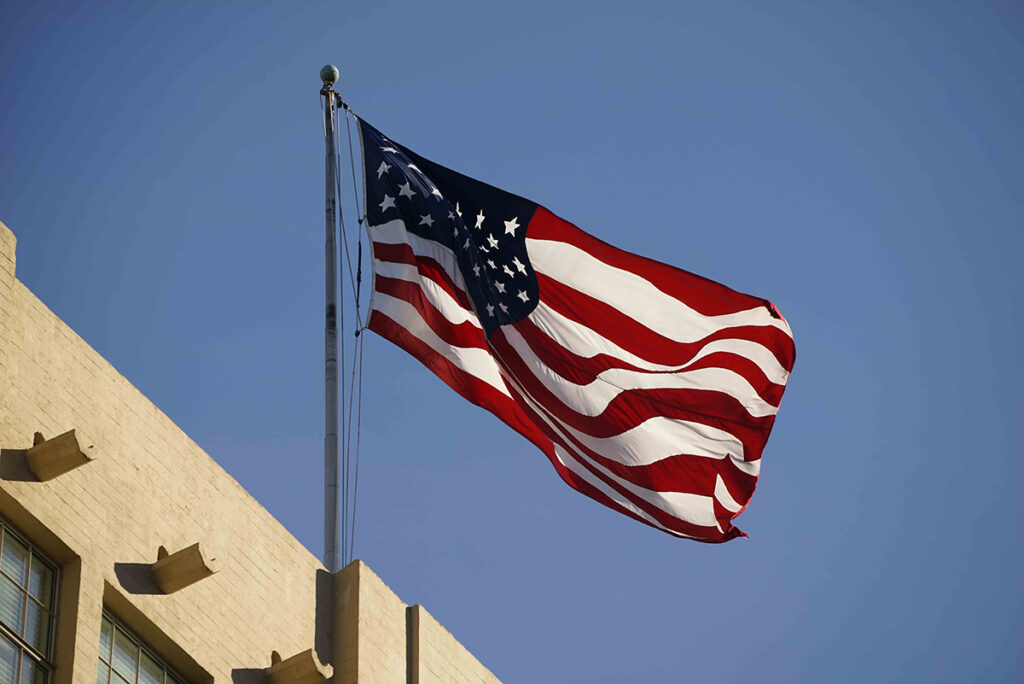
There’s a spirit that abides in this building. It has been gorgeously restored and transformed into a 21st century school, but the loading dock is still there, just outside the cafeteria, and the train tracks are too. You can see them all from the High Line. On the roof flies an American flag, but it too has been altered for a new age: the artist, Frank Benson, digitally mutated the perspective of the stars and stripes in an effort to create a flag that appears to be perpetually waving in the wind. Check it out: it looks familiar, but it has the future written all over it.
The American flag at Avenues School, designed by artist Frank Benson
As part of my ongoing lectures and talks about the High Line I’ve been digging deeper into the history of many distinctive buildings near the old viaduct-turned-park. “What’s That Building?”— a guide to architecture in the High Line’s viewscape — is a popular feature on this blog, and today I’m launching a new series of slightly longer pieces about selected buildings that will let me share their fascinating histories and at the same provide a new context for understanding them in relation to the High Line. I’m starting with the Westyard Distribution Center, a mammoth structure on Tenth Avenue between 31st – 33rd Streets. [Click here for the full series.]
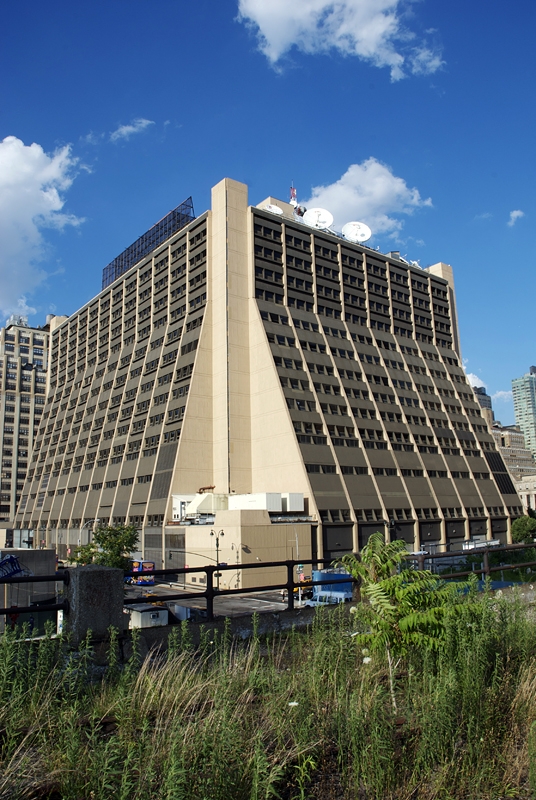
The Westyard Distribution Center was completed in 1970 and is considered a significant example of the architectural style Brutalism, which is defined by the use of rough materials like textured concrete and brick, and sharp, geometrical angles. When it opened, the Westyard had the only indoor, year-round ice rink in New York City (it closed years ago and today the cool kids skate at Chelsea Piers a few blocks south). It was built as a distribution center, and has 38 loading docks for trucks; today it’s home to a number of news companies including the Associated Press, New York Daily News, and WNET-TV, which explains all the satellite dishes on the roof. It is also known as Manhattan West.
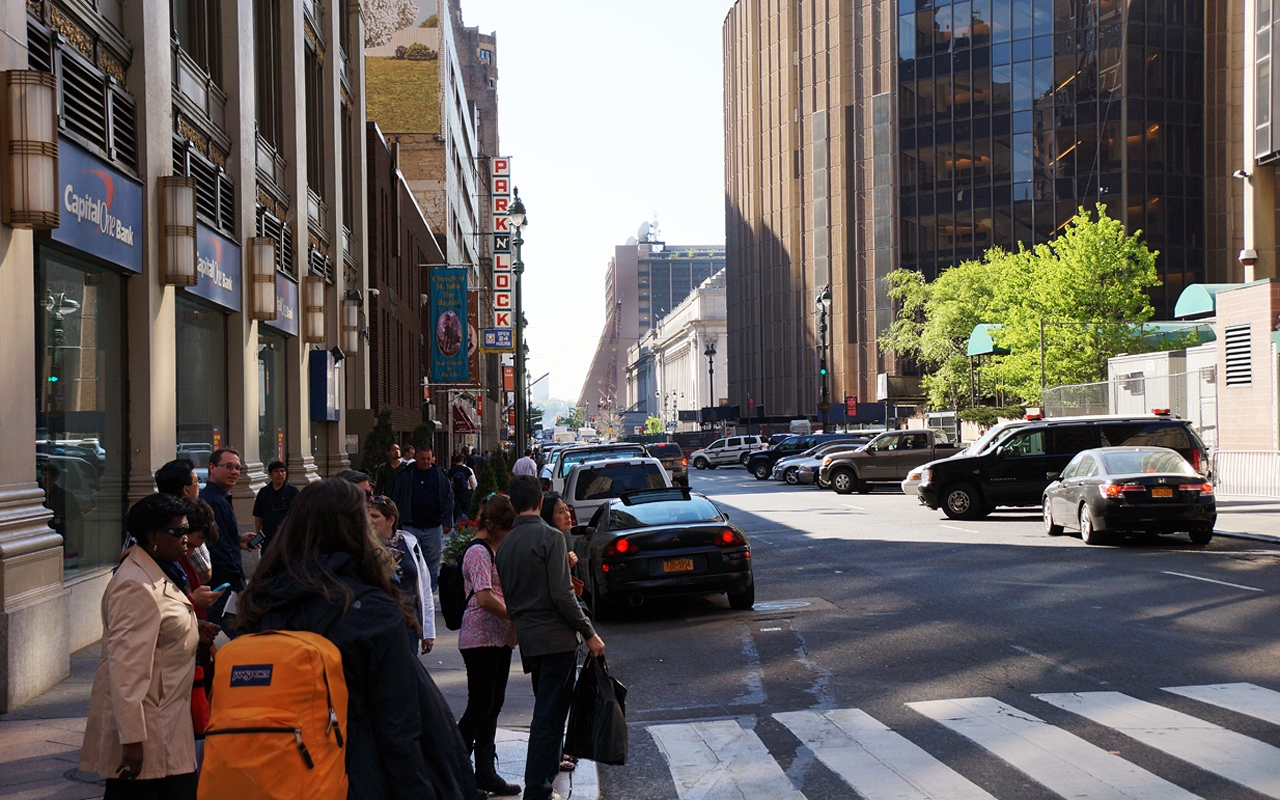
To fully appreciate this building you need to approach it more like a piece of sculpture than a piece of architecture, which means moving around and seeing it from every possible angle. The photo below shows the Westyard from Seventh Avenue — almost half a mile away. It’s a lousy shot because the light was bad and I was about to be hit by a car when I took it, but it shows how this massive, imposing building just elbows itself onto 31st Street, like it owns the place. It’s the architectural version of the pushy, aggressive, New Yorker:
The Westyard from 7th Avenue
I think this is a building that no one really loves in Manhattan except, perhaps, those of us who love trains and the city’s long, pioneering railroad history. The Westyard Distribution Center offers the perfect perch from which to contemplate both the past and present. But first, you have to leave the street and get a bit higher….
Looking east from the roof of the Ohm apt. building at 30th Street
Looking down on the Westyard you start to see how the building functions; how it straddles the train tracks that are used by three major railroads in New York City: the MTA’s Long Island Railroad (LIRR); New Jersey Transit’s commuter line; and Amtrak, the ultimate successor (after many bankruptcies, buyouts, and combinations) of Cornelius Vanderbilt’s New York Central Railroad.
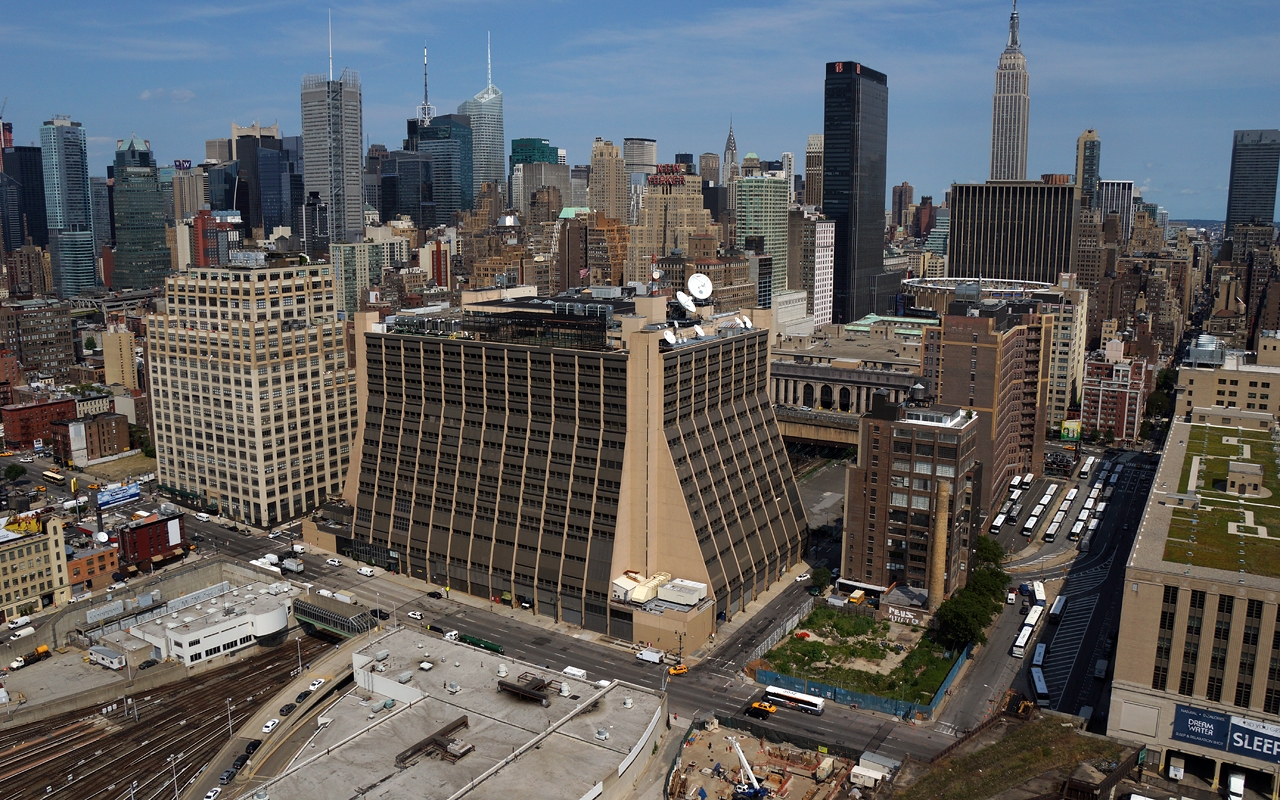
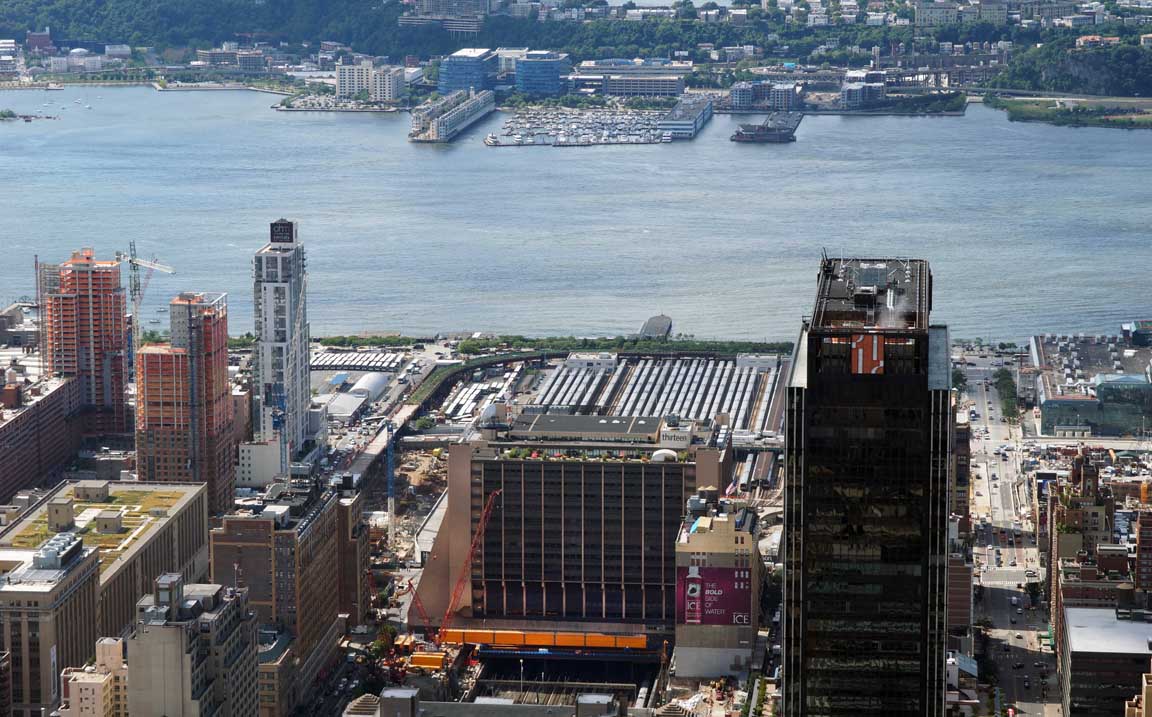
If you go up even higher — I took the photo below from the observation deck of the Empire State Building — you can see a train motoring underneath the Westyard en route to the Rail Yards. And you also see the High Line looping around the Rail Yards, half green and half concrete.
Looking west from the observation deck of the Empire State Building
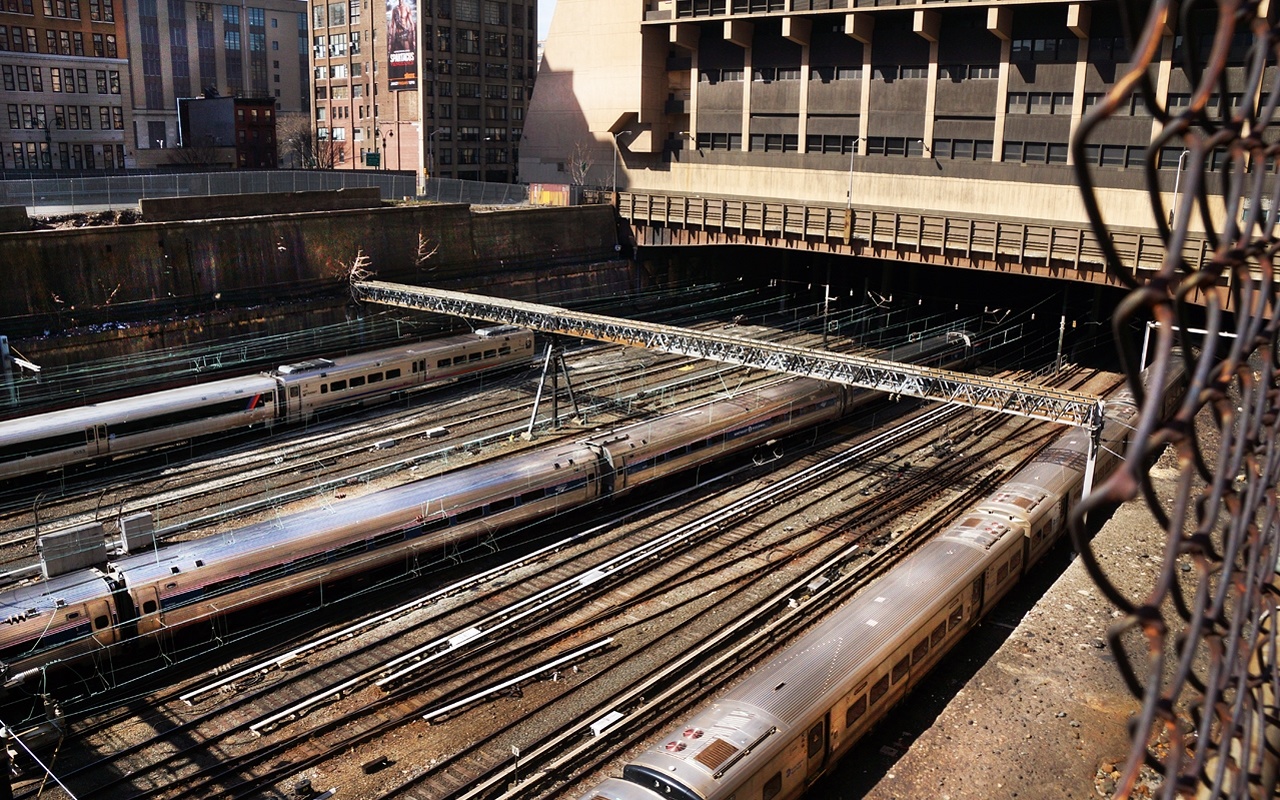
Back at street level, if you were to sneak into a parking lot nearby and stick your camera through a hole in the fence (I swear I didn’t cut that chain link!), what you would see is a very active railroad passage:
East side of the Westyard Distr. Center, looking down
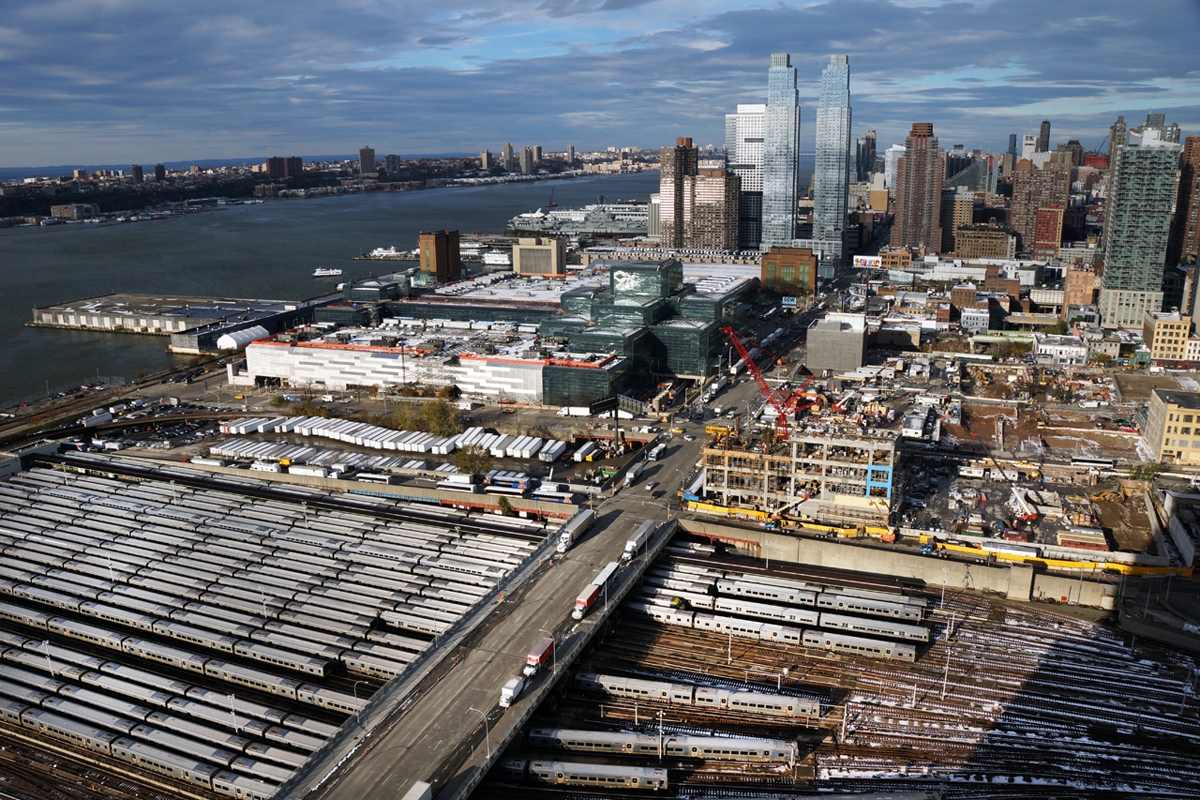
When you get up high again and look down onto the stub yard (called “stub” because it has no egress) what you see are trains from the LIRR that are parked there during the day. These trains came from Queens and Long Island to Penn Station, where they disgorged their passengers who then dispersed themselves around the city to do its business. The trains then motored a bit further west, under the Westyard, to the parking lot. When the commuters are done, at the end of the day, the trains return to Penn Station and take the now-tired commuters home to their families.
LIRR “stub yard,” looking north from Ohm Bldg.
Basically the stub yard is a giant railroad parking lot, and soon it will be covered with a deck and turned into a small city of office buildings, residences, and park spaces. It has a fancy new name, The Hudson Yards, and its own special tax structure. Soon the trains will be invisible, but the activity of the rail yard will go on as always underneath the new development.
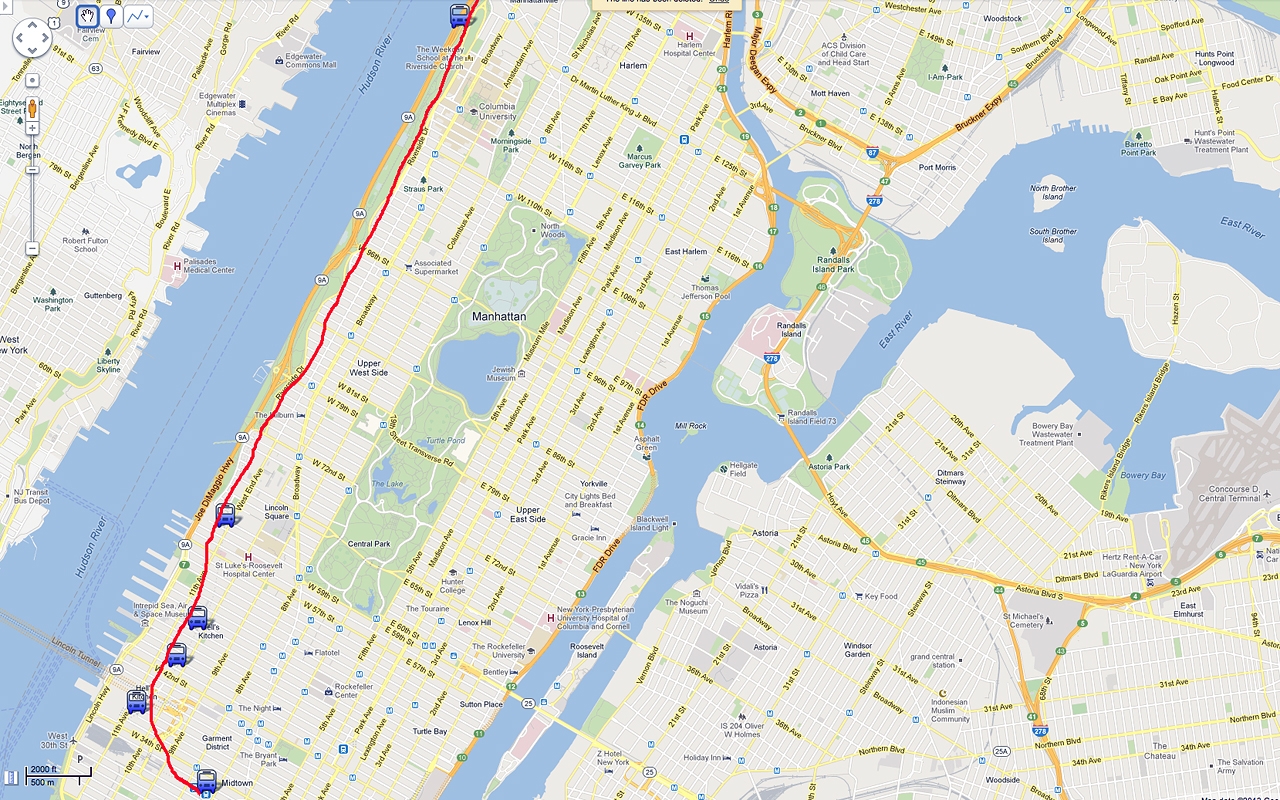
The New Jersey Transit commuter trains make a right turn and head north, underground, somewhere below the Westyard building, which was designed to connect with the Lincoln Tunnel. Those trains then pass under the Hudson River to New Jersey. Amtrak’s Albany and Canada-bound trains also pass under the Westyard, take a right and head north, but they follow the path of the old New York Central line up the coastline along the Hudson, which I roughly traced in a red line on this map:
Amtrak on the old New York Central tracks. Icons denote “cuts” in the street. [Click to enlarge]
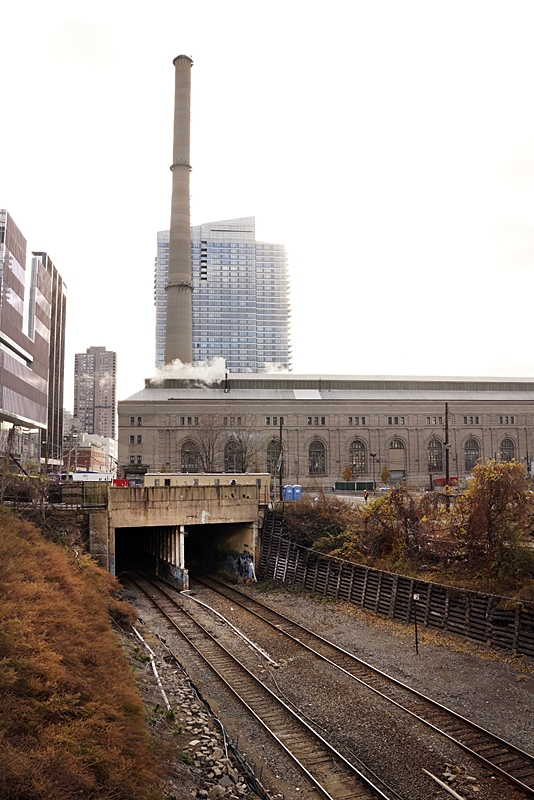
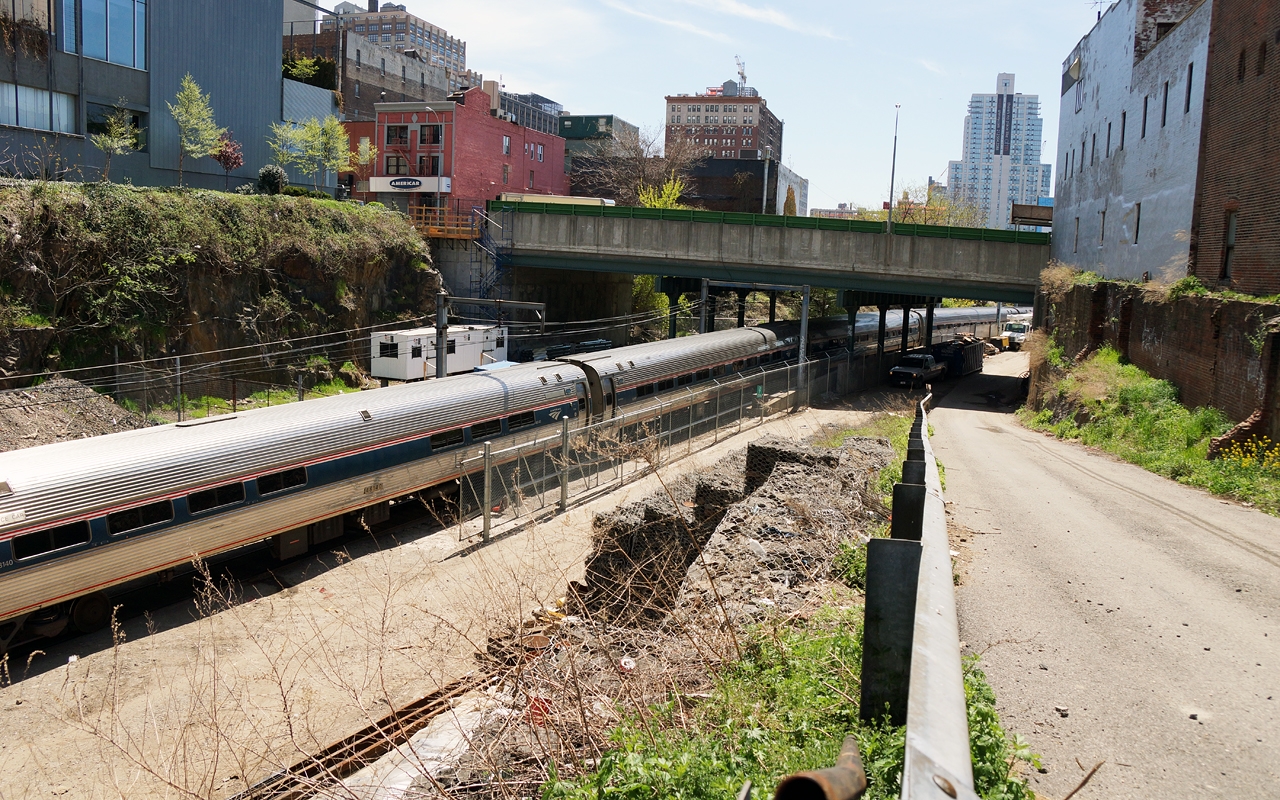
Those places I marked with little train icons show the cuts in the street where you can see still the train tracks, like this one, at 60th Street…
Amtrak cut at 60th Street near 11th Avenue
Sometimes you can actually see a train coming through one of the cuts, which can be found between 43rd – 46th; 48th – 49th; and 60th Streets. [Note: it helps to have the Amtrak app on your phone so you know when to expect one.] The train in the photo below is Amtrak #290, the Ethan Allen, from Albany to New York, scheduled to arrive at 1:50 PM. It was on time; I took this shot at about 1:48 at 38th Street between Tenth & Eleventh Avenues. It’s not a great photo, but it does give you a sense of the geography: there, on the right side in the background, is the tall Ohm apartment building at Eleventh & 30th Street, where I took the aerial shots that appear in this piece:
Amtrak’s Ethan Allen from Albany, passing through the 38th St. Cut
This aerial, 360-degree tour shows how the Westyard Distribution Center is the beating heart of the railroad on the West Side of Manhattan. This gives it a direct relationship to the High Line, though it’s not so easy to discern from the park (or, for that matter, from the street). In time, all visible traces of the rail lines will be covered, including the cuts I’ve mapped out above, which are fine reminders of our city’s magnificent railroad history. (Visit while you can…) Still, just knowing the tracks are there will always let me feel a connection to the past, and permit a deeper understanding of the neighborhood in which I live. All those passengers on all those trains — the LIRR, NJ Transit and Amtrak — will continue to pass under the Westyard; soon there will be a new Seventh Avenue subway station on Eleventh Avenue that will bring more trains — and people — to our increasingly crowded neighborhood. And of course there’s the still-expanding, former freight railroad, the High Line, which connects and brings to life so much of this history.
So next time you’re walking in the park, tip your hat to the Westyard. It may not be our most beautiful neighbor, but it has a story that few can beat.
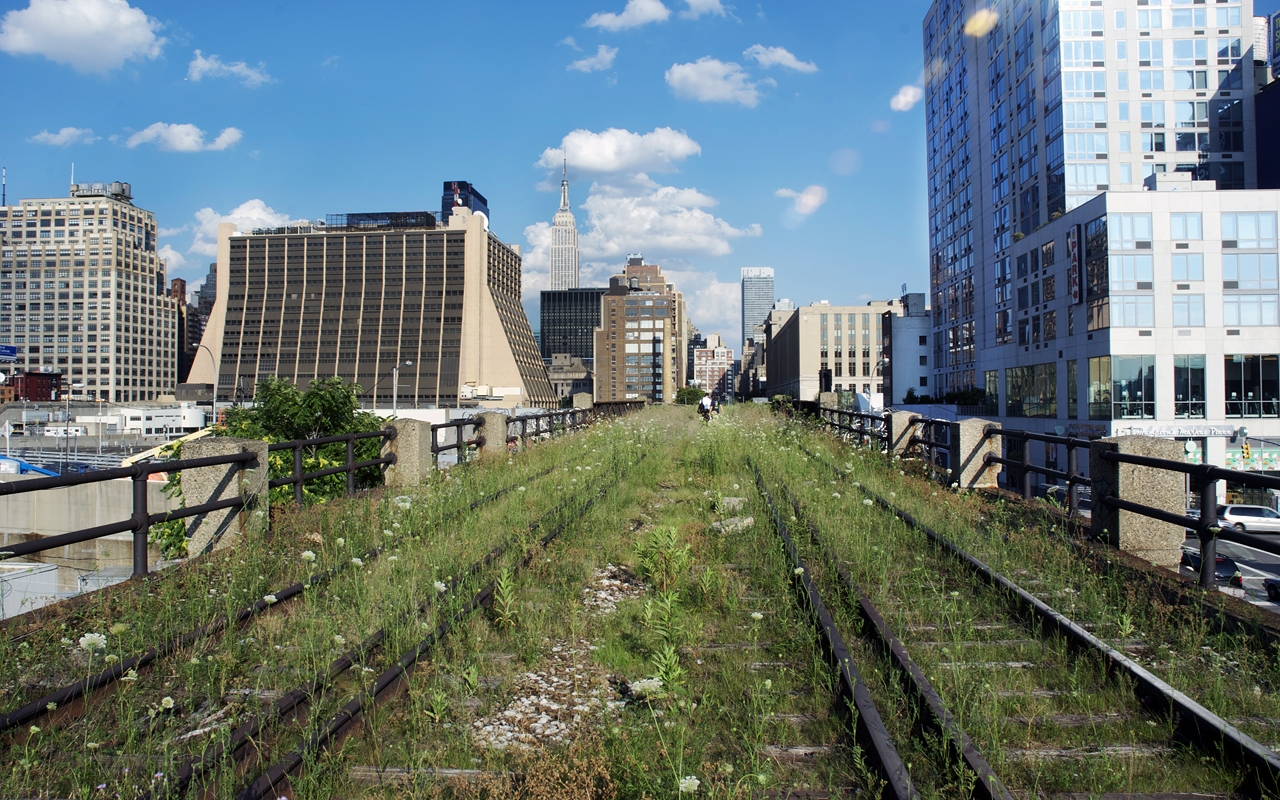
On the wild High Line’s Tenth Avenue Spur at 30th Street, looking east
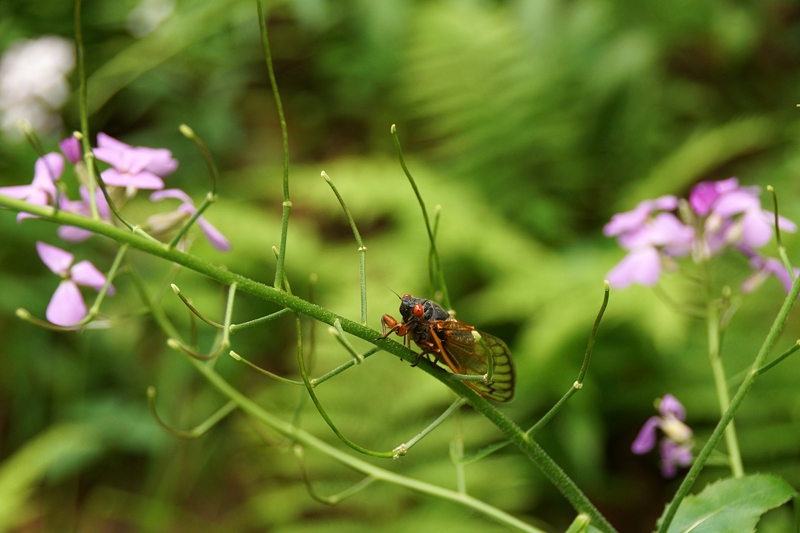
Magicada septendecim, the magical 17-year cicada, at Olana
Updated 9 June, 2013
On June 1, sometime in the early morning, the cicadas arrived in southern Columbia County. Slowly they have made their way up the eastern seaboard, and day by day I’ve been hearing reports of their noisy arrival from friends to the south. On Friday May 31, my brother-in-law got his first earful in Carmel, just a few dozen miles south of us. The process is like a giant deck of cards unfurling. It began in Georgia and slowly the cards started falling in North Carolina, Virginia, Maryland, Pennsylvania, New Jersey and now New York. What tipped the first card? Some invisible finger? More incredible, it was an ancient bit of insect instinct that set off the alarm in one of nature’s most extraordinary and exquisite biological clocks.
We discovered the first Magicada septendecim of 2013 on Saturday morning, June 1, at Olana, home of the American landscape painter Frederic Church. We heard the buzzing first, but it wasn’t until we had reached the top of the newly restored Crown Hill — a dramatic spot Church created to provide panoramic views of his landscape — that we looked down and saw our first one. Within days they were everywhere, loudly playing out the final weeks of their miraculous seventeen-year life spans.
Many people are disturbed by swarms of locusts — and there are literally billions of them — but if you take a minute to think about the life cycle of these amazing creatures your horror will soon transform into unmitigated awe. David George Haskell, author of the illuminating book The Forest Unseen, put it best when he wrote on his blog: “For those lucky enough to live where the action is, remember what you’re hearing: seventeen years of stored sunlight being released all at once as acoustic energy. The terrestrial end product of nuclear fusion exploding into your consciousness.”
Molted cicada shells, Olana
I’ve written about our experience of the 1996 brood in Germantown, and ever since news reports of this year’s awakening started coming in I’ve had a strange urge to think back on my life in 17 year increments. This is my fourth cicada season, and with any luck I have a few more ahead. With Haskell’s exhortation in mind, up there on Crown Hill, I did a bit of math and figured out that Church would have experienced a cicada invasion in 1860, the very year he started acquiring the lands that would become Olana. Seventeen years later, in 1877, his Persian-style house was complete, but Church was still engaged in the process of creating the network of carriage roads and landscape events that he believed was his greatest work of all. By the time he heard his last cicadas, in 1894, Frederic Church was crippled by rheumatoid arthritis and had stopped painting. He died six years later, in 1900.
What other creature beckons us so faithfully to think back in time, via the magic of “stored sunlight” transforming into “acoustic energy?” The life cycle of these insects has been honed and perfected over countless centuries, and for me their recreation of an ancient dance of life offers comfort, not horror. No matter how much and how radically our species has re-drawn the landscapes that surround us, an element of constancy exists just below our feet. These cicadas hibernate underground for precisely 17 years, sucking xylem from surrounding trees, and then they emerge to live out the dramatic stage of their life by breeding for the future. Six weeks later they die, but in the treetops above us, their descendants slowly take form, and when they are ready, they drop to ground and burrow into the earth. We are without them underfoot for just six weeks every 17 years, and during that period — this period — they dive-bomb us and drown out our conversations. A farmer I know compared the cicada buzzing to the sound of “a flying saucer landing on earth.” While they are here they make themselves impossible to ignore, and then they just disappear. We go on making scientific and technological advances; electing presidents; waging wars; re-creating landscapes.
What will you be doing in 17 years?
Click here to watch a truly gorgeous, fascinating stop-time video by Samuel Orr, “The Return of the Cicadas,” which documents the entire life span of the Magicada septendecim.
I’ve been gleefully awaiting the new bikeshare program, and for weeks have been contemplating the many ways I’d use it. Primarily, I’ve assumed, it’ll be handy for quick crosstown access to the subway on the East Side. According to Google Maps I’m 1.2 miles from the Lexington Avenue line, a distance it’s (much) faster to walk than it is to travel by bus. But even the closer subway — 8th Avenue — is a half mile away; surely the little blue bike will make mincemeat of that trip.
Today I used the bikeshare for the first time, and something utterly unexpected became clear: the bike actually promotes more walking.
A few days a week I work in a library on the upper east side, and usually I ride my own bike the 4 miles or so up and across town. But on rainy days I take the subway. Today, it was sunny in the morning, but promised to be lousy in the afternoon. In pre-bikeshare days I would just grab a few extra sections of the newspaper and take the subway both ways, eliminating any hope of a walk. But not today. Instead, I grabbed a bike at 11th Avenue and rode up the Hudson River Greenway to the docking station that’s closest to the library: 6th Avenue at 56th Street. It’s an inconvenient just-under-a-mile distance, but the result was a nice walk along the eastern edge of Central Park.
When I left the library it was pouring. In my glee about the blue bike I had forgotten to bring an umbrella, so it was a rainy walk back to the subway on the upper east side. But then it was a superfast bike ride from the subway station to my home on the far West Side. That was one benefit. The astonished looks from truck drivers as they saw a crazy, drenched, woman on a CitiBike in the pouring ride riding at full speed? Priceless.
So: my bikeshare back-of-the-envelope tally of savings has me up by $2.75, the fare I saved on the trip north this morning. The annual fee for the Citibike program is (with tax) $103.43, so I have many rivers to cross before earning it back. But if time is worth anything, I’m already ahead. Even more, I had a lovely walk that included bird song, pneumatic drill, plus the discovery of a monument to Richard Morris Hunt I had never noticed before, on 70th Street.
This is why the walkable city is such a gift to humanity.
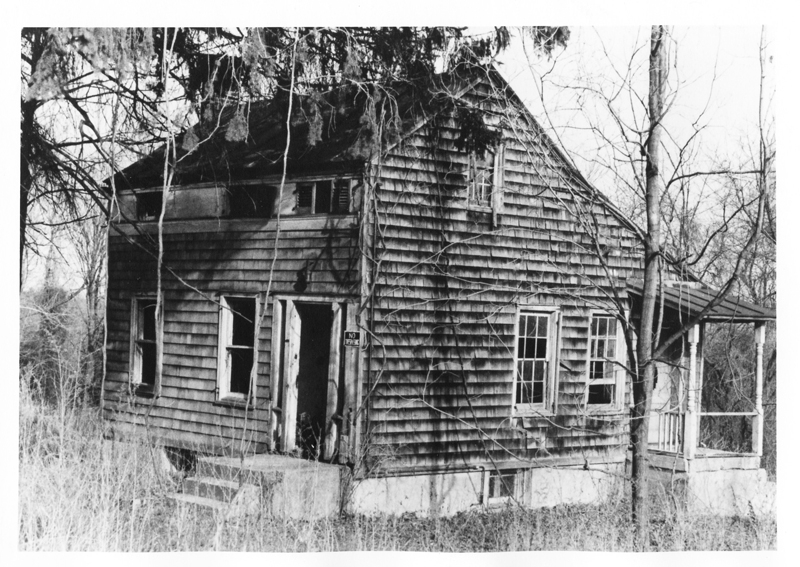
Seventeen years ago we were spending weekends in a small 19th century converted saltbox in Germantown, New York, that had once been home to the local school teacher. It was also her classroom. I bought the house in 1985 from an Episcopalian minister who was partly deaf but swore he could still hear the voices of 1860s school children echoing across the ancient floorboards. He loved the old wreck so much he hired a local contractor to restore it. The item he prized most highly about the lovely little house was a stairway bannister that dated from the Civil War. It was a wonderful place where I spent many happy years, but little did I know that something — or, to be more precise, hundreds of thousands of something — was lurking below ground.
Cicadas.
We’re hearing a lot about the seventeen-year cicadas these days. They are coming soon, and the memories of 1996 are returning to me like scenes from a Stephen King novel. For weeks we couldn’t go outdoors without being dived-bombed by hundreds of them. Our dog tried to catch them in his mouth as they flew by, but they pelted him with their orange wings and drowned out his barking with their endless buzz. We would race to the car in the driveway, swatting locusts from our heads with both hands, and then slam the doors closed. Crunch. Many cicadas died a quick, Toyota death, but inevitably one would make it inside, onto someone’s lap.
“Well,” I once said to Ann, “it’s better than mouse, don’t you think?”
Disgusted silence.
The cicadas made so much noise we couldn’t read, or carry on a sensible conversation with the windows open. When I played the piano I was accompanied by an orchestra that droned on and on in a weird, endless, Arnold Schoenberg track. It was like living in a chapter of the Bible. For six weeks the cicadas hurled themselves at the windows and doors, flying their crazy missions, 24/7, from pillar to post. And then, finally, they all died, and it got very, very, quiet.
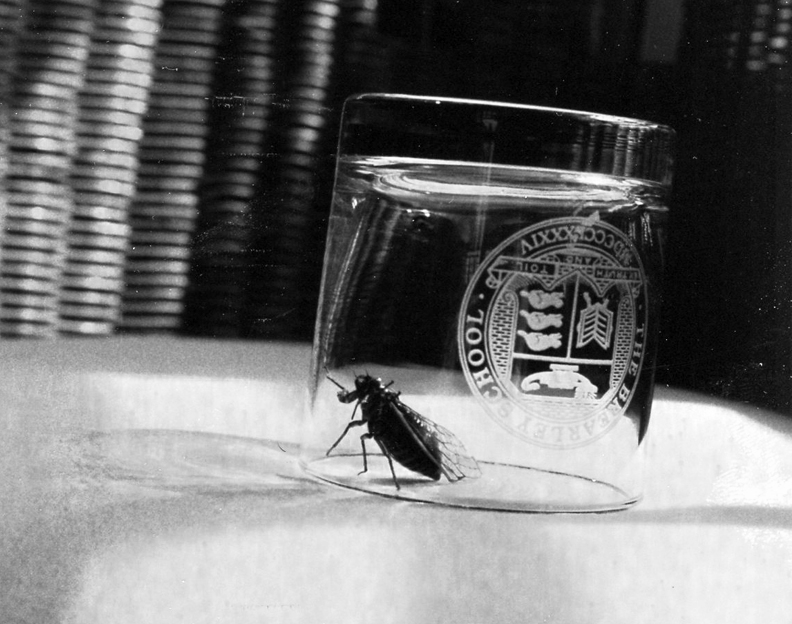
17-year cicada, trapped by the author in a highball glass, 1996
I don’t know why it is that one patch of land would be more cicada-rich than another. Perhaps it’s that the Germantown place was once farmland, and the soil was rich and pliable, perfect for a cicada to hunker down and spend seventeen quiet years. Inexplicably, friends nearby didn’t have nearly as many of the creatures as we did. We were, it seemed, Cicada Ground Zero. Today we spend weekends five miles north of Cicadaville but on a rocky mountain that seems — or perhaps I am just in Pollyanna mode — highly cicada-unfriendly. We shall see.
Meantime, I’m taking to heart the advice of David Haskell, I writer a greatly admire. In a blog post yesterday he urges those of us who are “lucky enough” — his words — “to live where the action is, to remember what you’re hearing: seventeen years of stored sunlight being released all at once as acoustic energy. The terrestrial end product of nuclear fusion exploding into your consciousness.”
While I’m waiting for the cicadas to rejoin us, does anyone have a good recipe?
 Earlier this week Joshua David and Robert Hammond, co-founders of Friends of the High Line, received the prestigious Vincent Scully Prize. Awarded by the National Building Museum in Washington, it was created to recognize extraordinary practice, scholarship or criticism in architecture, historic preservation and urban design. The namesake of the award and its first recipient was an art history professor at Yale University. New Yorkers may remember Scully best for his comment about the atrocity that replaced the majestic, Beaux-Arts Penn Station that was torn down fifty years ago this month: “One entered the city like a God. One scuttles in now like a rat.”