≡ Menu

Walking the High Line

Something to remind you.

Note: this video was posted after the High Line was closed because of Hurricane Sandy.

Video by Matt Baron. Original music by Rafael Cortés. Edited by Eric Paesel. If you’re interested in purchasing the score to Rafael’s composition, email me using the contact form.


Share
{ 0 comments }

Sandy and the Bald Eagles

During the last major storm, Hurricane Irene, a group of us hunkered down on this small mountaintop in Hudson, New York and were transfixed by a sailboat that had moored in the inlet near Roger Island, a tiny spit of land just a stone’s — or piece of railroad ballast — throw from the Amtrak tracks heading north to Albany and south to Manhattan.

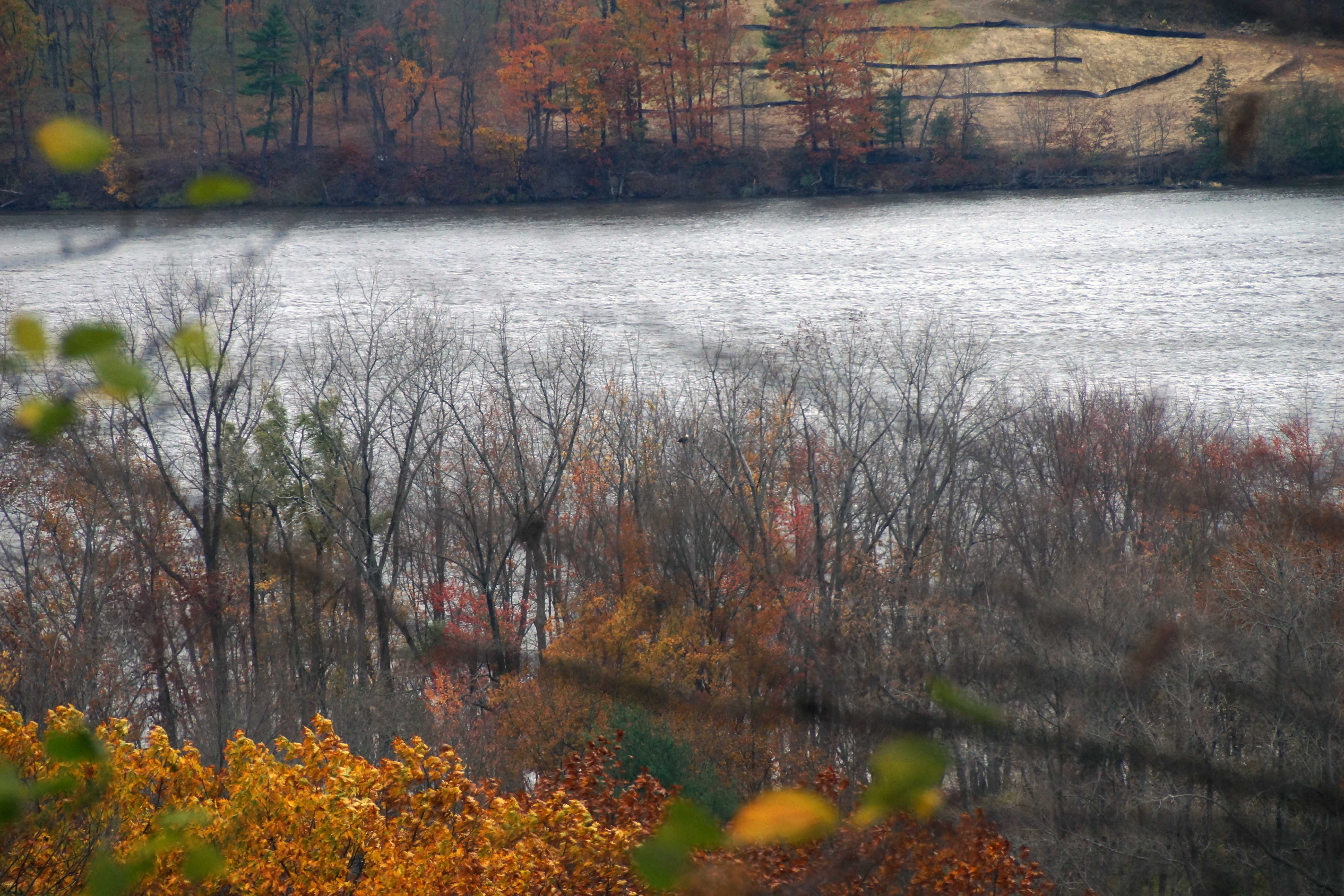
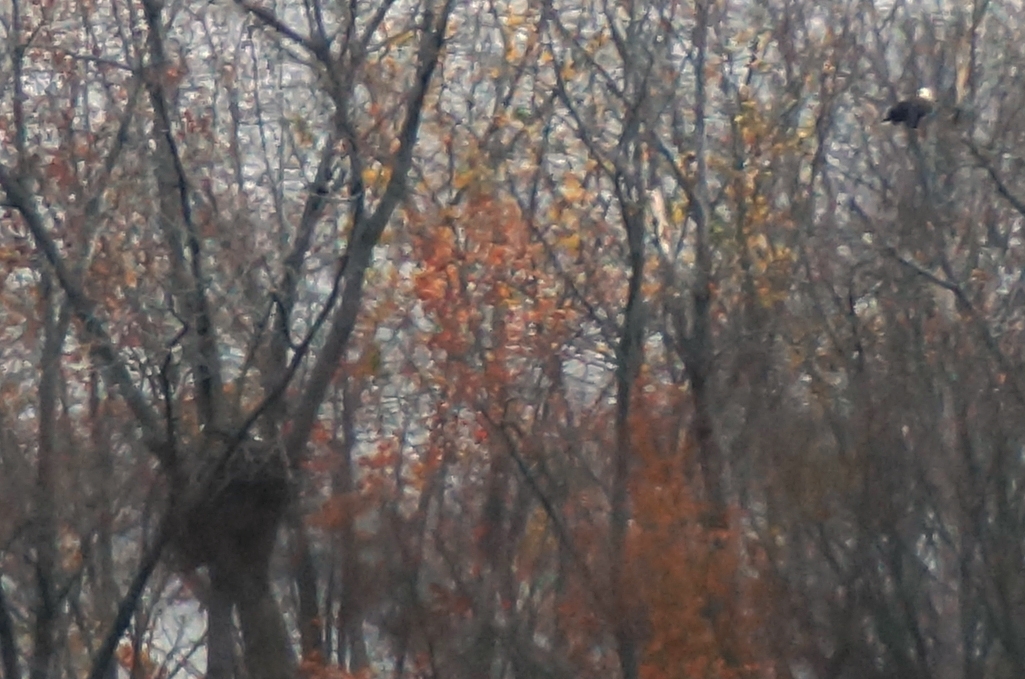
Today, a year later, a new storm bears down on us. The sailboat has found another port of safety but we are again transfixed by Roger Island. A bald eagle and its mate are hopping from nest to tree, surveying the landscape, perhaps assessing the changes that are coming our way. The river has tossed up a slew of whitecaps and the wind is getting stronger. With my telescope I can see the feathers on the eagle’s tail blowing in the wind. In the photo above, taken with a telephoto lens, you can just make out a tiny white head in the tree, 2,500 feet to the west, and the massive nest just to the south (left).

What does the eagle see? What does he know about the oncoming storm? Will his nest hold up in 75 mile per hour winds?

I think about a villanelle by W.H. Auden.

Time can nothing but I told you so.
Time only knows the price we have to pay;
If I could tell you, I would let you know.

Good luck, Eagles.

Share
{ 0 comments }

Magical Water Towers

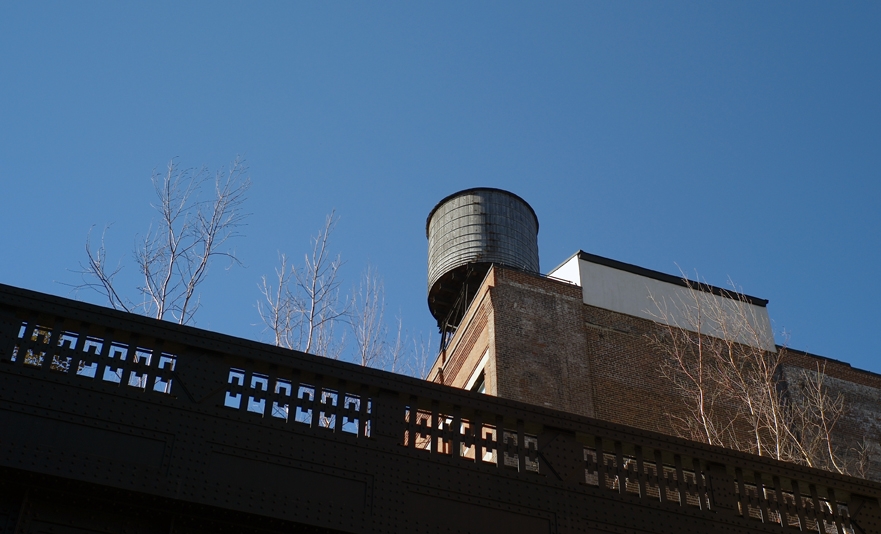
Water towers are as much a part of the New York City landscape as skyscrapers, and many people find as much art in the rooftop “hoops and staves of the Middle Ages” as they do in the city’s modern architecture. That’s a quote from Charles Kuralt, the great CBS newsman, who also loved the city’s water tanks and appreciated their place in our urban landscape as well as the ancient crafstmanship that produced them.

Today I got an email from a reader of this blog who pointed me to a short film that Kuralt would have loved, “The Water Tower Player” (or, its original French title, “Le Joueur de Citernes”). It’s a brief love poem to New York City’s water towers made by a French filmmaker named Emmanuel Gorinstein.  This film is a magical imagining that takes you into a realm that Maurice Sendak, Tim Burton and Hugh Ferris would recognize and feel happy in. It also brought to mind the characterization of another landscape icon that Marcel’s grandmother recalls in Proust’s Swann’s Way. Of the cathedral spire in Combray she says: “My dears, laugh at me if you like; it is not conventionally beautiful, but there is something in its quaint old face that pleases me. If it could play the piano, I’m sure it would play.” For his film about water towers, Gorinstein dispatches a violinist, and mon dieu, can he he play.

I won’t even attempt to describe the film here, I’ll just give you a link. It’s only fourteen minutes long, but find a time when you’re ready to be astounded, and moved, and then click. And when you’re done, here’s a link to Gorinstein’s blog, where you’ll find his marvelous, moody, often other-worldly artwork.

The upcoming Water Tank Project in Spring 2013 will provide countless new opportunities for artists to conjure with the city’s water towers. Lucky us.

Share
{ 2 comments }

Meanwhile, Back in the Garden…

Today was groundbreaking day on the High Line. It was a festive event in the still-wild Section 3, with lots of politicians, celebrities, sponsors, Best Friends of the High Line and kids from Chelsea’s Clinton Middle School, who were on-hand to toss wildflower and native grass seeds into the old rail bed. I watched it on NY1 and it looked very jolly indeed, but there was something missing. In this last stretch of truly wild garden on Manhattan’s west side, there were no gardeners.

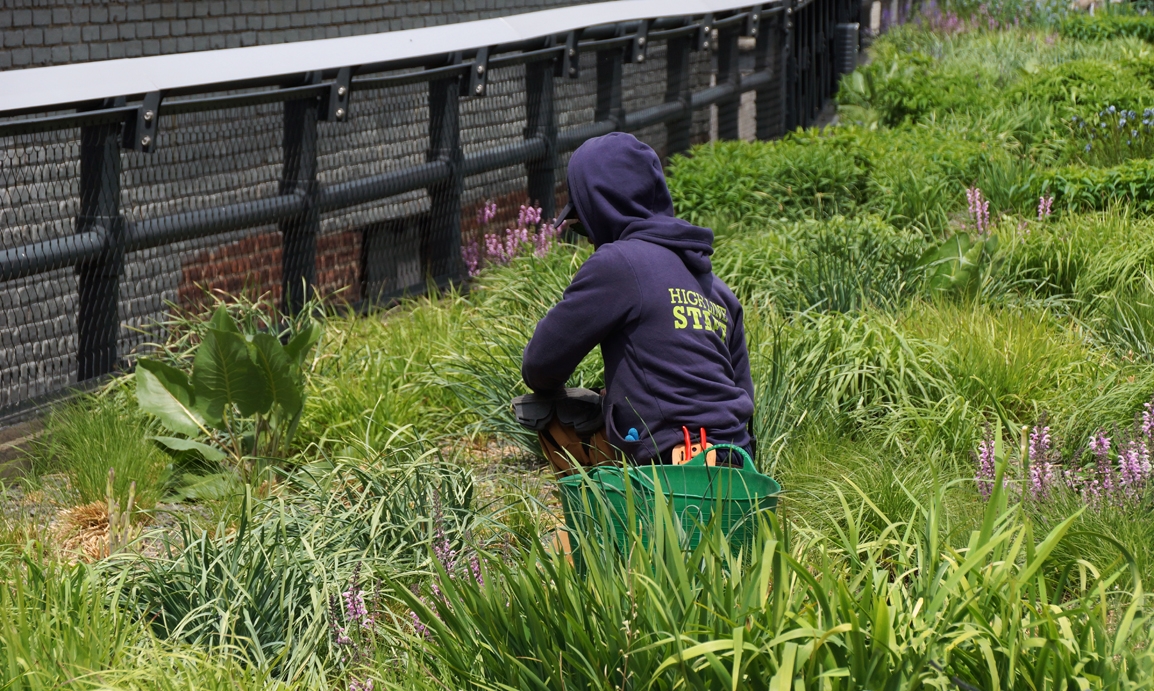
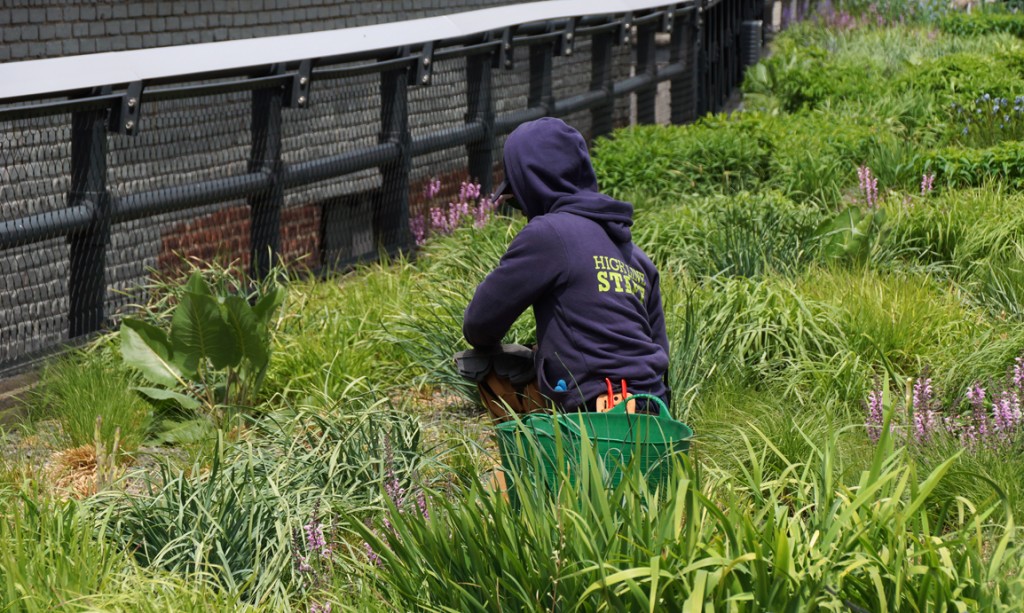
I took a walk through the park later on, and they were all there in their usual posts: deep in the flower beds, riding carts filled with trugs and clippers, kneeling in the rocky railroad “ballast” to weed and trim, standing patiently in the pathway answering questions from tourists about the names and purposes of various plants.
Actually, the High Line was filled with celebrities today, and only some of them were there for the groundbreaking ceremony. There was a major bottleneck on 14th Street as Nigel Barker pranced about in front of other photographers and a zillion tourists. On the lawn, a lady in a pink chiffon dress mugged for more cameras, teetering on a pair of skyscraper-high black & white platform shoes. Celebrities love the High Line, and the High Line loves celebrities; it’s a mix that has served the park well since the very beginning.

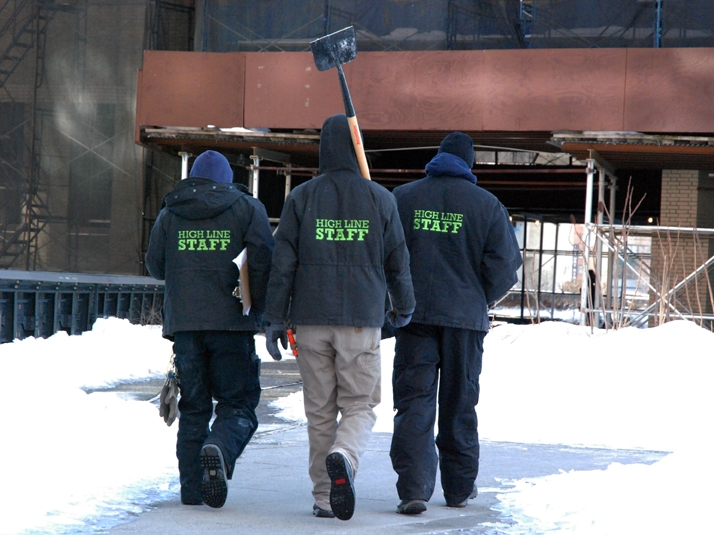
But if you ever wonder why the place looks so beautiful whenever you go there, the answer is quietly, often very shyly, laboring away behind a stand of tall grasses. The High Line is divided into zones, and each zone has its own dedicated horticulturist. These guys are incredibly knowledgeable and hard-working, patient as the day is long, and perhaps the most adaptable creatures in Manhattan. They manage to stay cheerful in every extreme, from the broiling hot sun of summer to the icy winds of winter that knife you in the face and steal your wallet to boot. They work in thunder storms, ice storms, and almost always, these days, tourist storms.
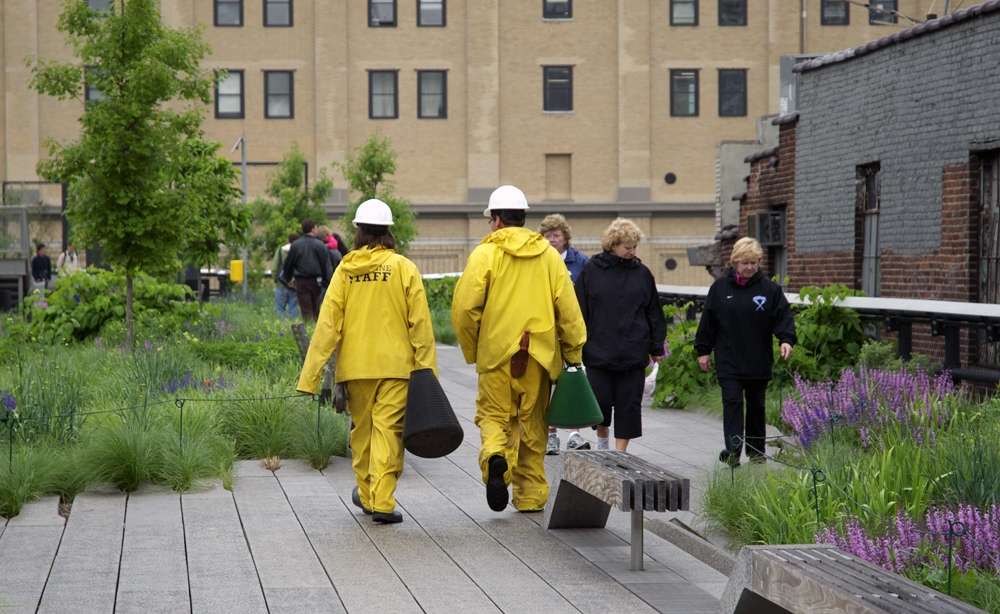
If you want to know what it’s like to spend a day with the gardeners of the High Line, read my piece about “The Choreography of the Cutback.” These are the folks who make the High Line sing. And I guess it makes sense that they were in the garden today, working with the plants, instead of hanging out with politicians and celebrities. These guys break ground every day; why should today be any different.



Share
{ 0 comments }

One Mile of Film Yields an Infinity of Patterns

Celluloid crosses the bridge known as the Flyover

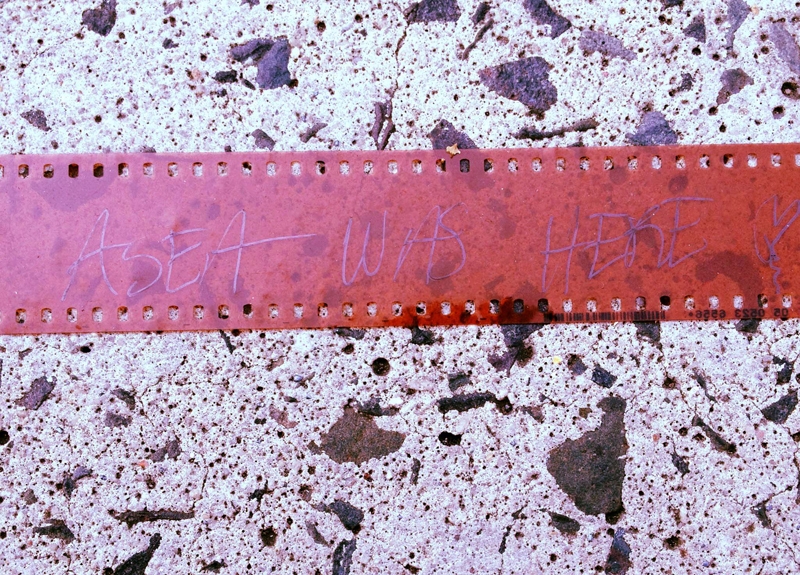
I spent the afternoon of Thursday, September 13th 2012 on the High Line as part of the volunteer staff for Jennifer West’s unusual film/performance project, One Mile Parkour Film. For this project West, a Los Angeles-based filmmaker, taped a mile of celluloid to the surface of the High Line and encouraged visitors to engage with it by writing messages, dragging their stilettos over it, dousing it with water, whatever they were in the mood for. I watched a man flick the ash of his cigar onto it.

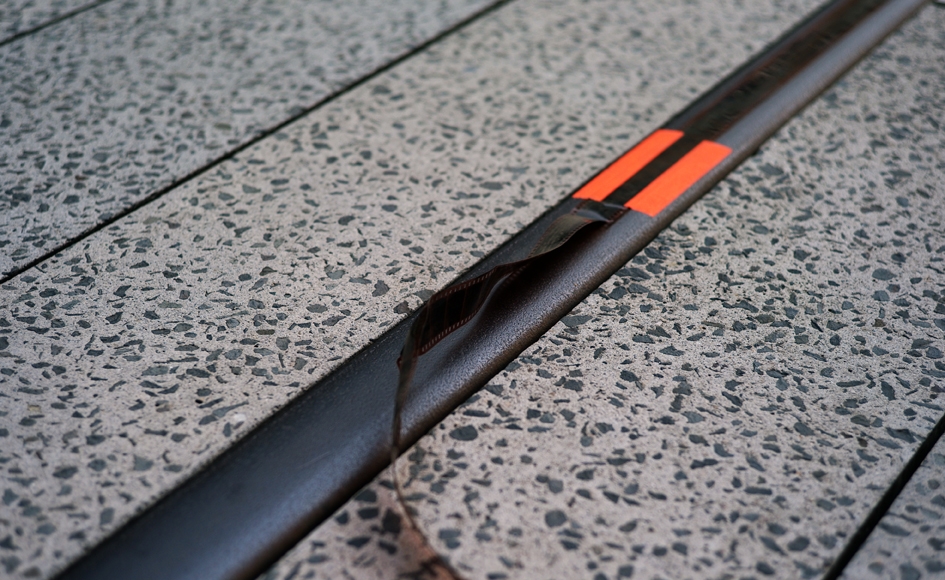
I didn’t have time to catch the parkour part of the day’s events, but you can read more about it here if you’re interested. What intrigued me about this project is the many and varied patterns the film strip created as it passed over the different surfaces of the High Line. Verticals clashed with horizontals (above), repetitive shapes sat alongside random ones (below).

ASEA WAS HERE

As it lay flat on the walkway, the endless line of little sprockets in the film stood out against the random, disorganized specks of black stone in the cement. People wrote messages on the celluloid, introducing new elements. In some places the film snapped in two and coiled up along the walkway: accidental patterns. The different materials — celluloid film, steel rails, cement walkway — and the changing light kept this strange, temporary, installation interesting all day.

Busted film: plastic on steel surrounded by concrete

But there was one truly cool effect that I’m guessing was totally unexpected. I noticed it by chance when I glanced out my window as the sun was beginning to set. The film strip was glowing. Little dots of light were suddenly dancing off the surface of the park. I grabbed my camera and tripod, thinking it would pass quickly, once the sun had gone, but the effect lasted all night. The LED lights below the High Line’s railings provided enough illumination and at just the right angle to make Jennifer West’s filmstrip look like a magical third rail running up the middle of the pathway. In the morning it was gone.

Film strip at dusk, catches the light from the park railings

The glowing strip of celluloid

I’m not sure what all of this will add up to, but West will answer next month when she returns to the High Line to show “a digital format video” made from the mile-long piece of film that was altered by the visitors of September 13th.  (Details are here.) It’s all a bit meta for me, but, the events surely made for an unusual day on the High Line.

Share
{ 0 comments }

New Kid on the Avenue

The former R.C. Williams warehouse, now Avenues School

Today is the first day of classes at Avenues, the new “world school” whose campus is located in a stately former warehouse on Tenth Avenue between 25th & 26th Streets. Over the next few years the school, a for-profit venture conceived by Benno Schmidt (former head of Yale University) and Christopher Whittle (founder of the Edison Project), will open additional campuses in Beijing (2014), Sao Paolo (2015) and London (2016).

A hallmark of the internationally-focused school is multilingualism. What’s unusual about the language approach is that Avenues is committed to making every student fully bilingual within seven years. If you walk through the new building you’ll see that every bit of signage, from elevators to bathrooms, is written in English, Spanish and Mandarin.

Like many people who spend a lot of time on the High Line, I watched the renovation of the old warehouse with great interest. When I was writing my book I did a bit of research into the R.C. Williams Company, the wholesale grocer that commissioned it, but as the renovation neared completion I found myself eager to learn more. With luck I discovered a company history, published in 1936, and it turns out that this firm has a long and rich history as innovators in the wholesale food industry. But the thing I found most intriguing, given the present use of the warehouse, is that from its very first days, beginning in 1809, R.C. Williams was a global enterprise. [continue reading…]

Share
{ 2 comments }