by Annik LaFarge
on September 7, 2011
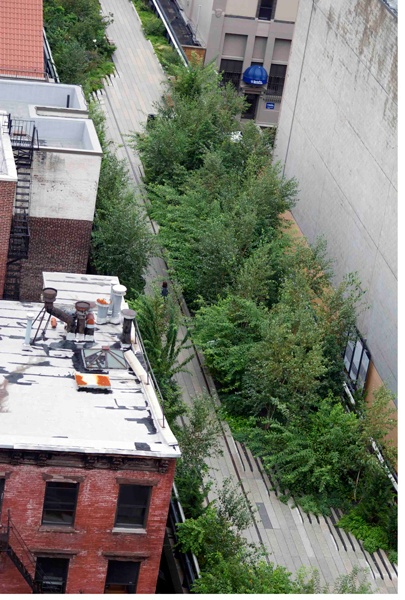
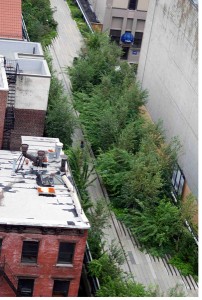 If you’re having trouble re-engaging with work this first week after Labor Day, I encourage you to take a walk through the Chelsea Thicket, one of my favorite sections of the High Line. I’m sure there’s a scientific reason for why a billion crickets have taken up residence in this particular patch of Manhattan, but after a long day in the office you probably don’t care.
I couldn’t resist doing a bit of investigation into this question and quickly stumbled upon a project that took place in New York just a few months after the High Line opened in 2009: the Cricket Crawl. This was a crowd-sourcing event whose purpose was to discover whether the common (or true) katydid (Pterophylla camellifolia) — the cricket we commonly hear in the country — had disappeared from New York City. In 1920 an amateur naturalist, William T. Davis, published a paper in the Journal of the New York Entomological Society in which he lamented that “the true katydid is either extinct or nearly so on Staten Island.” He speculated that it was also gone from the surrounding area, a victim of poor air quality that resulted from the many factories that were active at the time. (You can download Davis’ report from Ken Kostel’s blog.) The Cricket Crawl, organized by the American Museum of Natural History and the U.S. Geological Survey, took place on September 11th and the news is good: there are indeed true common katydid’s in town, along with seven other species of cricket. You can read the group’s final report here.
But all of this is getting rather wonky. You’re tired, longing for another week of summer. The Chelsea Thicket is a particularly peaceful part of the High Line, and it has become wonderfully unruly as the trees have grown. Branches reach out across the path, and in wet weather you’re likely to emerge drenched, as though you’ve had a sponge bath that lasted a full city block. But best of all is the sound track: those chirping crickets — who knows what species they are, but who cares? — all male (because only the males chirp), singing up a storm.
You might prefer, this September 11th, to tune out the news and listen to crickets instead. So head over to the Chelsea Thicket for a live concert. If you can’t make it to the High Line, you can listen to a few examples that were aired as part of this NPR story. Or you can really wonk out and listen to mp3 files of citizen cricket crawlers reporting on what they heard, when, and where.
{ }
by Annik LaFarge
on August 28, 2011
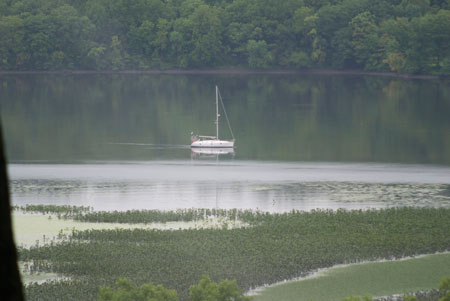
HUDSON, N.Y.
Yesterday afternoon, apparently in preparation for the hurricane, a sailboat laid anchor just below us in a cove near Roger Island. All morning a parade of boats — small and medium-sized yachts — motored up the Hudson River, probably on their way to the St. Lawrence Seaway. They were getting out of New York Harbor before the storm arrived.
 But not this boat. At dusk we we went out to the porch to grill fish, and stood there for a while with our glasses of wine and stared down at the river, speculating . Why here? we wondered. Why this particular spot? As lights winked on across the river the sailboat remained completely dark; even the running lights were off. We figured maybe they were sleeping while they could, before the storm hit. They had pulled in the dinghy, battened down the hatches, and apparently were tucked away, waiting for the worst of it.
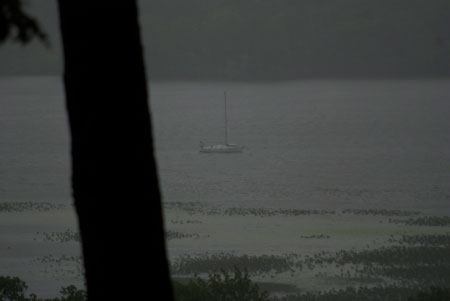
Early this morning I went out into the teeth of the storm to take a photo through the pounding rain. Incredibly, the sailboat was in the exact same position, still facing north, buffeted by small whitecaps but otherwise rather peaceful. A few hours later it shifted 90 degrees and now faces west, towards the Catskills. The storm rages on, the Internet has come and gone and come again, and the sailboat rocks in the waves, anchored three times in the silt. The bow again faces north.Those people will have a story to tell about this night in the land of Rip Van Winkle.
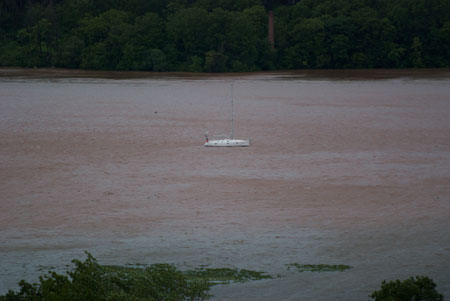
And when they finally emerge from below deck and look around them, the sailors will be forgiven if they come to believe that Hurricane Irene magically transported their sailboat to the muddy Mississippi River.
{ }
by Annik LaFarge
on August 25, 2011
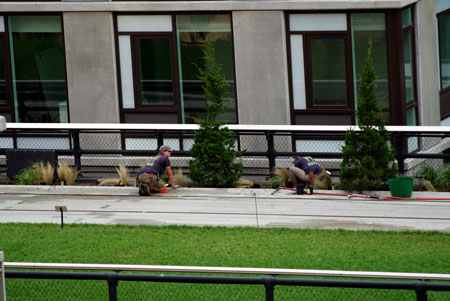
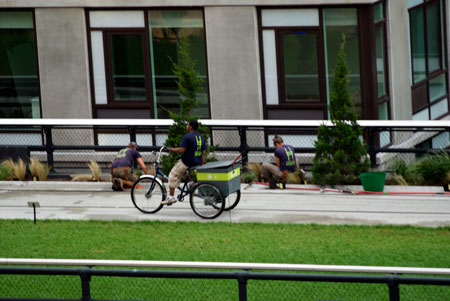
Once the scaffolding came down near the High Line’s lawn — it was there to protect visitors from construction debris at “Ten23,” the new condo on Tenth Avenue — there was work to be done in the garden beds. Most of the evergreen trees under the scaffold suffered badly from lack of sun and rain, and had to replaced. Early this morning the walkway got a power wash, and then the gardeners brought out the new trees and grasses. They paused for a thunder storm that rolled through at lunchtime, then got back to work.
Speaking of storms: Here’s what that section looked like on January 7 of last year:

With a hurricane bearing down on the east coast there’s more nature coming at us. Meantime, it’s a regular day on the High Line. If you’ve gotten used to having a spot to perch during bad weather, here’s a friendly reminder that there’s no place to take refuge from the rain now that the scaffolding is gone.
{ }
by Annik LaFarge
on August 16, 2011

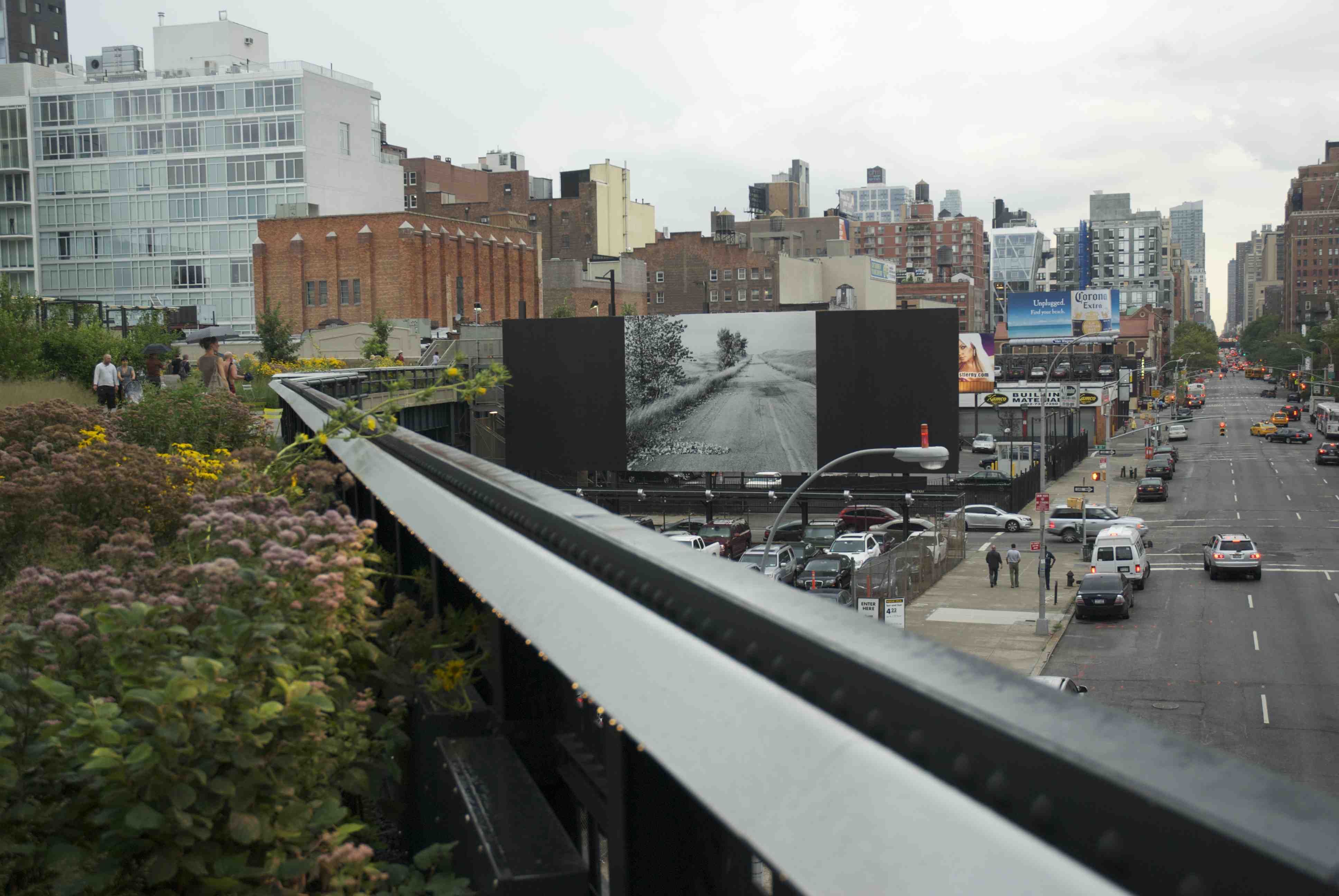
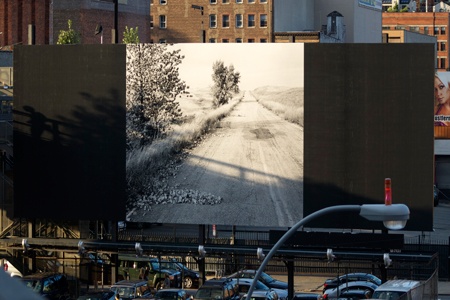
I love the (relatively) new billboard on the High Line, which is part of the park’s great public art program. Joel Sternfeld selected Robert Adams’ black & white photograph of a highway in Nebraska, titled “Nebraska State Highway 2, Butte County” and it will remain on the billboard over the giant parking lot on 18th Street until the end of this month.
The High Line’s website explains that Adams made this image in 1978 “as part of a survey to discover how the grand landscapes of the western United States had been shaped, in ways both subtle and dramatic, by human development.” The empty road makes a strong contrast with our own “grand landscape” of Manhattan, towering majestically above Tenth Avenue where an endless stream of taxis, cars, motorcycles, trucks, bicycles, pedicabs, razors, and dudes on skateboards goes rolling by, day and night.
But I noticed something else when I looked at some photographs I took a few weeks ago: you can see the shadows of people walking along the High Line in the photograph. I have no idea if this was intentional, but Sternfeld understands better than anyone the way the sunlight dances on and around this park.
So there we are, walking along Robert Adams’ deserted Nebraska highway: yet another connection the High Line makes for us between the canyons of Manhattan and the prairies of the American west.
{ }
by Annik LaFarge
on August 4, 2011
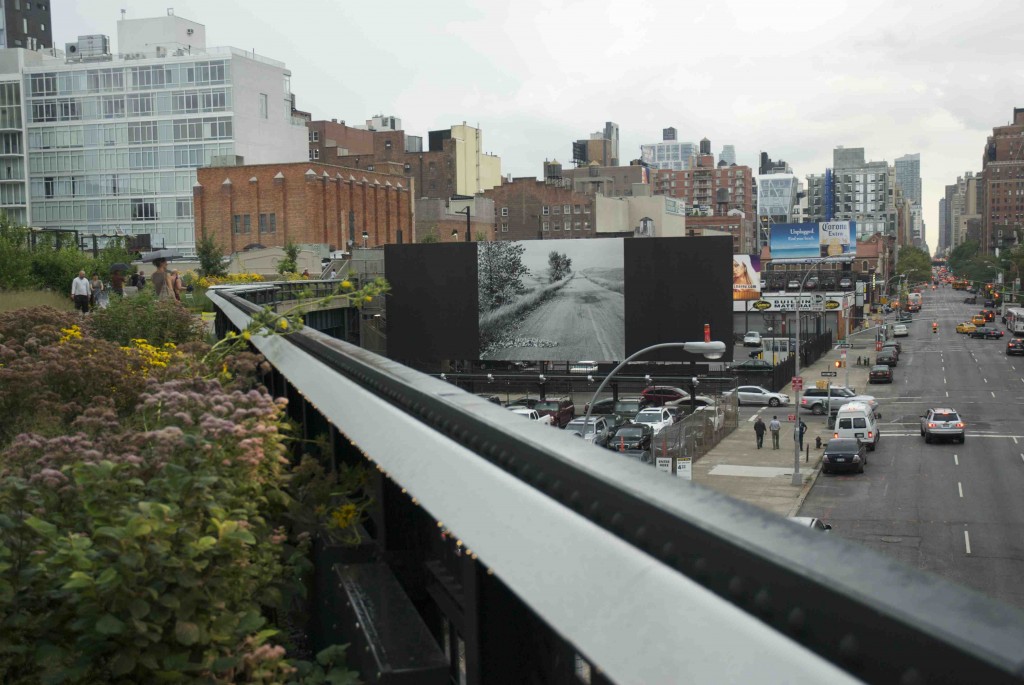
There was a beautiful, Sternfeldian sky above Manhattan this afternoon, and even though I had work to do I grabbed my camera and hit the High Line. There I found the striking Robert Adams billboard that just went up yesterday, which is part of a new outdoor photography exhibit that Joel Sternfeld is curating. You can read about it here, on the High Line’s website. The photo is called Nebraska State Highway 2, Box Butte County, and it conjures the prairie grasses that are in such wonderful abundance now (you can practically smell the cilantro of the prairie dropseed from the street below). It also puts a midwestern highway parallel to Tenth Avenue, which makes sense in a weird way when you consider that “cowboys” rode down these streets beginning in the 1840s.
The High Line is beautiful all the time, but on gray, rainy days, it has a particular magic. Sternfeld told Elizabeth Barlow Rogers, the great New York City conservationist, that he only shot photos on days when the sky was a neutral gray. “I wanted it to be clear in the pictures that if there was glory in the High Line, it wasn’t due to my skill as a photographer. By not borrowing beauty from the sky, the High Line itself is what is important in the picture.” You can read the whole interview here.
So today it was a Sternfeld sky over an Adams photograph. The High Line brings the prairie to Manhattan, and on a rare, rainy, August day, it was a treat to behold.
{ }
by Annik LaFarge
on July 29, 2011
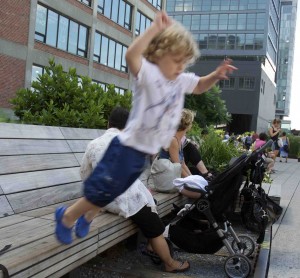 Let’s just pretend, for a moment, that you could do this. (And if you’re reading this blog we both know you can’t….).
But if you could… wouldn’t you?
{ }
 If you’re having trouble re-engaging with work this first week after Labor Day, I encourage you to take a walk through the Chelsea Thicket, one of my favorite sections of the High Line. I’m sure there’s a scientific reason for why a billion crickets have taken up residence in this particular patch of Manhattan, but after a long day in the office you probably don’t care.