≡ Menu

Perfect High Line Weather

With rain and thunder in the forecast it’s a perfect day for the High Line.

Many folks complain about the crowds in the park. Now that spring has arrived (in theory, at least) there are scads of people there and it’s only going to get more crowded once the new section opens.

On really rainy days the die-hards come out. Pass them by and you might get a subtle nod, like guys on motorcycles who flash their lights at fellow bikers traveling in the opposite direction. Yeah, cool, you’re here too. Nice day for a walk.

Share
{ 0 comments }

Lights on the High Line


Last night’s twinkling of lights
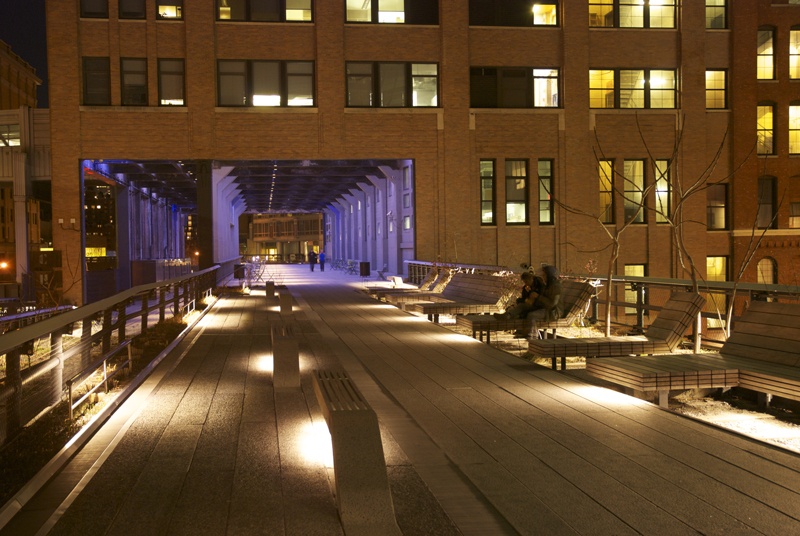
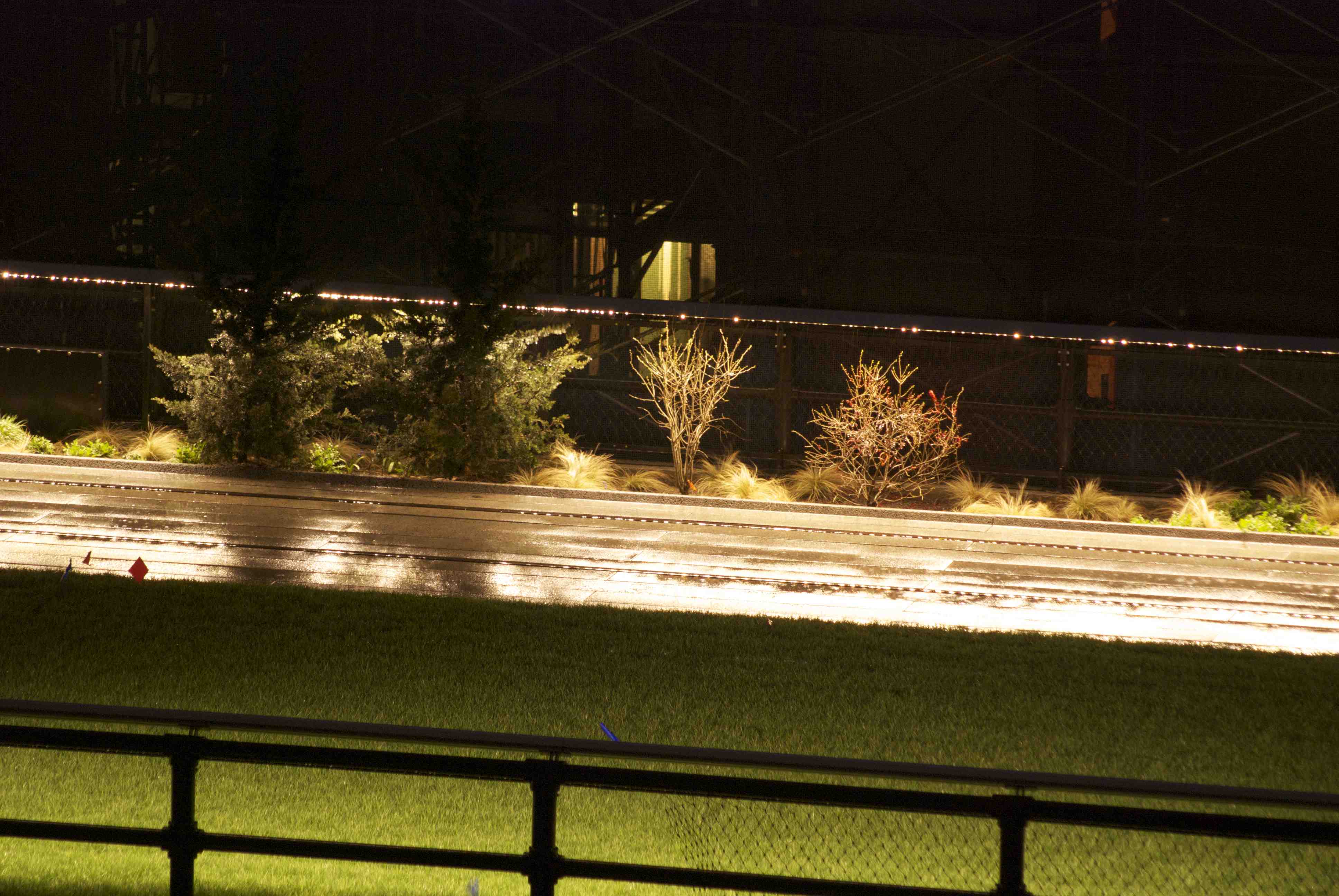
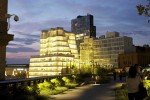
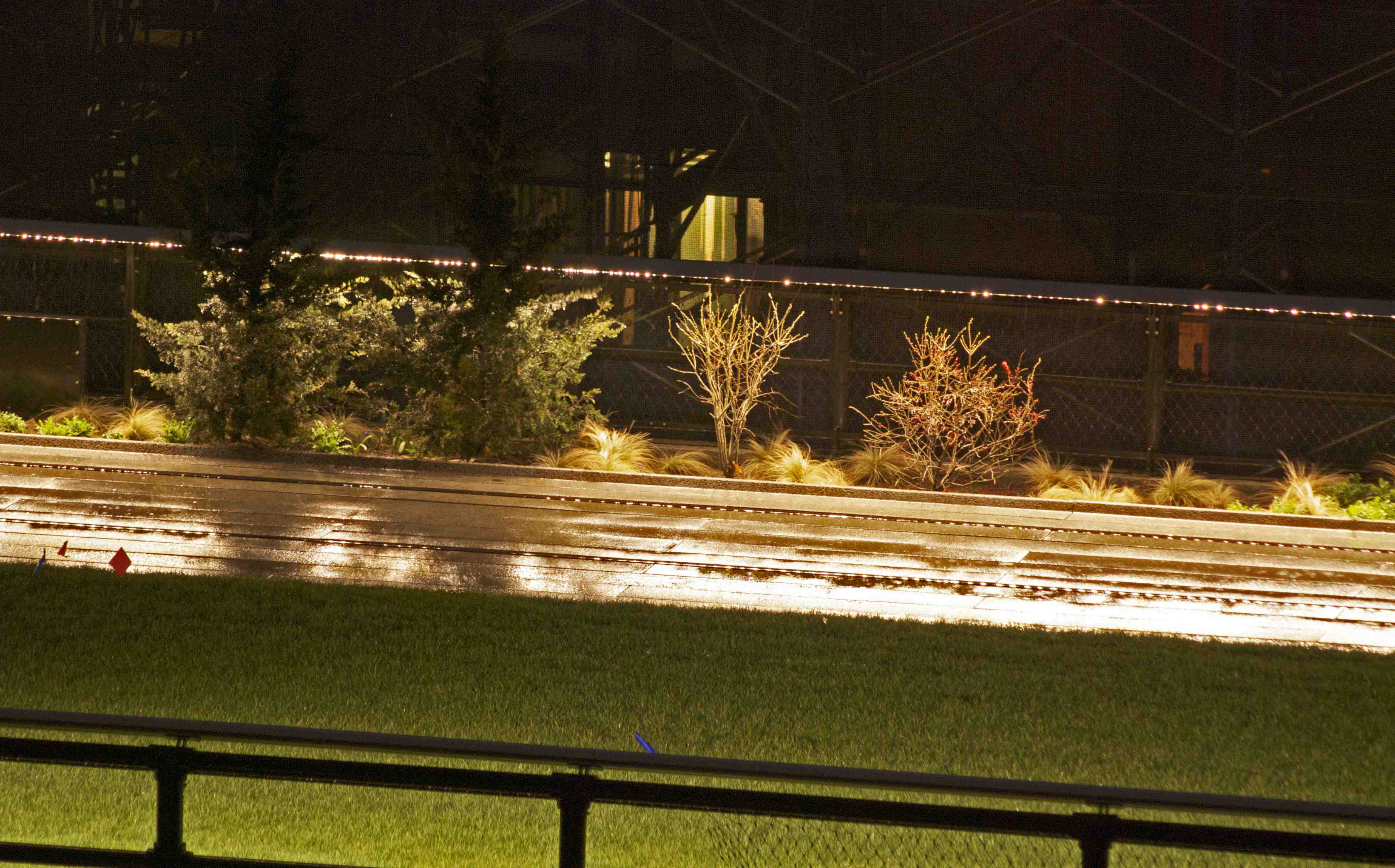
on the new section of the High Line (my little patch is between 22nd and 23rd Streets) made me think about the lighting throughout the park. It was designed by Hervé Descottes of L’Observatoire International, a lighting design firm based in New York.  What’s most remarkable — in a city of blaring, flashing lights — is the restraint that Descottes imposed on his design. The chief example of this is the fact that all the lighting is set below eye level. Never on the High Line will you turn away from something because there’s light in your eyes, and never will you quickly turn around to look at something because it’s cast in a spot light. Like great book design you don’t immediately “see” it; it’s so well integrated into the narrative that it only enables it, never overpowers or even suggests itself.

This is a city of big egos, filled with designers and architects whose work constantly pulls at you. “Look at me, over here, see this detail, this brilliant effect.” With the lighting on the High Line Descottes did something entirely different. He lights the path — an important piece of business — and he places soft, lovely, LED lights under the guard rails and here and there amid the plants. It seems at once random and planned, and in any case completely organic to the park’s overall design.

I had no idea what it would look like out there once the new section of High Line opened, and I confess I worried about the lights. Would they pierce the living room window, like the old Chase Bank did before the (even more garishly lit) condo-in-progress blocked it?

Last night the lights popped on for the first time, against a backdrop of rain, thunder, and lightning.  There was no one there — no workmen, no tourists — just the twinkling glow against the evergreens. Hats off to you, Mr. Descottes.

Share
{ 0 comments }

Lights, Camera….


Oh my, we have Action on the new section of the High Line.

All these years I’ve wondered what it would be like to gaze out the window and see my little patch of High Line lit up. The new section is still not open — it’ll be another few weeks — so presumably they’re testing things. Fittingly this new stage lit up against a clap of thunder (cue the dog growling) and a teeming rain. Well, it’s a marvelous night….

Share
{ 0 comments }

It Tolls For Thee…


Sad news that Stephen Vitiello’s marvelous exhibit, “A Bell For Every Minute,” will close later this Spring. The folks who run the High Line have a robust program of art exhibits and they’ve created a one-year rule for themselves to keep the programs fresh and new. That makes (some) sense, but it’ll be hard to say goodbye to the Bells.

The exhibit has occupied the 14th Street Passage since June of last year, and it was one of the High Line’s original art projects. “A Bell For Every Minute” is a sort of audio map of New York City. Every minute, on the minute, a different bell from around town rings, from the familiar opening bell of the New York Stock Exchange to the 500 pound bell that welcomed visitors to the Dreamland Pier in Coney Island until it was lost in a fire in 1911. Divers retrieved it from the ocean floor in 2009 and Vitiello recorded it for his exhibit. There’s also a little girl’s bicycle bell, which I always love to hear.

The site of the exhibit – a bleak concrete tunnel – reminded the curator, Meredith Johnson, of a bell tower. While the enclosed space makes a perfect “auditorium” for the multitude of bells, it’s also an open space with all the day-to-day noises of the busy city that surrounds it. Every hour on the hour all fifty-nine bells ring at once.

I emailed Stephen Vitiello to ask if he’s planning to create an online home for “A Bell For Every Minute” and he’s not. The length of the piece plus the fact that it’s so site-specific make it very challenging, if impossible, to reproduce with integrity on the web. He passed along a link to a French website, Palais de Tokyo, where you can listen to a podcast of his “Bell Study,” which Vitiello describes as “a very quiet, processed bell piece that plays in between the louder hits each minute.” So once the exhibit closes this, alas, is all that will be left of “A Bell For Every Minute.”

For me this exhibit has become an integral part of the High Line. Every time I visit I hear a different series of bells, and of course every trip is a new experience because the ambient noises from the city — car horns blasting, kids screeching in joy, cruise ships bellowing, dogs barking, motorcycles roaring, cellphones ringing, rain falling, pneumatic drills howling — constantly reinvent the soundscape. Every minute, in fact.

So make sure you visit before June so you can get those bells in your ears at least once more before they go away.

And if this exhibit causes you to become interested in Vitiello’s work, as it did for me, you can find his website here and a very cool gallery of his audio works here, at “SoundCloud.”
Share
{ 0 comments }

To see a World in a blade of grass…


(With apologies to William Blake….)

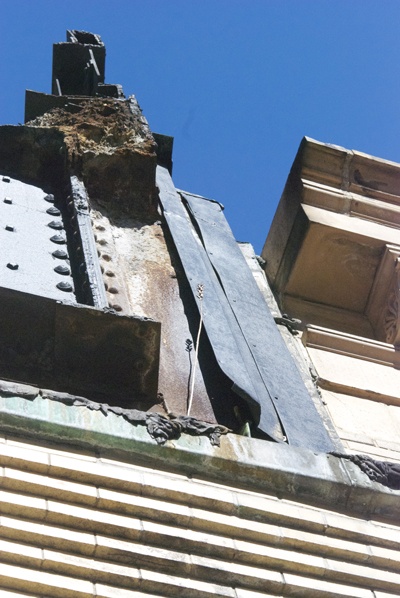
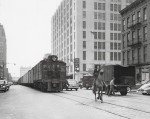
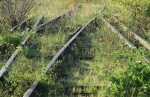
As the opening of the second section of the High Line draws near I offer a tiny, easy-to-miss piece of nostalgia for hard-core lovers of this “meadow in the sky.” The single blade of grass you see in the photo above grows at the southern-most portion of the original High Line on Bank and Washington Streets. Trains pulled through what was then the Bell Telephone Laboratory, the largest industrial research center in the world — TV was invented here as was radar and the transistor — and would continue on a few more blocks to the St. John’s Park Terminal at Spring Street. Today the building is Westbeth, an artist’s community. I used to spend a lot of time here as a kid with friends of my dad’s. It’s a very cool building, though it seems to have shrunk since I was a teenager.

This stalk of grass is most likely a volunteer that hitched a ride from the prairies of the midwest on a train that was headed to New York City. (Is anybody else hearing Arlo Guthrie right about now?)  Or maybe the seed it sprang from dropped from the beak of a bird’s mouth as it was flying south. Who knows? Piet Oudolf, the great Dutch plantsman who designed the modern High Line, filled the park with many kinds of prairie grass that are native to North America — classic John Wayne stuff — but also grasses from the United Kingdom, Europe, South America and North Africa. Everything you see in the park today was planted recently, but many of the varieties were “self-sewn” over the decades that the rail line operated, from 1934 to 1980. I bet this Bell Labs/Westbeth blade of grass sewed itself. Maybe someone out there can identify it.  Meantime, we can gaze up and give it a little salute, because this single stalk, a hardy New York City native that grows — even thrives — between metal and concrete, stands for much of what’s great about the High Line and the city it traverses.

Long may it wave.

Share
{ 1 comment }

The River That Flows Both Ways

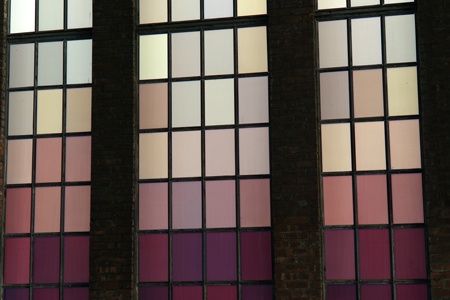
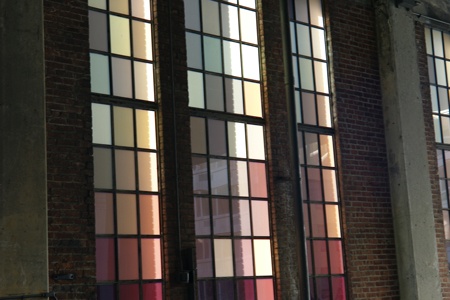
The art exhibit by Spencer Finch, “The River That Flows Both Ways,” is one of my favorite parts of the High Line and today I discovered something I hadn’t noticed before. Again, I thank the camera, which caught something my eyes didn’t see on their own: the reflection of the building just opposite the colored glass windows.

One of the things I love about the High Line is the multitude of windows you see while walking along, everything from cracked, bricked-up windows with bullet-holes on old industrial buildings to the undulating curves of the IAC building. And in the Standard Hotel there’s a “window” cut in the eastern footing of the building that looks onto other windows: Windows on windows. So I shouldn’t have been surprised to see the reflection of yet more windows in Spencer Fitch’s exhibit.

Another thing I admire about “The River That Flows Both Ways” is the fact that every time I photograph it it looks different. Just like the river itself it can’t be nailed down. It keeps changing depending on how the light is falling, where you’re standing, what time of day it is, what season of year, and what the weather is like.  I find the changeableness of this exhibit oddly comforting because it’s so perfectly reliable.

The Algonkins, the people who first settled in New York Harbor, named what we now call the Hudson (after the English sea captain) “the river that flows both ways.” They were stunned when they first saw it, a river with currents that flow north and south at the same time. You can see it yourself; just stand on a pier or lean up against a railing along the Greenway. I’ve never seen anything like it anywhere else; it’s just fascinating and confounding.

That’s what Spencer Finch’s exhibit captures: the movement and changing patterns of this great river. You can read about his project here, and see a photo that looks nothing like mine.  I hope the High Line folks make this wonderful exhibit a permanent feature of the park.

Share
{ 0 comments }