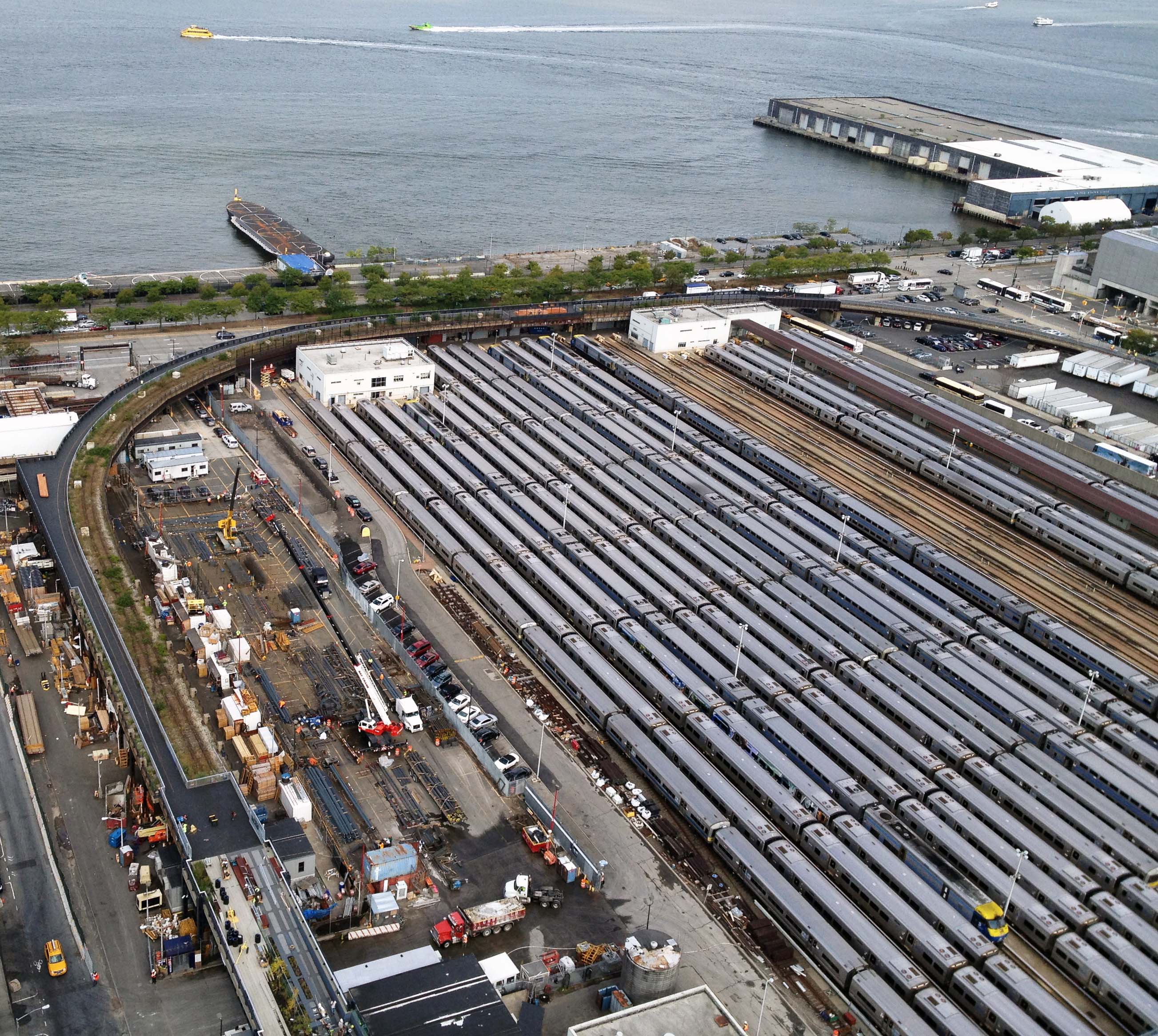
≡ Menu

Yesterday’s post about the upcoming Hudson River voyage of the Lehigh Valley No. 79 focused on the three former terminal warehouses in view of the High Line: the Baltimore & Ohio’s; the Starrett Lehigh building; and the Terminal and Central Stores complex. But there are several monuments on the river itself that will make fantastic perches for shooting the floating museum as it heads north.

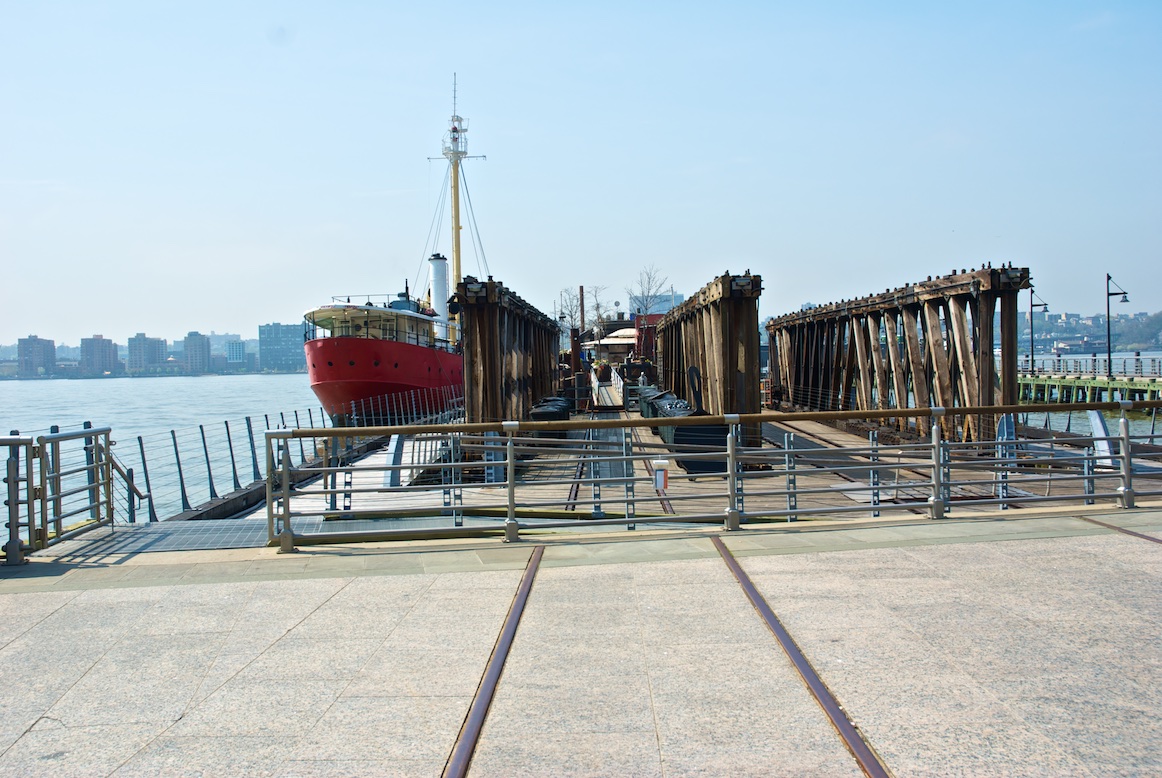
Pier 66 with Frying Pan, John J. Harvey, and railroad tracks

Pier 66 with Frying Pan, John J. Harvey, and railroad tracks

First: Pier 66, at 24th Street. Originally built for the Delaware, Lackawanna and Western Railroad — later known as the Erie Lackawanna — this float bridge is now home to two historic boats: the John J. Harvey and the Frying Pan. As part of the preservation effort of this Lighterage Era structure the railroad tracks that once connected the barge to the Starrett Lehigh warehouse across today’s West Side Highway are still there, and you can ride a bike across them. You can also grab a beer and burger at the Bar & Grill while you wait for the Lehigh Valley No. 79 to pass by.

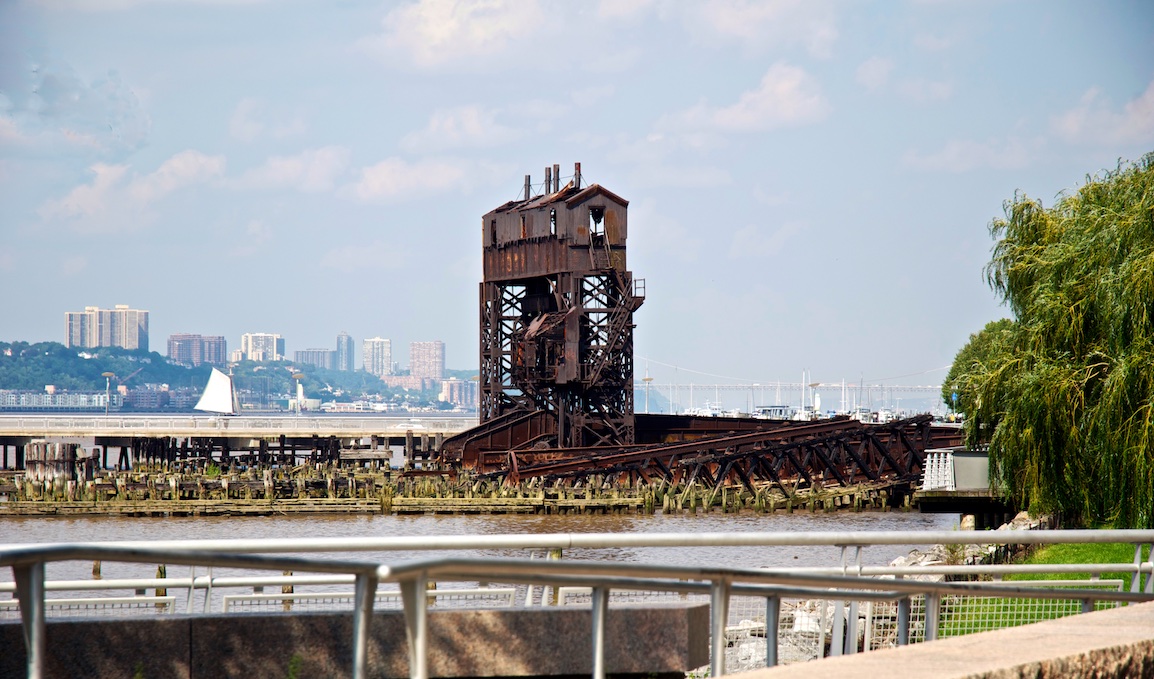
69th Street Transfer Bridge with Clearwater Sloop in the background

69th Street Transfer Bridge with Clearwater Sloop in the background

Or: head a bit farther uptown and you’ll find the gorgeous, brooding remains of the 69th Street Transfer Bridge, once used by the New York Central Railroad to transfer railroad cars that had floated across the river from Weehawken, NJ.

For the ideal shot, position yourself on the river’s edge and point your camera so you can capture both the Lehigh Valley No. 79 and the infrastructure of the float bridge as the barge passes by. This way you can get a bit of living history in motion. The day I shot the photo above I was lucky to capture Pete Seeger’s Clearwater Sloop as it tacked across the river just a bit north of the transfer bridge.

Follow @museumbarge on Twitter for updates about the barge’s schedule.

For more information about the lighterage system read this excellent short history that includes reminiscences from the men who captained and worked on the tug barges.

Share
{ 0 comments }

History Sailing By the High Line

Starrett-Lehigh (center) flanked by two other railroad warehouses: Central Stores (at right) and B&O (at left)

Starrett-Lehigh (center) flanked by two other former railroad warehouses: Terminal and Central Stores (right) and B&O (left)

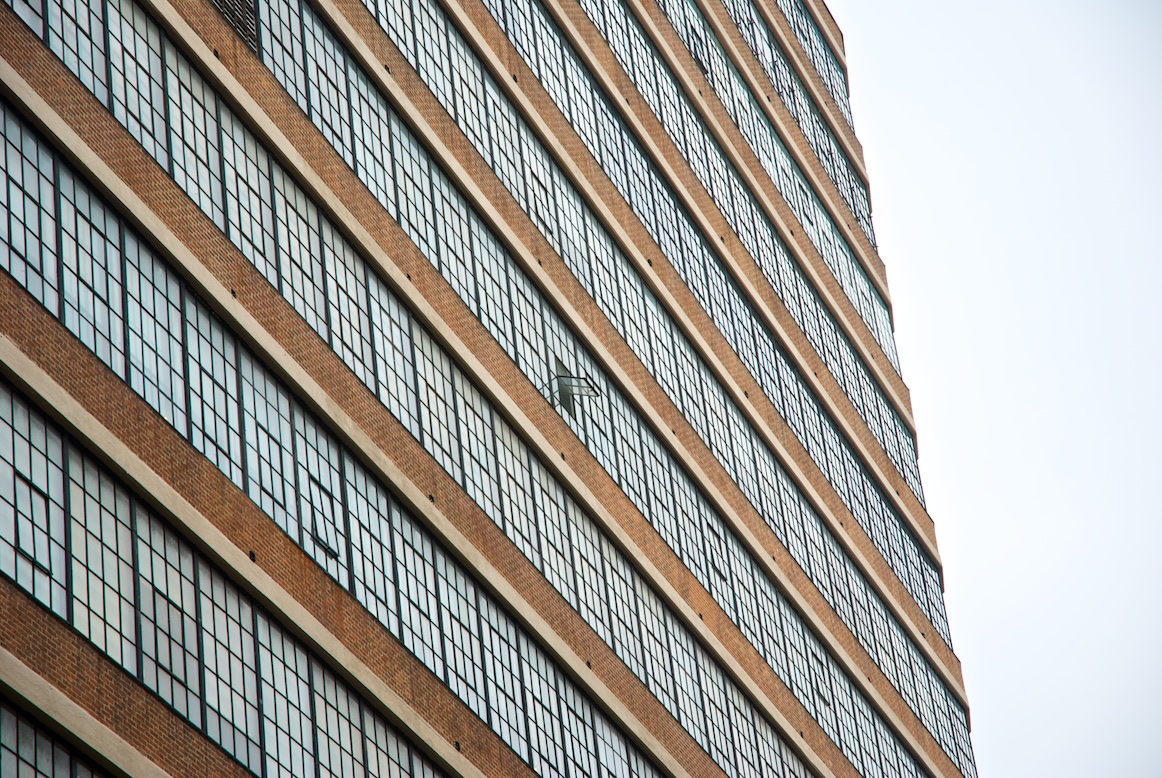
One of the great monuments in view of the High Line is the Starrett-Lehigh Building, a behemoth that straddles the superblock between 26th and 27th Streets on Eleventh Avenue. Look at it for more than a minute anytime, day or night, and you’ll most likely see a light flashing in one of the eight miles of windows that circles this enormous building. That’s because it’s filled with design, magazine, new media and advertising firms, and many of its offices double as photo studios.

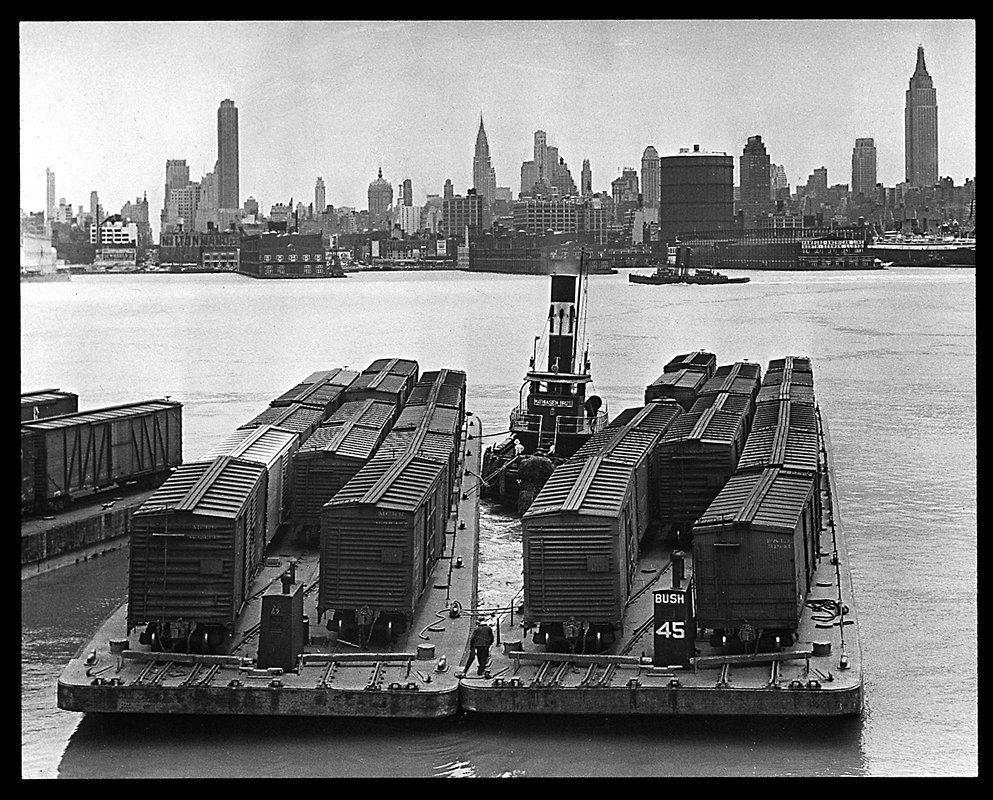
But in 1931 this 2.2 million square foot building served a very different purpose: it was a terminal warehouse for the Lehigh Valley Railroad, built with funds from the Starrett Investment Corporation. It played a vital role in the Lighterage Era, a time before bridges and tunnels enabled food and commercial goods to be swiftly transferred across the Hudson River. The workhorses of that era were the railroad barges, giant floating platforms that could carry as many as a dozen boxcars from terminals in New Jersey to warehouses in Manhattan. Known as “lighters” or car floats, they were a fixture of the Hudson River landscape for decades. In the 1930s, National Geographic reported that as many as 5,000 barges crossed the Hudson every day. Phillip Lopate, in his excellent book Waterfront, observed that “In their heyday, the barges were almost as synonymous with New York’s iconography as its skyscrapers.”

Railroad car floats in New York Harbor. Photo: New York State Archives

Railroad car floats in New York Harbor. Photo: New York State Archives

But not every barge carried actual boxcars; a significant number of vessels in the lighterage system were constructed of wood and ferried “less than carload lots” of perishable goods like coffee, flour, rice, sugar, and spices in their protected spaces. Goods were brought on board by longshoremen at a railroad terminal or were transferred on the water from a ship. These tug-powered barges were the only link between ships and railways, allowing cargo that had traveled across oceans to be offloaded and transferred to a railroad terminal like the one built for the Lehigh Valley Railroad on the Far West Side of Manhattan. Once inside, the goods could be stored, re-packed and re-shipped to their final destination.

In the days before trucks hit the newly built Interstate Highway System and airplanes took to the skies, the lighterage system was a vital part of America’s commercial transportation network. It was how stuff got from one place to another.

Later this month millions of us, from the Hudson River’s southern gateway all the way north past Albany, will have the chance to witness a rare and exciting event as the 101-year old Lehigh Valley No. 79, the only surviving all-wooden unit from the Lighterage Era, makes a 35-hour voyage up the river to a dry dock in Waterford, New York. Visitors on the High Line will have the opportunity to watch a very particular bit of history in action as the barge passes three former railroad warehouses located between 26th – 28th Streets: the Baltimore & Ohio (now the site of Bedrock Mini Storage at 241 11th Avenue); the Starrett-Lehigh and the Terminal & Central Stores complex (home to shops, art galleries, and a furniture company). [Note: click on the first image in this post to enlarge it and see all three.]

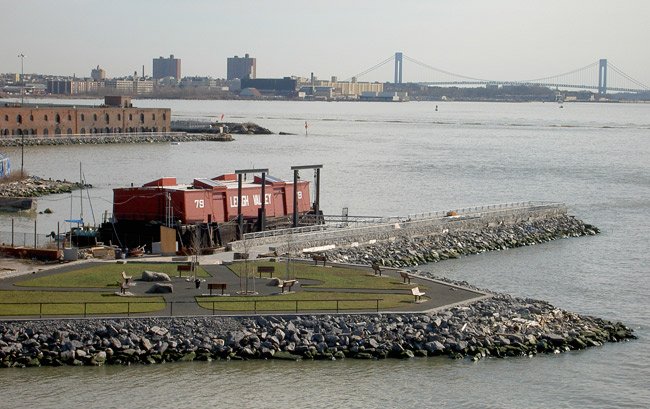
The Waterfront Museum. Photo by David Sharps

The Waterfront Museum. Photo by David Sharps

Today the barge is the Waterfront Museum, founded in 1986 and dedicated to promoting an understanding of New York’s maritime history and the ecological importance of the Hudson River estuary. It’s also the home of David Sharps, a former cruise ship entertainer who rescued the barge from the place where it lay grounded in New Jersey, cleared 300 tons of mud that had settled in the hold, and restored it to seaworthy condition. David and his wife raised their two daughters on the barge and still live there at Pier 44 in Red Hook, Brooklyn.

Sometime in the next week the Lehigh Valley No. 79 will depart Red Hook and begin its voyage north. There are countless spots on both sides of the Hudson River, from Brooklyn to Waterford, where you can watch this marvelous historic barge pass by. The actual date will be announced soon, but for now there’s a 7-day window, beginning June 23rd. Follow @museumbarge on Twitter or the official Facebook page for details about timing and location. Folks traveling on the barge will Tweet constant updates so you can position yourself on a bridge, at a park, on a mountaintop, or anywhere along the river to take your photo and share it with the world.

The Lehigh Valley N0. 79 has made only three trips up the Hudson River. This summer’s passage was mandated by the U.S. Coast Guard, which ordered the vessel to be dry-docked and inspected after Hurricane Sandy. Any necessary repairs will be made in Waterford and then the barge will return to its home in Brooklyn. It’s an expensive project, and the Museum is gratefully accepting donations; go here if you’d like to contribute. I just donated $79 in honor of the official number the barge was assigned by the Lehigh Valley Railroad when it rolled off the Perth Amboy Dry Dock in 1914 and assumed its role in the vibrant marriage of river and rail that constituted the Lighterage Era.

For more information about the Waterfront Museum and Lehigh Valley No. 79, visit the official website here, or download the National Register of Historic Registration form [PDF] which includes architectural details about the barge and history of the Lighterage Era.

Share
{ 0 comments }

High Line Architecture: The Whitney Museum

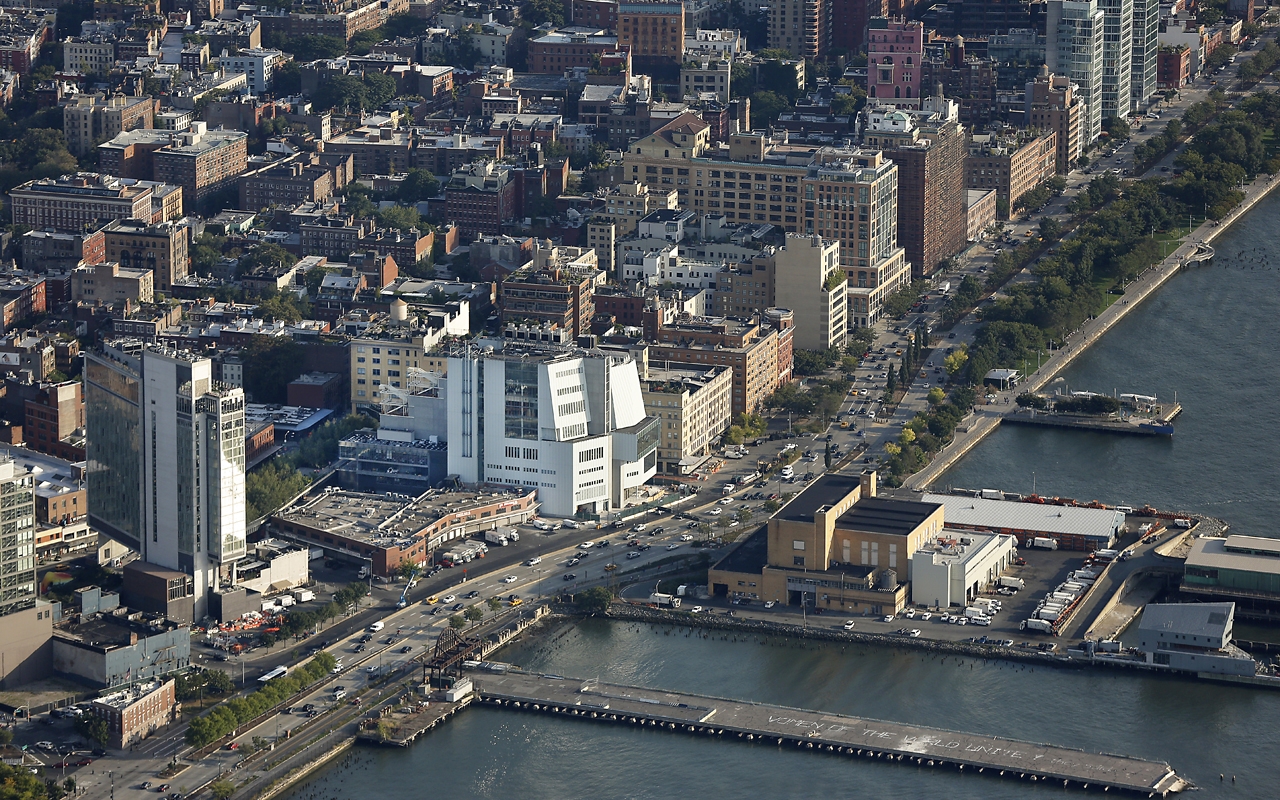
New Home for the Whitney. Choto courtesy Whitney Museum of American Art

New Home for the Whitney. Photo courtesy Whitney Museum of American Art

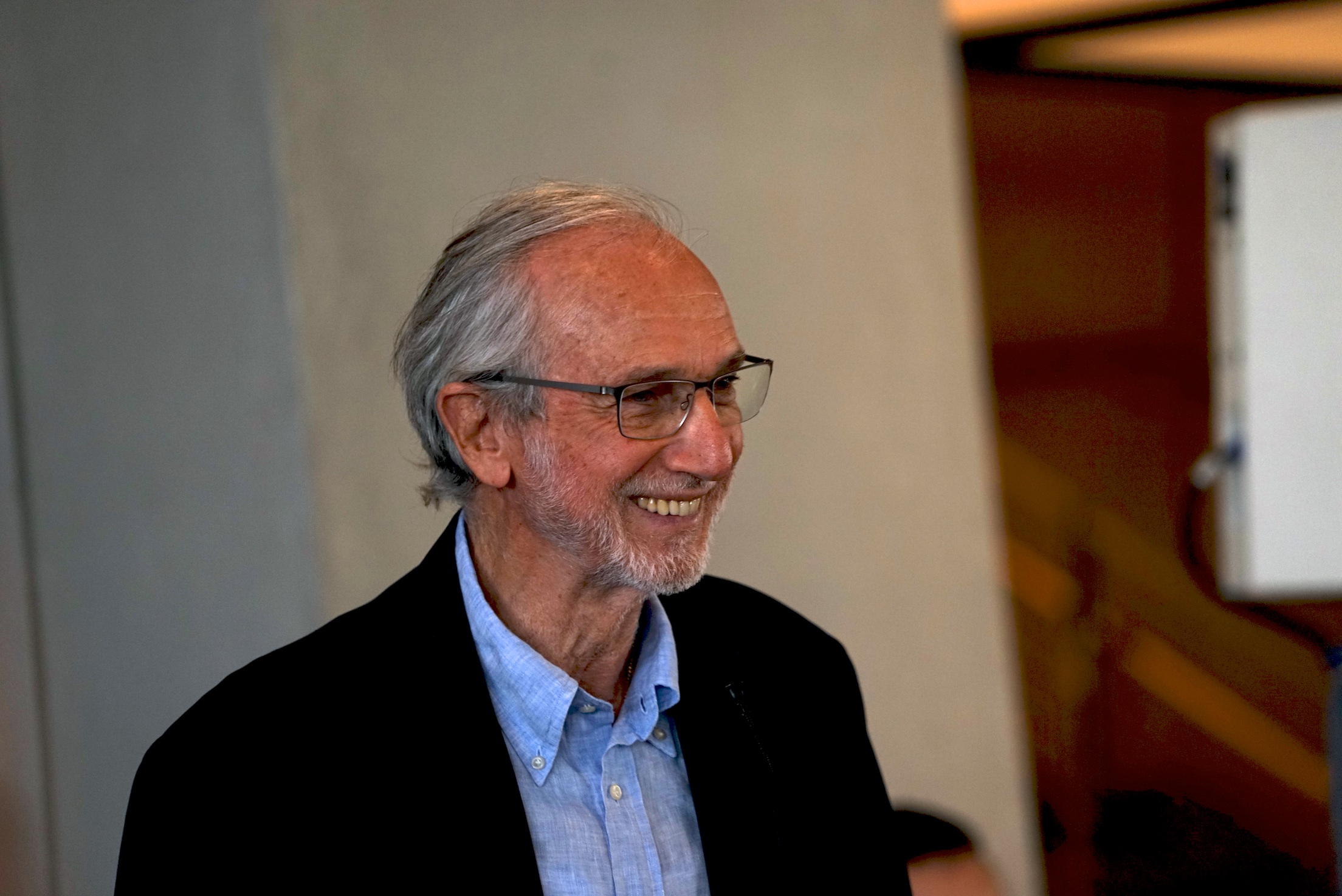
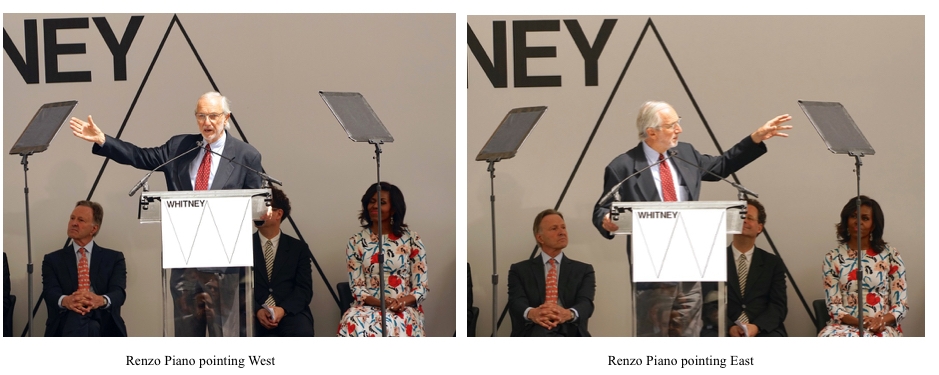
When architect Renzo Piano speaks about the Whitney Museum of American Art he uses his entire body to illustrate the artistic intent of his new building. During the museum’s official dedication ceremony he gestured first to the east, and a view that cuts across Manhattan Island. “This building talks to the city,” he said, then turned left and pointed to the Hudson River. “It also talks to rest of the country: all the way west, to Los Angeles, if you look carefully,” and then to the world beyond. This new building, with its massive windows and expansive 360 degree views, seems designed to enable a sort of outward-looking contemplation and engagement that most museums, with their emphasis on what’s inside, right in front of you, don’t encourage.  “I’m pretty sure that beauty will save the world,” Piano said, and this new home for one of the country’s foremost collections of American art makes the point at every turn that all the beauty inside is made more powerful by its connection to a greater, wider landscape.

This is the fifth article in my series “High Line Architecture.” Like the previous other pieces, it’s not an architectural or aesthetic review but instead a look the history of the place a building occupies, and a contemplation of how the landscape around the High Line has changed over time. (See below for links to the previous articles; as always, click an image to enlarge it.)

Renzo Piano: "I'm pretty sure that beauty will save the world."

Renzo Piano: “I’m pretty sure that beauty will save the world.”

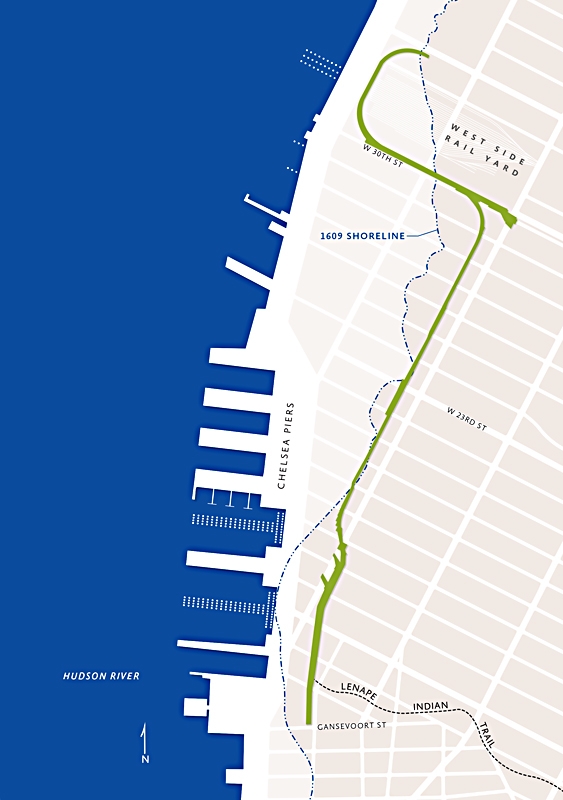
There’s something felicitous about the fact that this quintessentially American institution, one that celebrates creative inventiveness and innovation, sits on land that’s man-made.  When the first Europeans arrived at these shores in 1609, they would have sailed or paddled over the spot where the Whitney now stands.  Gradually, beginning in the early 19th century, this watery area was filled in so an early generation of developers and real-estate schemers could start building stuff on it. Like much of the far West Side — virtually everything west of Tenth Avenue, including the High Line — the Whitney sits not on Manhattan schist but on landfill. (Interestingly, as the map below shows, the High Line roughly follows the landfill line all the way to the Rail Yards. This makes a walk from one end of the park to the other a great way to contemplate not only how we transformed what was on our island but also how we transformed the geography of the island itself.)

The original 1609 shoreline (dotted line), a Lenape Indian Trail, and the High Line.

The original 1609 shoreline and the High Line. Map by Marty Schnure.

The huge complex of buildings across the street from the Whitney, the West Coast Apartments, is another example of  ingenuity: modern commercial refrigeration was pioneered here. In the late 1890s, the Manhattan Refrigerating Company developed one of the earliest and most technologically advanced cold-storage facilities, based on a complex system of underground pipes that fed cooled water from the Hudson River into a huge, multi-storey warehouse that eventually would connect with the High Line, itself an innovation that opened in 1934.

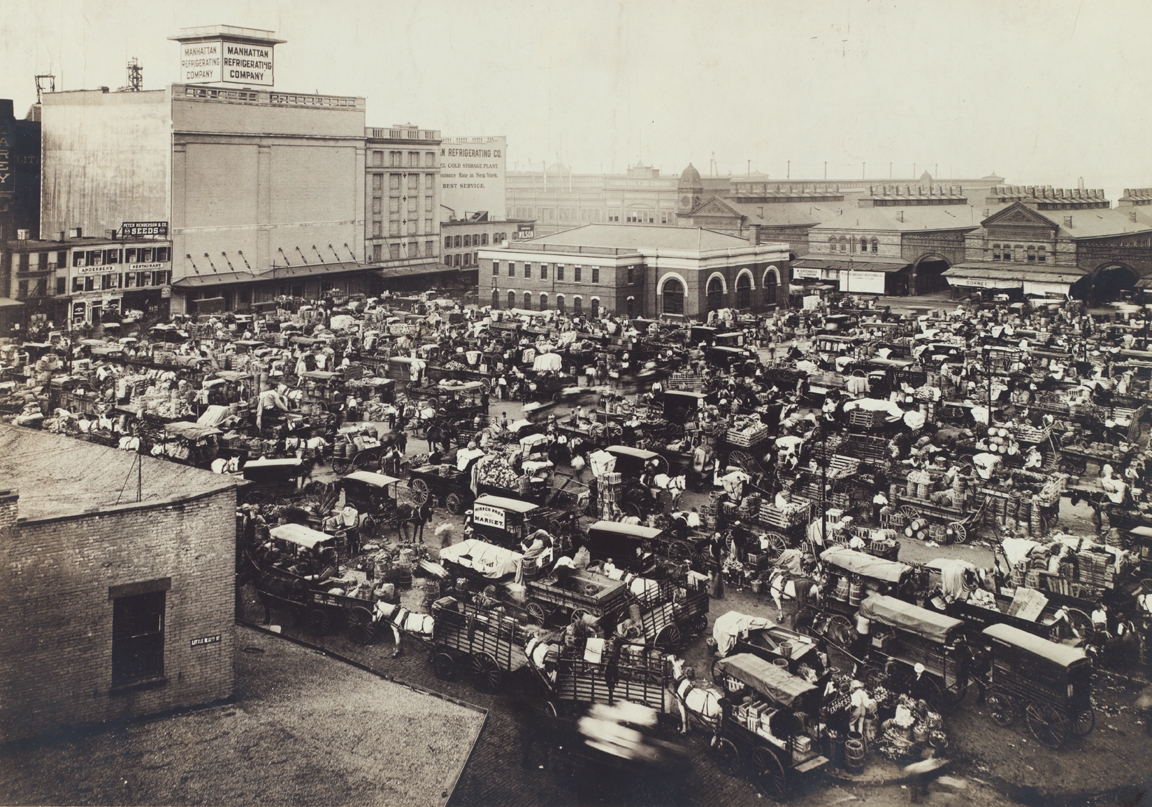
This little patch of land(fill) also has a long and distinguished foodie history. As early as 1879 there were outdoor farmers’ markets here; the neighborhood was filled with merchants who came from all over New York state, from Long Island to the Hudson Valley, to sell poultry, meat, seafood, eggs, butter, vegetables, beer. You can still trip over the Belgian block (also known as cobblestones) that were here long ago, or take refuge from a downpour under the metal canopies that sheltered grocers in rainy weather.

The photo below is from the first decade of the 20th century and shows the area where the Whitney now stands. This year two restaurants — Santina (under the High Line) and Untitled (in the Whitney) — opened on this very spot, each in a virtual glass box with windows onto the street and a commitment to serving food made from local farmers and growers. Generations removed from the men who came here with horse and donkey carts, they include a welcome 21st century cohort: urban farmers who grow produce on rooftops in Brooklyn and Queens.

But the rich food history stretches back even further:  long before there was a railroad or a farmers’ market here, the area was a prime hunting and fishing grounds for the Lenape people. Using data from the Welikia Project, the 1609 shoreline map also shows the location of a Lenape Indian trail that runs over land now occupied by the handful of remaining meatpacking plants that still operate underneath the High Line and gave the neighborhood its name.

Farmers' Market at Gansevoort Street, circa 1910s. Courtesy NY Public Library

Farmers’ Market at Gansevoort Street, circa 1910s. Courtesy NY Public Library

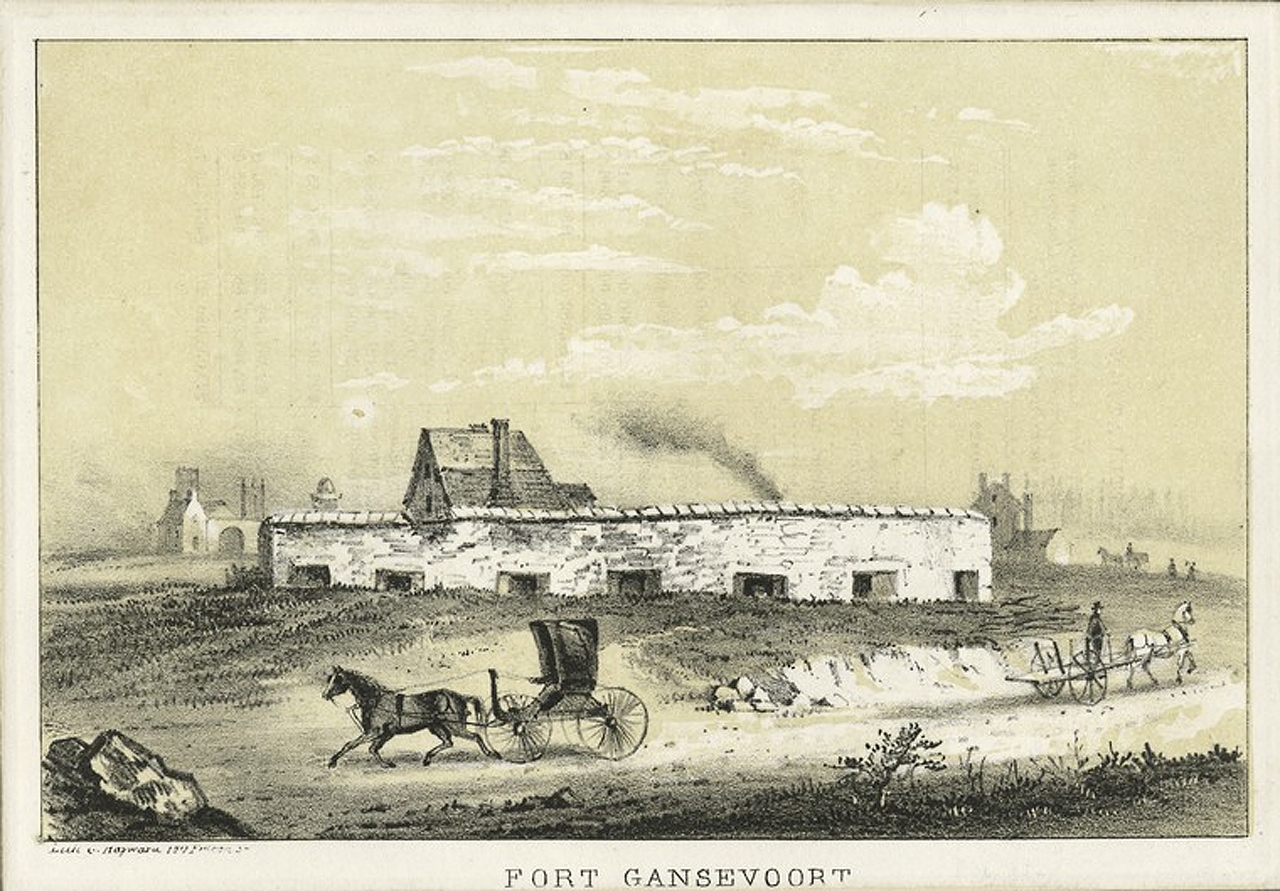
The Whitney site was also important in the military history of the United States: in 1808, in anticipation of a war against Britain, a fort was hastily built here on pilings erected in the Hudson River. Known as Fort Gansevoort, it was named after the revolutionary war hero Peter Gansevoort.  Some five decades later, Gansevoort’s grandson, Herman Melville, would spend almost twenty years just across the street at the Gansevoort Dock, where he worked as a Customs Inspector.

Fort Gansevoort, Coursey New York Public Library

Fort Gansevoort, Coursey New York Public Library

All this history: food, trains, technology, soldiering. A bit of river at the edge of a forest becomes a fort, a farmers market, a multi-storey refrigerated warehouse with a railroad passing through it, a world-class park and now an art museum that urges us to look outward, through its many windows, onto the wide and complex world we inhabit. Inside, the museum deploys art and artists to push the boundaries ever farther and inspire and challenge those acts of contemplation and engagement.

The whole project feels experimental, even radical. On the fifth floor, the architects provided a sitting area that runs the length of the museum and faces west, encouraging visitors to sit and contemplate the Hudson River. All day long the boats go by: water taxis, ferries, oil tankers, cargo ships, police vessels, luxury yachts, cruise ships, kayaks and barges carrying gasoline and home heating oil, like the one in my photo below. On the West Side Highway cars, trucks and motorcycles rumble along. Between the river and the highway cyclists, bladers and skateboarders glide by on the bike path. All the while, visitors in the new Whitney Museum are sitting and watching. Behind and above them, racing across the wall and visible to all those mariners, drivers, cyclists and pedestrians outside, are the “Running People” of Jonathan Borofsky, an artist known for works that capture figures in movement: people walking, running, flying. This museum, resting on its man-made foundation in a place saturated with invention and history, has taken us into a new era of art appreciation, one where we are always engaging and never quite sitting still.

Piano conveyed everything the new Whitney stands for when he said, in his closing remarks: “Thank you for coming. The building is yours.”

Borofsky_Whitney

“Running People at 2,616,216” (1978 – 79) by Jonathan Borofsky. The Whitney Museum of American Art, 5th floor, the inaugural exhibition “America is Hard to See.”


Renzo-Piano


To learn more about the Gansevoort Market area of the West Village, read Tony Robins’ excellent walking tour which is filled with history and illustrations. Download a PDF or read it online here.

Architecture on the High Line
: click the image below to read previous posts in the series

Tim Saternow Furniture Exchange Warehouse, 525 West 22nd Street, 1940 (Spears Building), 2010 Watercolor on paper, 60x40”

The Spears Building


Morgan-Aerial_October-2012_1280x800

The Morgan Mail Facility

Cass Gilbert-designed warehouse, now Avenues School

RC Williams Warehouse / Avenues School

The Westyard Distribution Center

Westyard Distribution Center


Share
{ 0 comments }

Into the Wild

For Johnny.

The genius of the High Line at the Rail Yards is that it’s two different places at once, yet each part perfectly captures the essence of this now mile-and-a-half long, exquisitely beautiful park. [As always, click an image to enlarge it.]
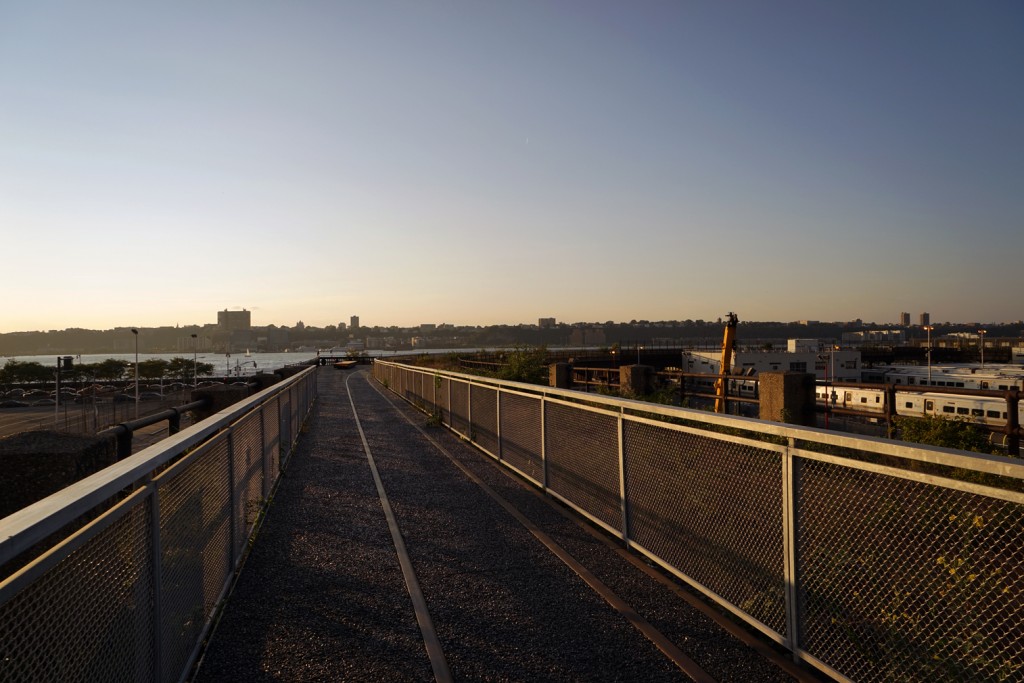
The High Line at the Rail Yards

The High Line at the Rail Yards

Every landscape tells a story, whether its urban, rural, or wilderness, and much of what I’ve been doing on this blog for the past five years is peel back the layers of this particular place to discover the many threads in a rich, ongoing narrative about the Far West Side of our little island. What makes a visit to the final section of the High Line so exciting is that its creators have taken the old story of the abandoned railroad and married it so seamlessly and artfully with the new story of the High Line Park.

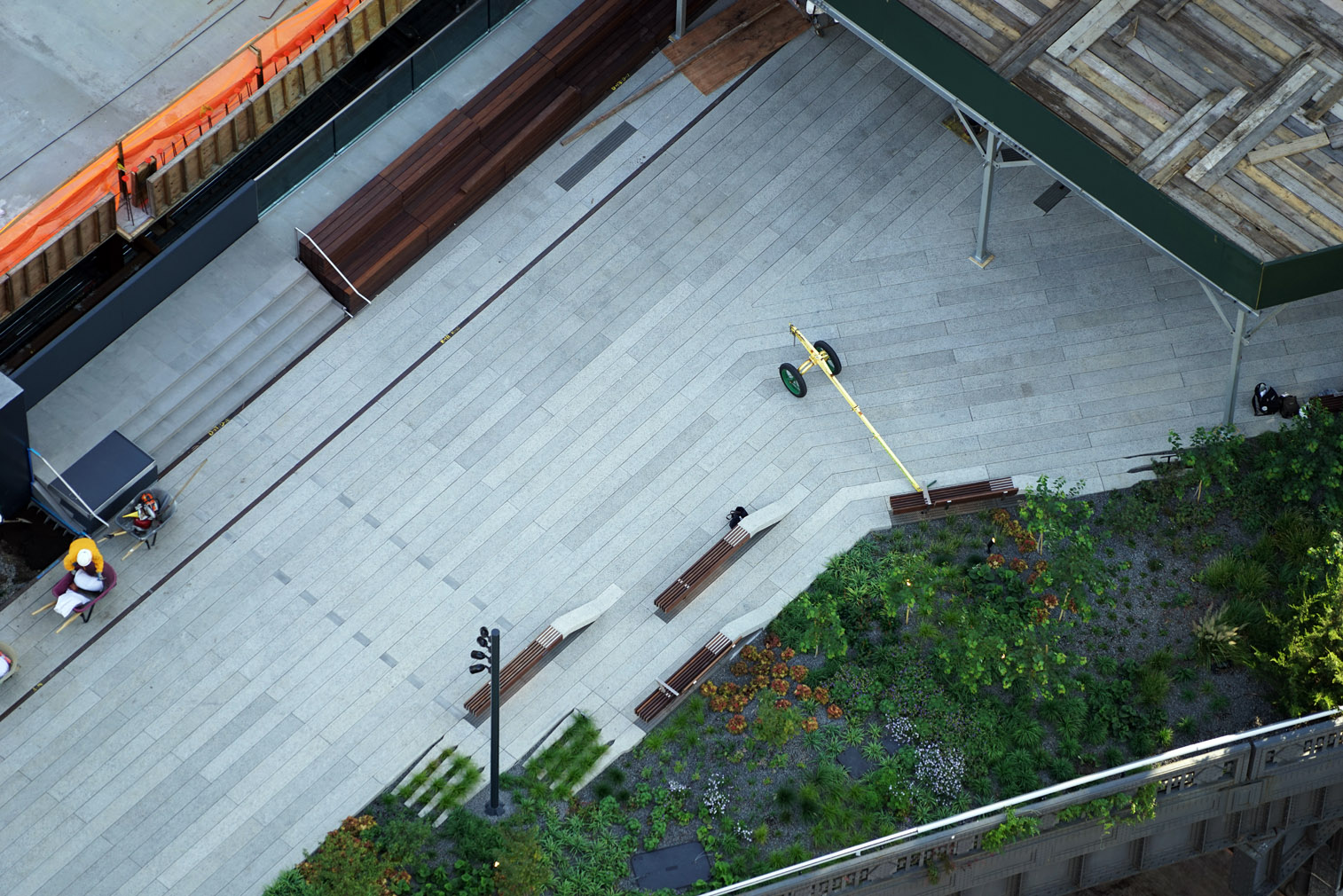
A simple change in paving material and a gate that closes at dusk signals the transition between a “wild,” self-seeded garden and a modern park that galvanized an international movement devoted to the adaptive reuse of post-industrial places, powered by new ideas rooted in the concept of greenness and sustainability. The fact that the official opening of the High Line at the Rail Yards coincided with the People’s Climate March made the experience of being here all the more powerful. One could justifiably feel, standing in the “park in the sky” at the spot where the March ended and participants began streaming in, that you were, for just that one fleeting little moment, in the most hopeful place in the world.

It makes it all the more appropriate that a visitor’s first footsteps in the High Line at the Rail Yards pass over a little knuckle in the pavement known as “The Crossroads.” Some day in the future, when the massive Hudson Yards neighborhood is complete, The Crossroads will be the only spot in the park where you could walk in any direction of the compass. But for now, visitors are irresistibly pulled west toward the Hudson River, into a newly designed section that’s remarkable for its sense of openness and natural light.
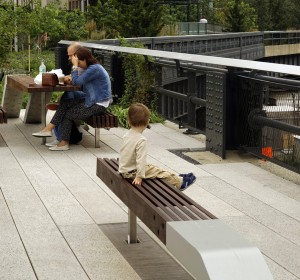
"Make it sittable." -- William H. Whyte

Make the place sittable, William H. Whyte said

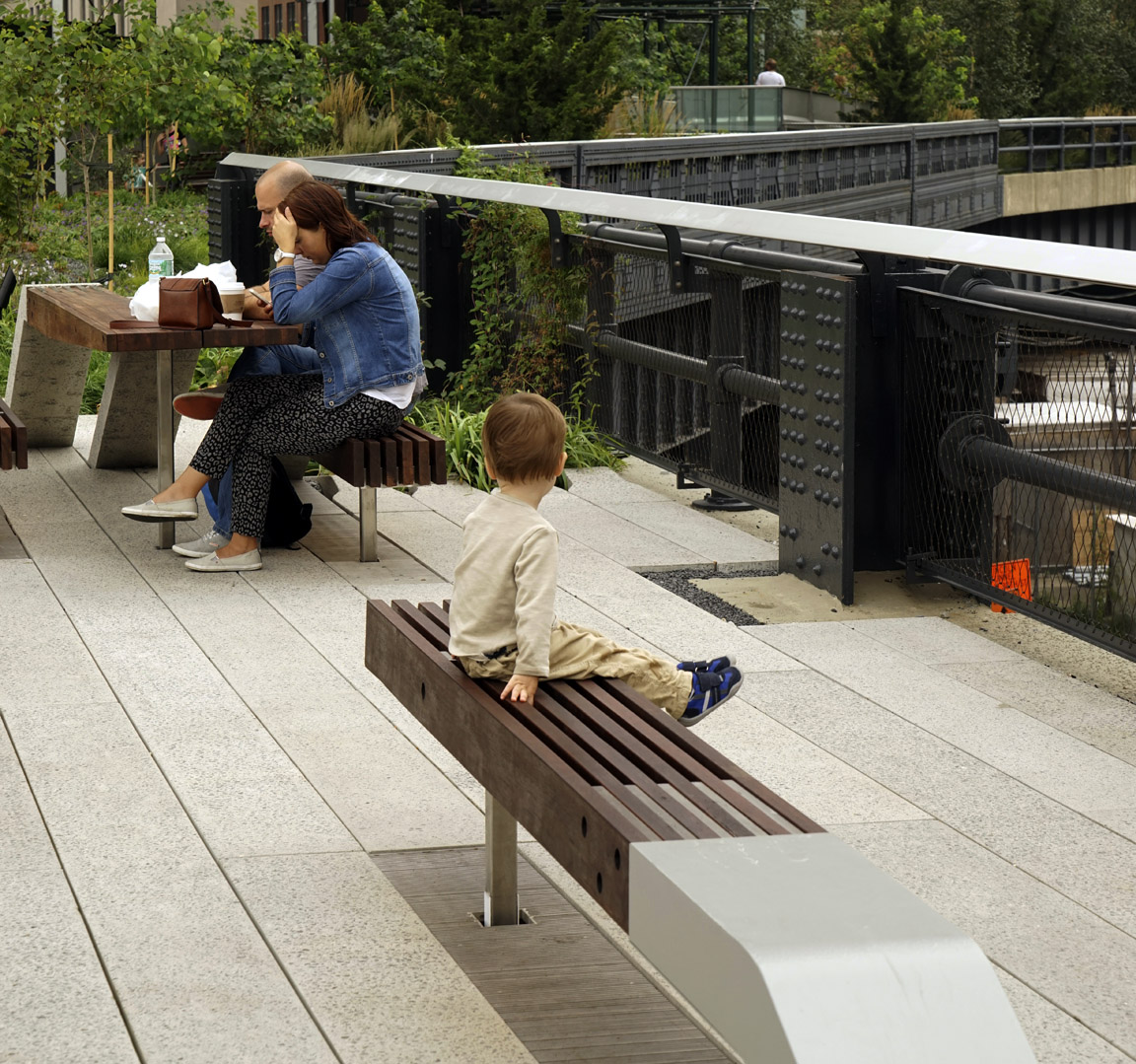
If William “Holly” Whyte were still alive he would be smiling, because in this new area the architects have conceived a whole new vocabulary for the humble act of sitting and hanging out in the city. There’s a “peel-up” bench that see-saws (and gives your calf muscles quite a workout in the process…); love seats that allow couples to engage in conversation while facing each other; a bench that doubles as a xylophone; and long tables where you can quietly work at your laptop, do some urban sketching, or enjoy a picnic with a friend.

Which gets to one of the most striking differences between the newly designed section of the Rail Yards and the rest of the park: there are lots of things to do here. Many visitors love the High Line because it was designed for promenading or just sitting quietly and watching the world go by. In the warmer months you can get a bite to eat, but essentially that’s it. It’s the Slow Park, and that’s always been part of its charm. The Rail Yards is without doubt the most beautiful part of the park, with its expansive Hudson River views and wide, sunlit plazas, and it is indeed a spectacular place for promenading and observing. But there is also much to do here, especially if you’re a kid.
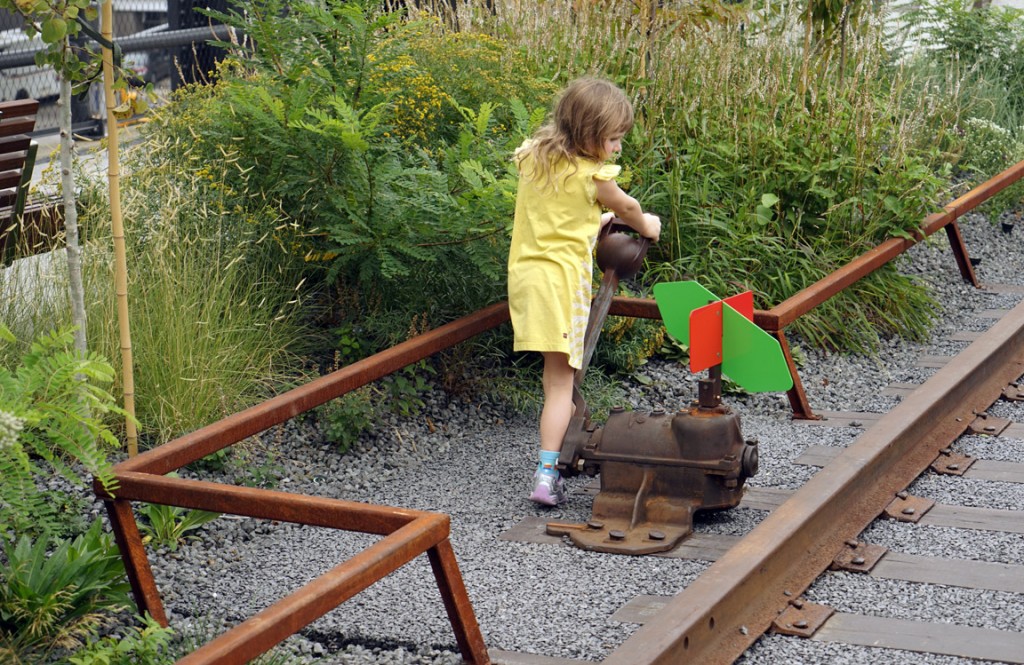
A refurbished signal switch is just above the MTA's working rail yard

A refurbished signal switch is just above the MTA’s working rail yard

The Pershing Square Beams: Just for Kids

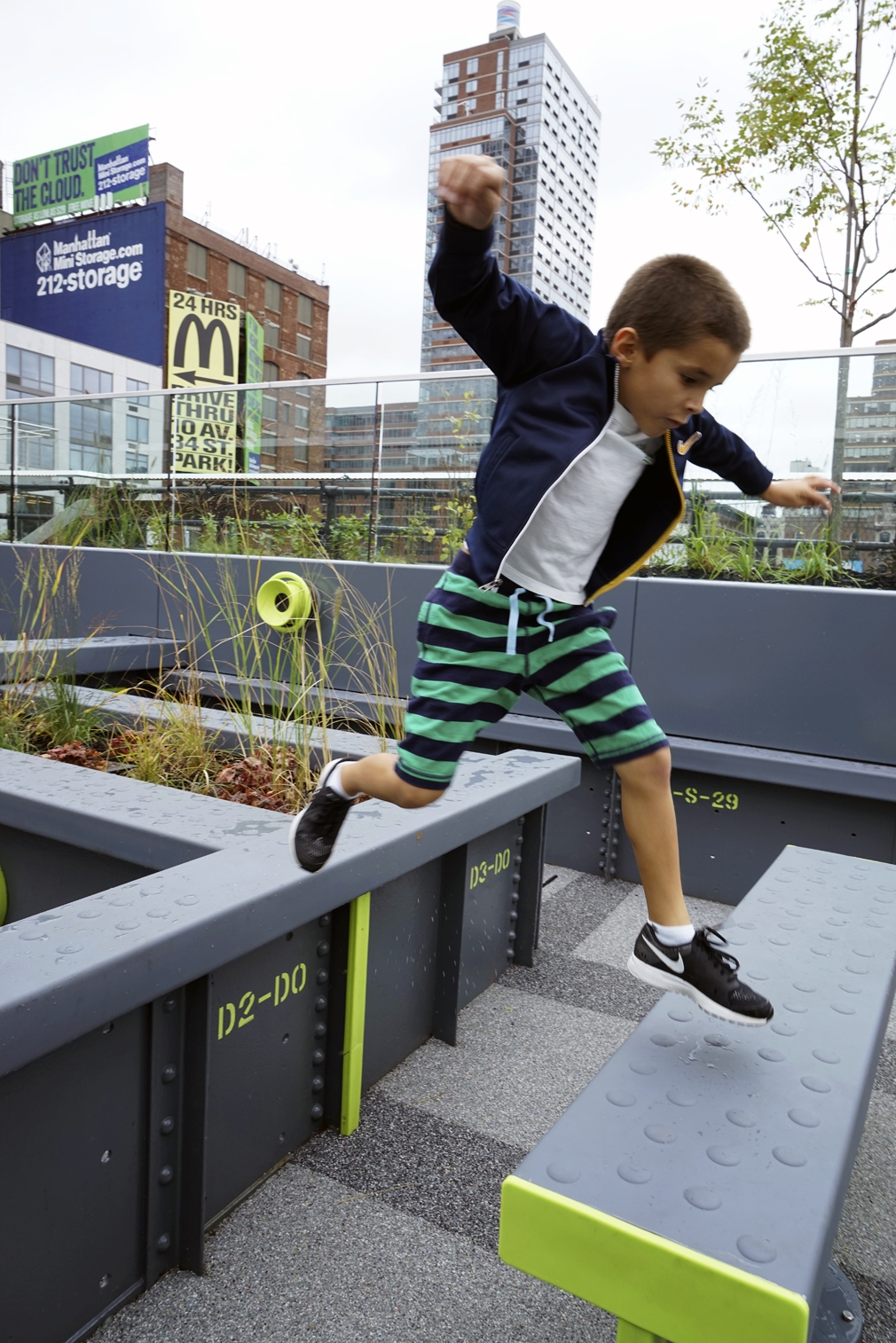
Kids now have a place of their own on the High Line, and it’s one of the few spots in New York City where adults are not allowed unless accompanied by a child. This area was created by removing a section of the original steel beams, then covering the remaining ones with a thick layer of silicone. The result is a cool space filled with nooks and crannies for investigation and romping. A periscope offer’s a kids’ eye view of the Rail Yards, and a special tube between beams allows them to have private but amplified conversations across a distance. On opening day I overheard one little boy bellow into the tube: “I love you, mommy.”
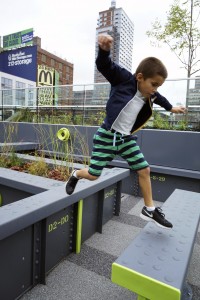
One of my young friends leaps in The Beams

One of my young friends leaps in The Beams

Best of all, The Beams allows kids to get right inside the structure of the viaduct itself and see how the whole thing was put together. The engineering seems to intrigue them; one day this week a little girl interrupted her game of leaping from beam-to-beam to exclaim to her mother: “Look, those are rivets!”

Walk the Rails, Watch the Trains

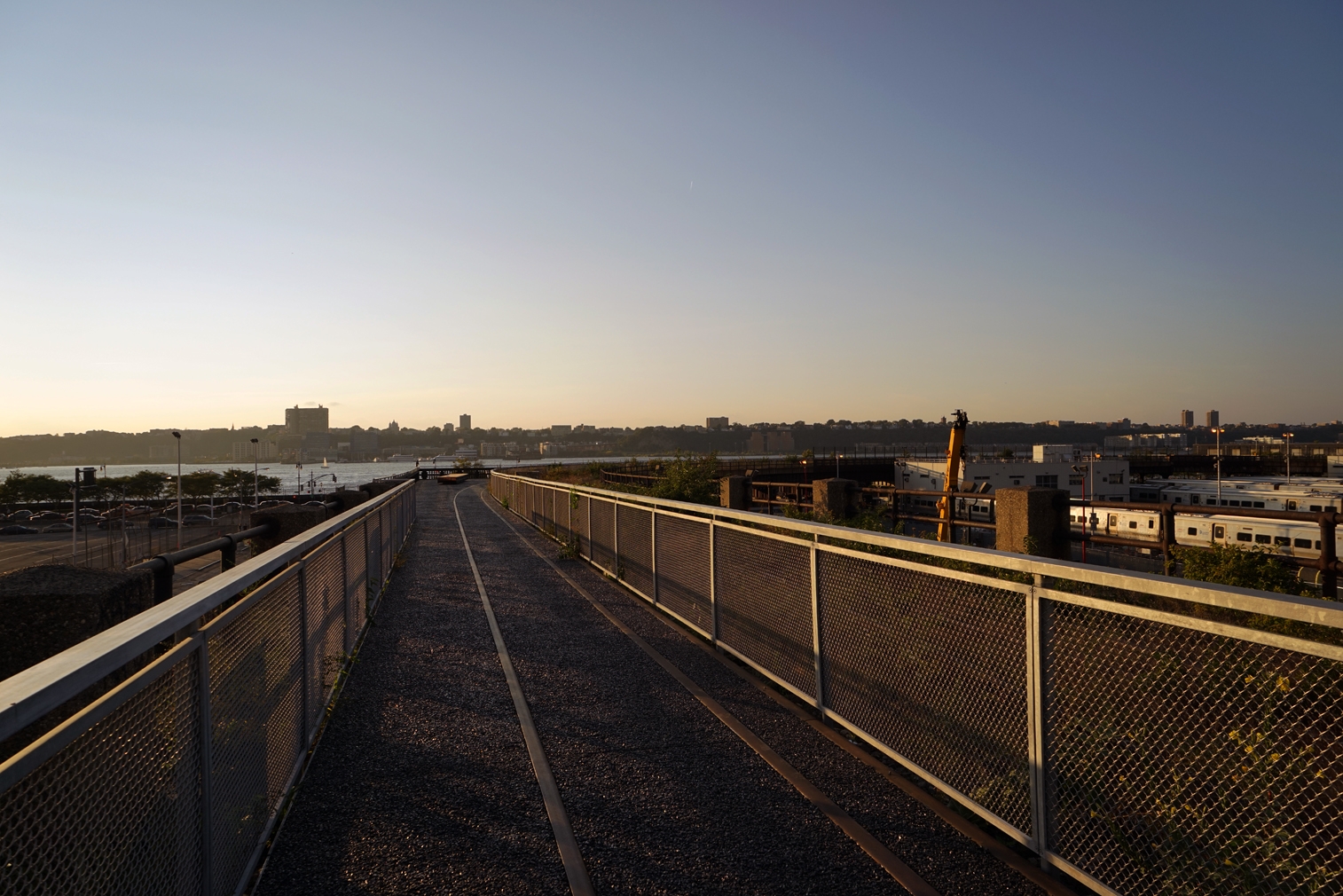
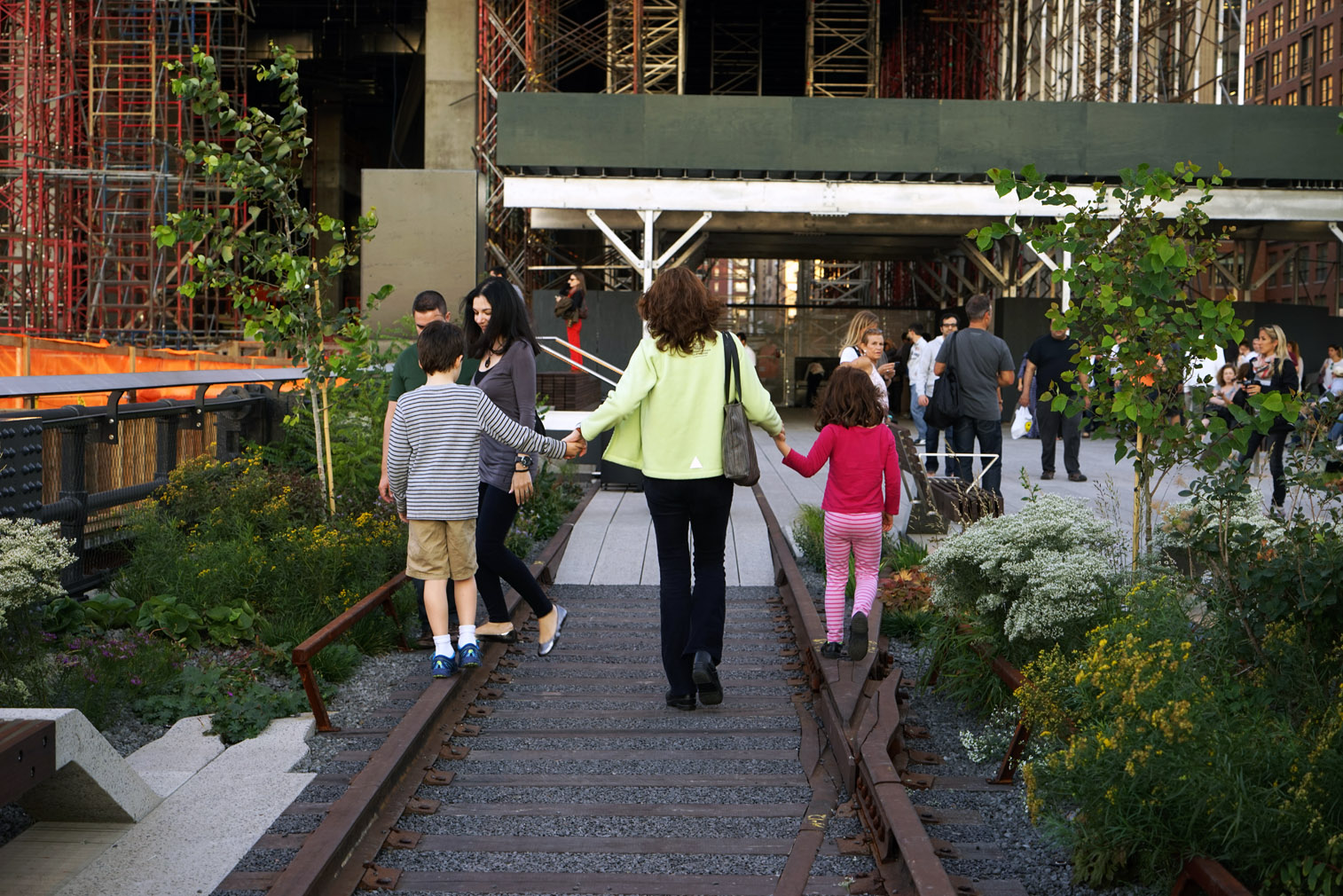
Ever since the High Line opened people have been yearning to walk on the rails. It’s one of the most natural things in the world, like whistling or humming while you work, but it’s not allowed in the park because the tracks cut through garden beds that would be damaged by heavy foot traffic. In the new section, the designers created three “Rail Walks” so visitors can stroll between the tracks or hop on a rail and walk along it. As you move along, balancing on the rails, you can gaze down at real trains as they enter and depart a working rail yard:  the commuter trains of the Long Island Railroad. Having dropped their passengers off at Penn Station a few blocks east, they proceed to the Rail Yards where they park until it’s time to make the return trip.
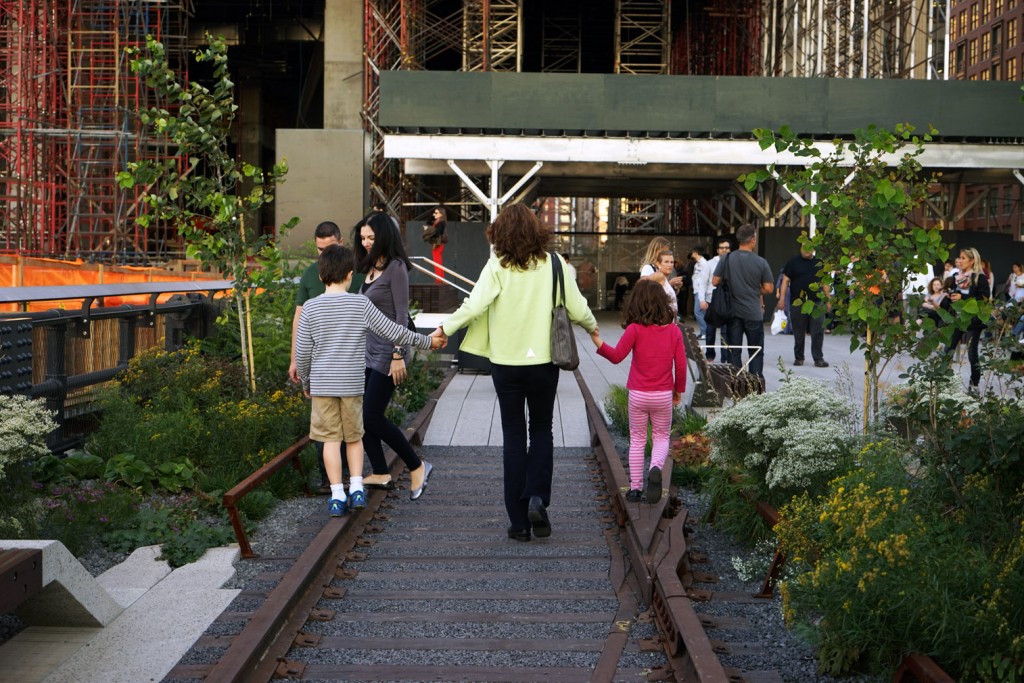
The Rail Walk

The Rail Walk

See the Past and Future at Once

But what takes your breath away in the new High Line at the Rail Yards is the “wild” section. What makes this such a powerful place is the fact that it has been left alone. I think this section, which wraps around the Western Rail Yards, is one of the most beautiful, inspiring places in all of New York City. An “interim walkway” now cuts through the plants, grasses and trees that spontaneously grew here after the trains stopped running in 1980. The temporary path was born of financial exigency – it was the quickest way open up the entire Rail Yards section, even though funds only existed to formally design part of it – but it offers an experience that is truly priceless. Here is a central part of the High Line’s narrative, an introduction to the real, wild garden that inspired the planting and design scheme throughout the entire park. Everywhere else on the High Line the tracks were taken out for remediation of the rail bed, including the removal of asbestos and lead paint, then replaced along with new plants that came from a nearby nursery. Here, the tracks remain in exactly the same place they were when the trains rumbled along them, surrounded by shrubs and perennials that have grown here, unseen, for decades. All around are breathtaking views: of the busy Hudson River to the west and vast, open stretches of Manhattan to the north, east and south.

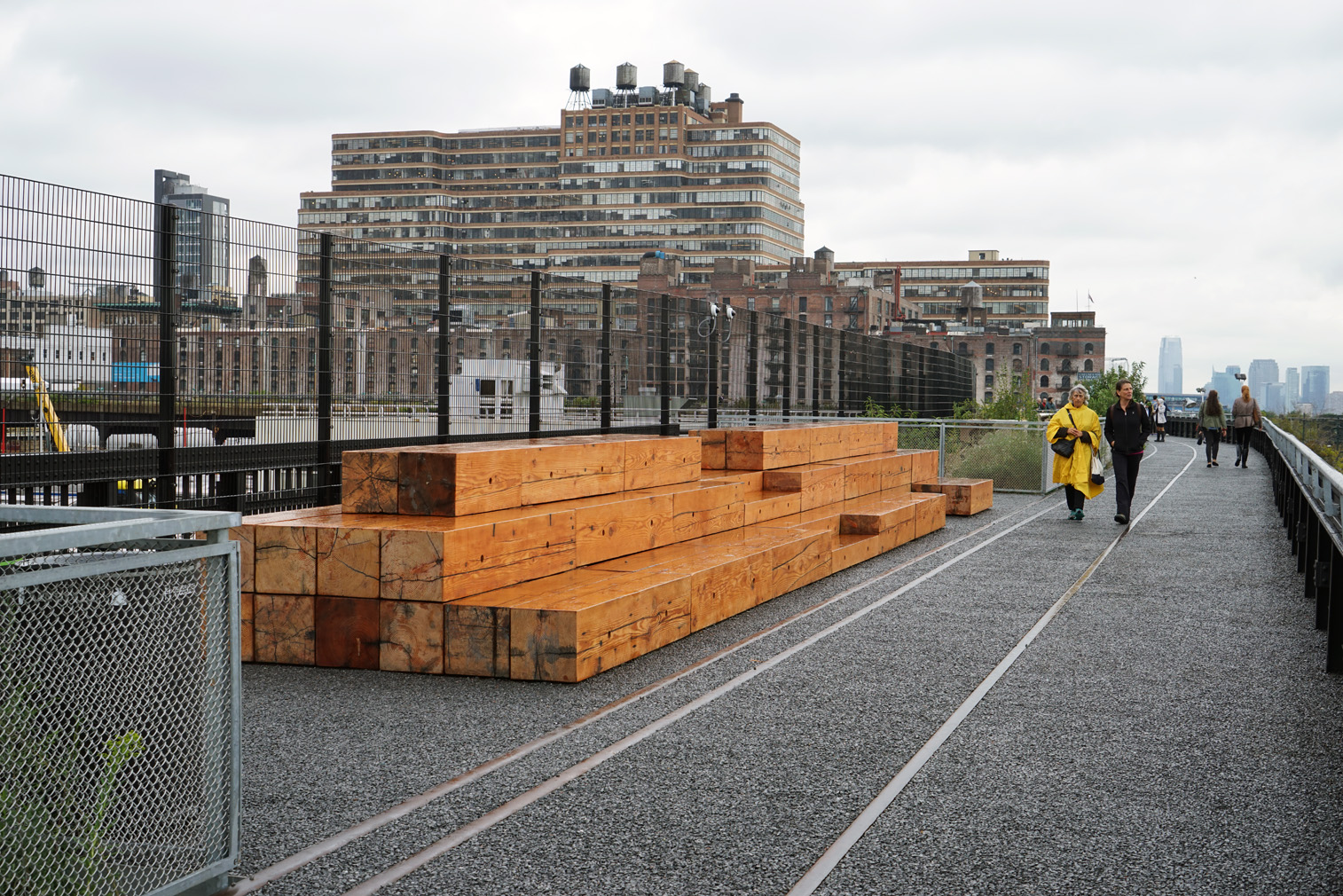
In the middle of the wild section is a seating area made of long, wide timbers stacked on top of each other. The genius of this arrangement is that you can turn your back on the city and gaze out at the boat traffic and constantly shifting light along the Hudson River.
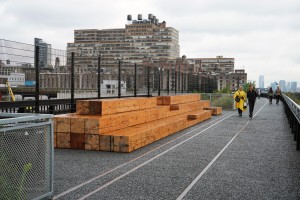
East/West facing seating steps

East/West facing seating steps

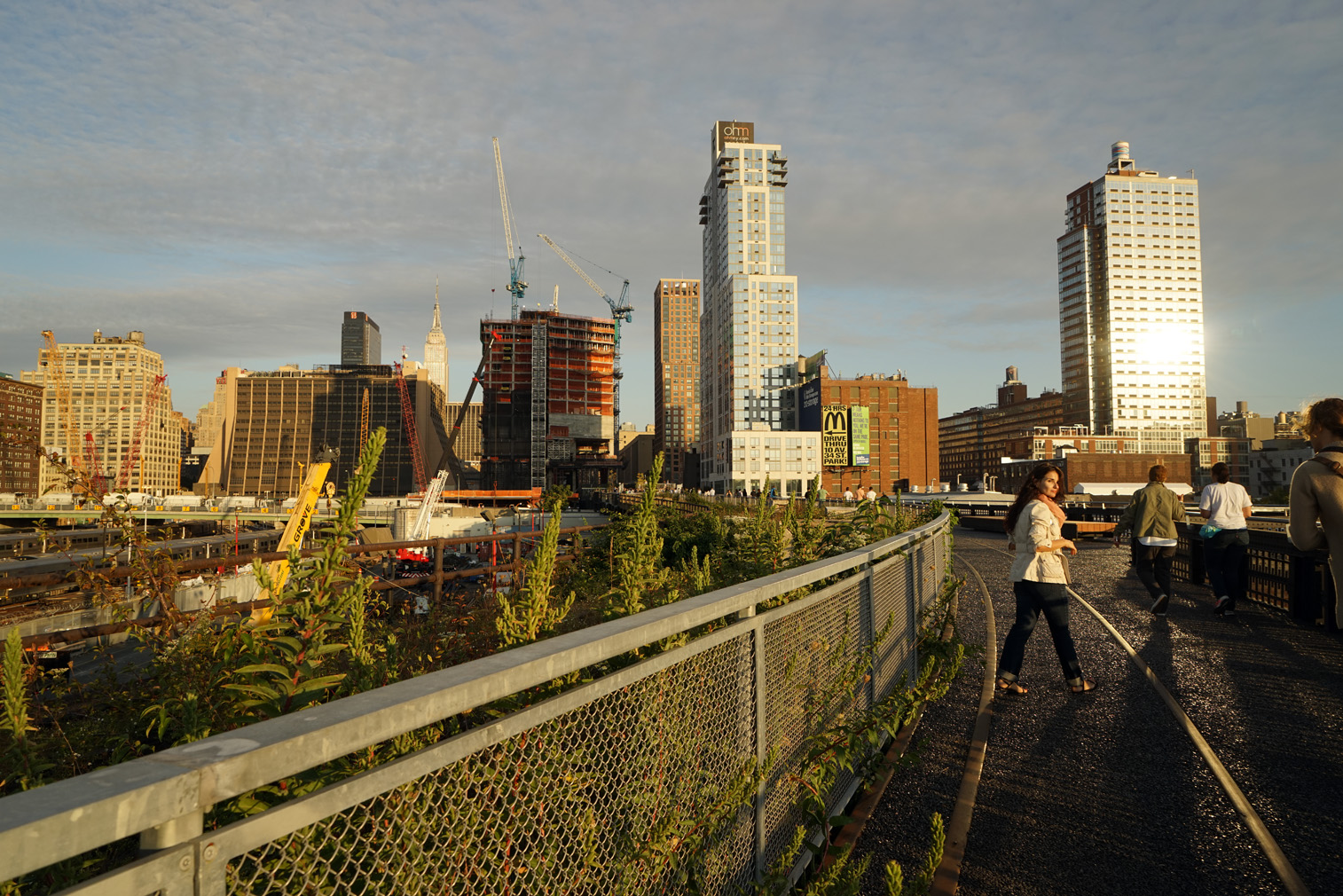
Or, you can turn your back on the river and watch a whole new city rising around the Hudson Yards, a neighborhood-in-progress that will, when it’s completed some twenty years hence, be twice the size of Rockefeller Center. If you’d like to watch a civilization in the constant act of reinventing itself, there’s no better place than here. All around you are the markers of time: shiny new buildings of the future, crisscrossed by construction cranes and men in hard hats; commuter trains keeping to their schedules, coming and going around the clock; rusty tracks from the old freight railroad, now overgrown with native and exotic plants; children of all ages playing and engaging with the place.
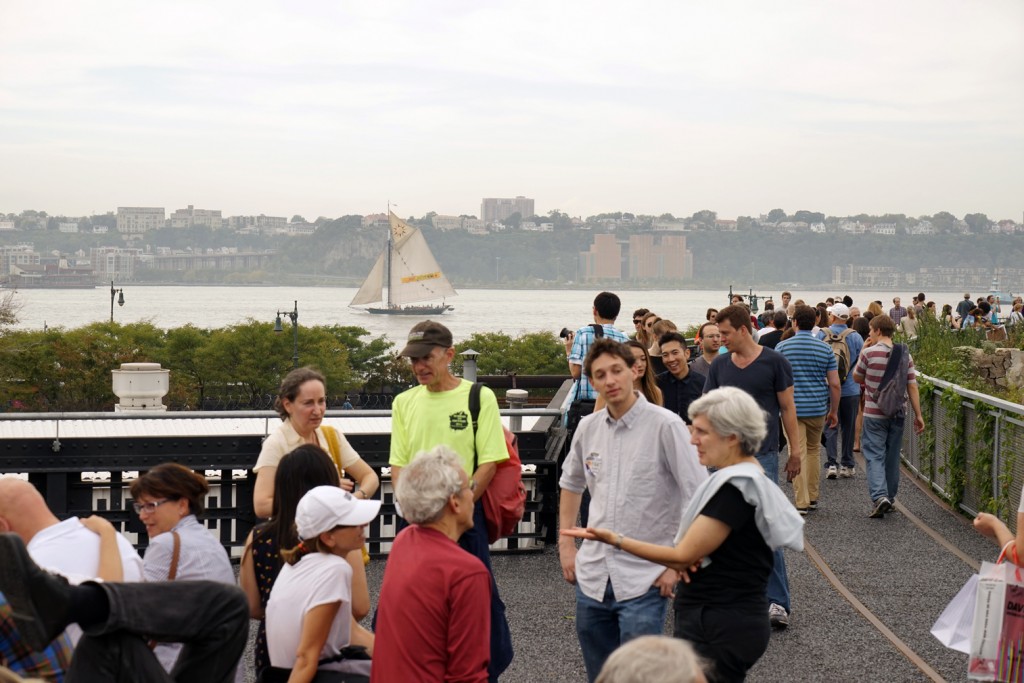
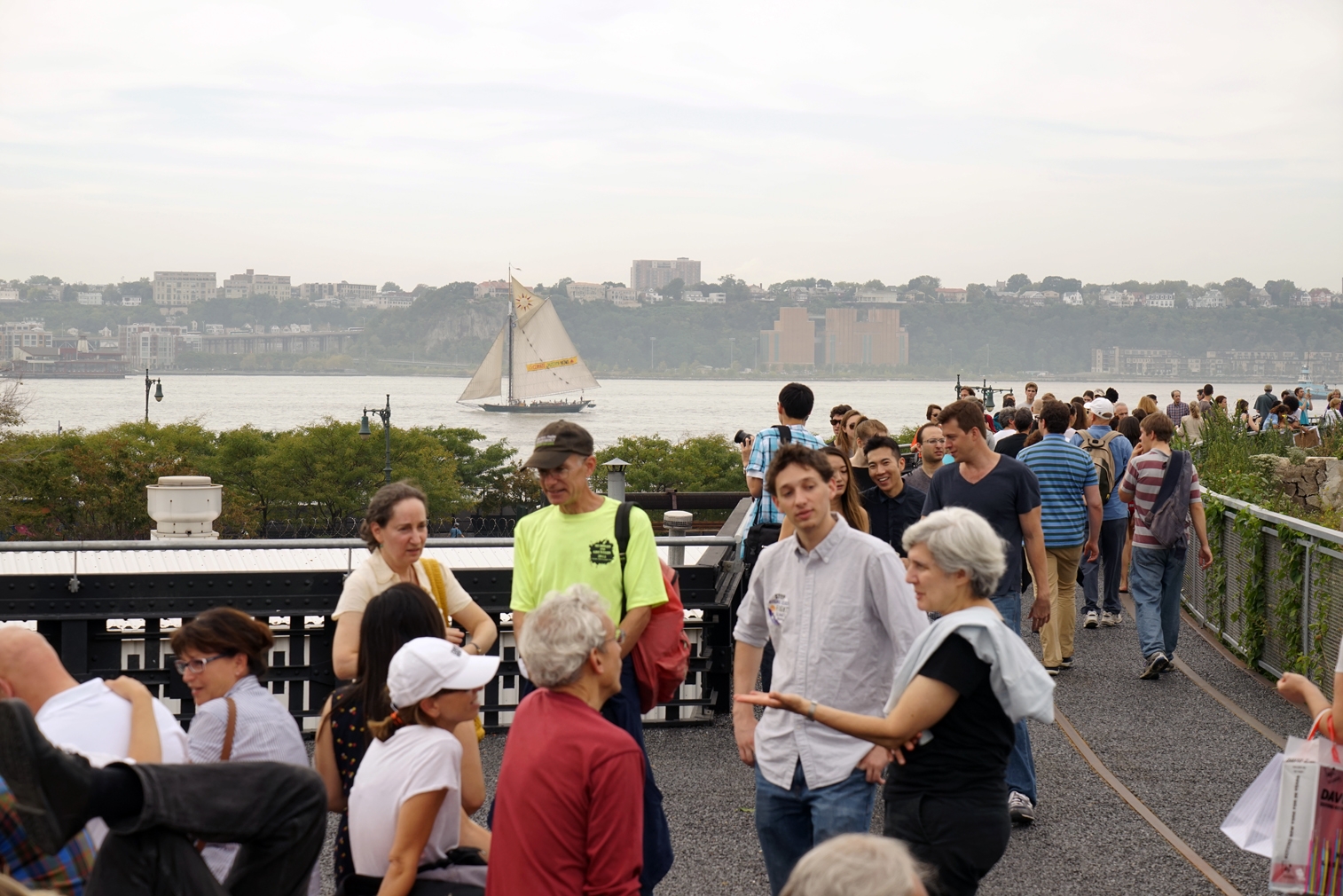
Pete Seeger's sloop Clearwater passes between the Rail Yards and the first section of the Palisades during the People's Climate March

Pete Seeger’s sloop Clearwater passes between the High Line at the Rail Yards and the first section of the Palisades during the People’s Climate March

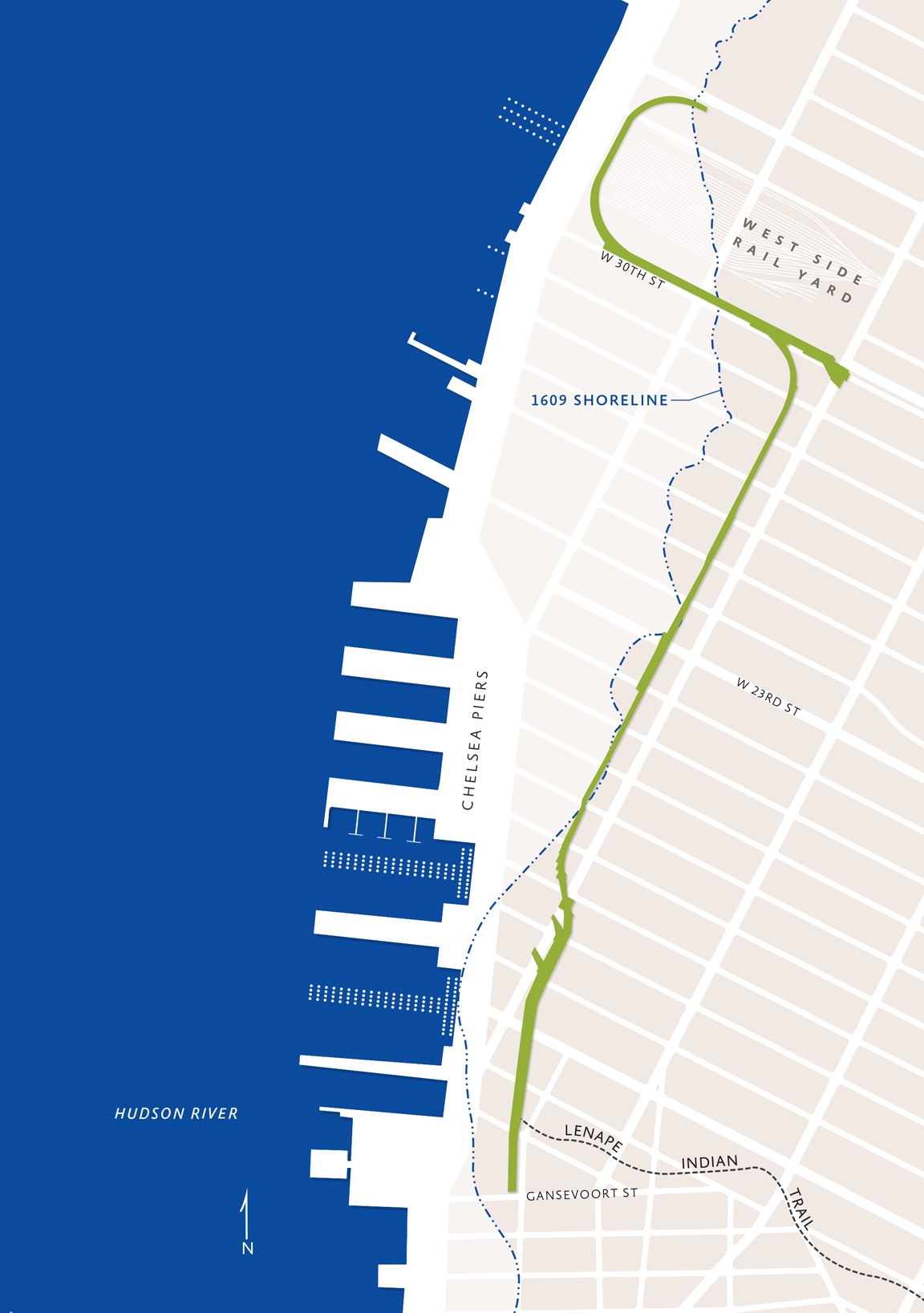
Time is in the landscape too, beginning with the Hudson River, carved in the last Ice Age some 20,000 years ago and used by us for the past four hundred or so as a primary force of American life, culture, commerce and art. Never content to let the river be, we’ve exerted our force on it in countless ways, and a good place to consider that is on the High Line’s new “Catwalk,” a raised path that crosses 11th Avenue. According to the Welikia Project, which collected massive troves of data on the ecology and topography of Manhattan Island before the Europeans arrived, in 1609 the Hudson River flowed just below today’s Western Rail Yards. (Marty Schnure of Maps for Good used the Welikia-Mannahatta data to create a special map for On the High Line that shows the original 1609 shoreline in relation to the entire park. Click the image of the map below to enlarge it and see the detail.)
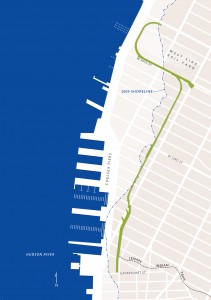
The 1609 shoreline and the High Line. Map by Marty Schnure, created for On the High Line

The 1609 shoreline and the High Line. Map by Marty Schnure, created for On the High Line

Centuries of landfill later, we have the the High Line, Chelsea Piers, the Intrepid Sea, Air & Space Museum, the West Side Highway, and dozens of old warehouses that are home to art galleries, tech, design and media firms — including the architects of the High Line itself, Diller Scofidio + Renfro, who work in a large studio space in the Starrett-Lehigh Building.

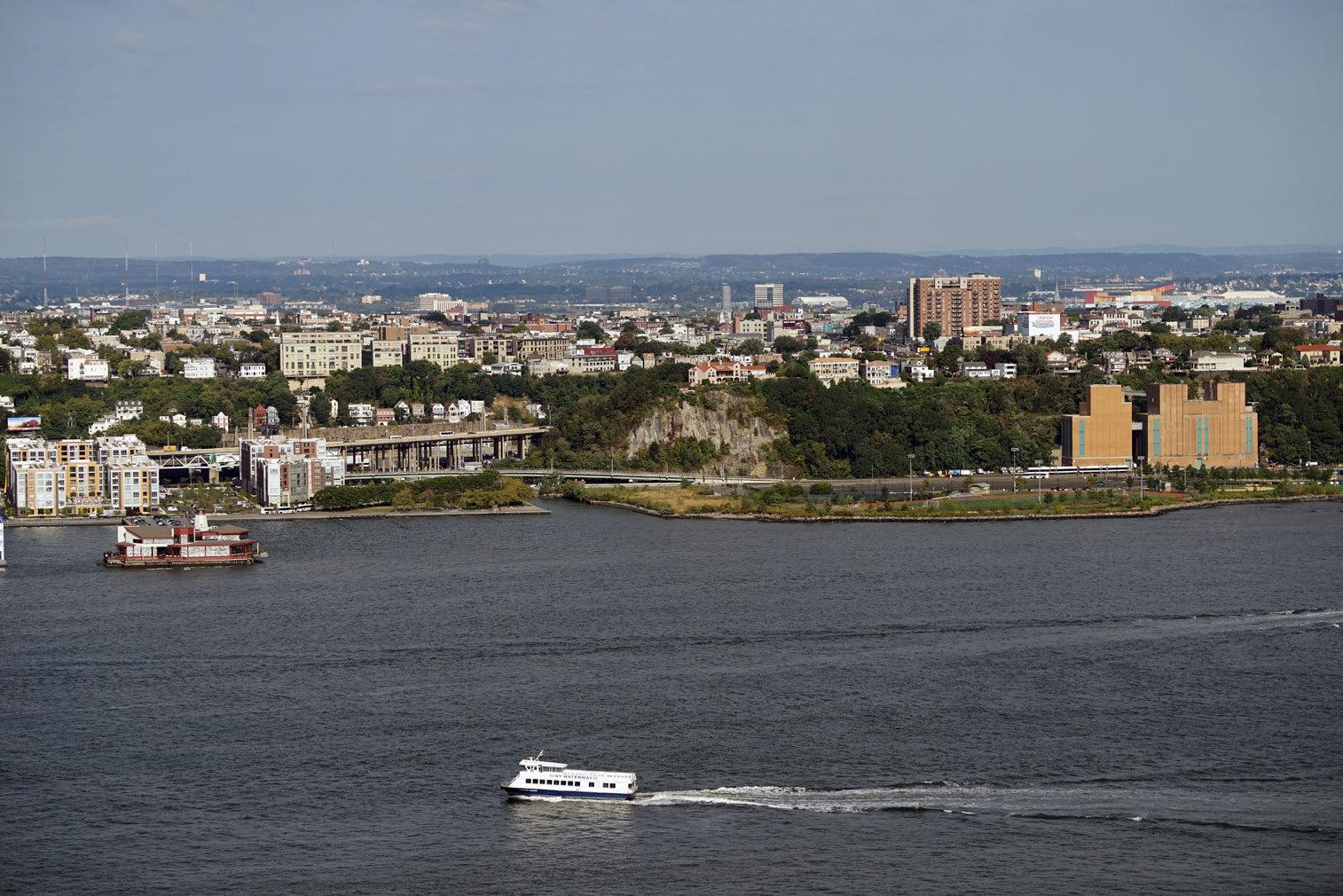
But a look across the river takes us much, much further back in time. On the western bank of the Hudson, just across from the Rail Yards,  you can see the first segment of the Palisades, created at the end of the Triassic Period some 200 million years ago. It’s a place where ancient geology meets classic human folly:  in July 1804, Alexander Hamilton, former Secretary of the Treasury, was shot and killed here by Aaron Burr, then the Vice President of the United States. In fact, this craggy spot in the town of Weehawken was a popular dueling ground; DeWitt Clinton fought a duel here in 1802 and Oliver Hazard Perry fought one in 1818. Today, a railroad runs through it.
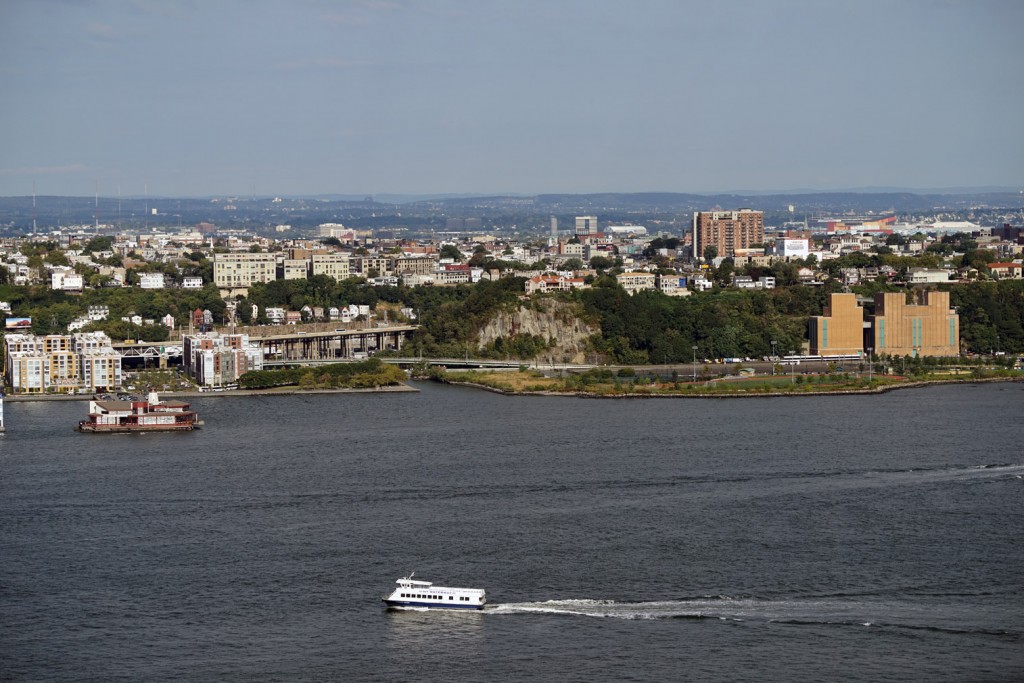
Hudson River, Palisades Cliffs, Weekhawken dueling grounds

Hudson River, Palisades Cliffs, Weekhawken dueling grounds

The new section of the High Line offers these and countless other points of contemplation. It’s a gift of extraordinary, timeless value. Every time you visit you will see something new against something old; it’s the ancient dance we do in New York, and there is no more beautiful, inspiring, place to bear witness to it.
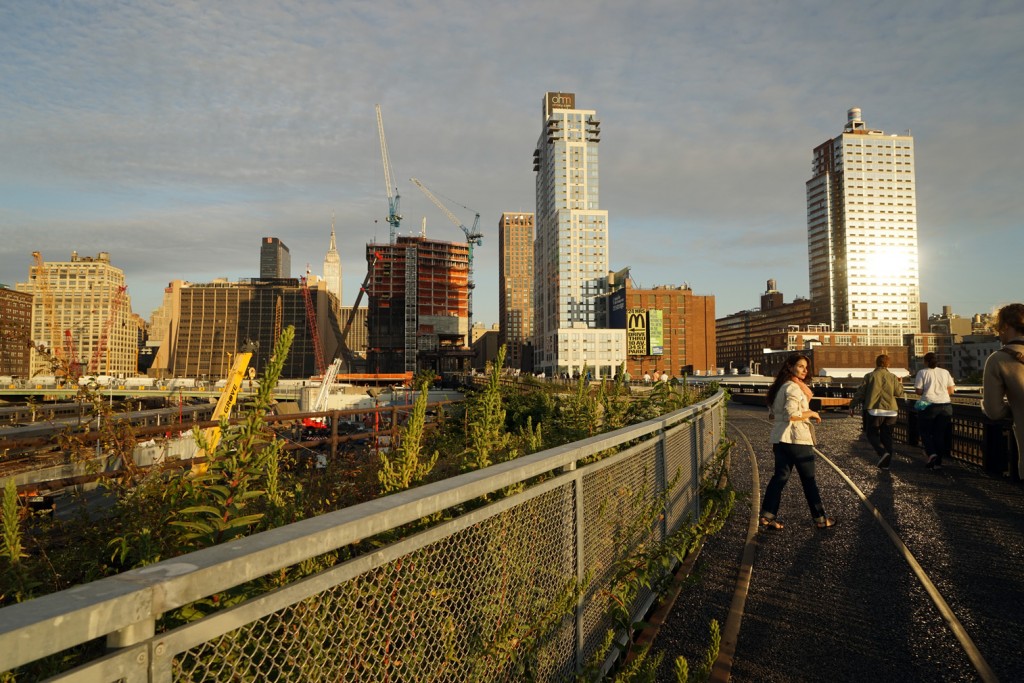
The High Line at the Rail Yards, dusk on opening day

The High Line at the Rail Yards, dusk on opening day

The High Line at the Rail Yards, opened September 20, 2014
Plant design: Piet Oudolf
Landscape Architects: James Corner Field Operations
Architects: Diller Scofidio + Renfro
Lighting: L’Observatoire International
More information at TheHighLine.org
 

Share
{ 0 comments }

The Crossroads at the High Line

The Crossroads at the High Line at the Rail Yards

The Crossroad at the High Line at the Rail Yards

Tomorrow, when visitors enter the third and final section of the High Line at the Rail Yards, their first footsteps will take them to a unique spot in this now mile-and-a-half long park. Some day — not tomorrow, but in a year or so — this little knuckle known as The Crossroads will be the only spot in the park where you could go in any direction of the compass. Visitors this weekend will enter from the south, and if they like can walk a bit to the east (under the construction shed). When the final piece of the High Line is completed in 2016, this eastern path will cut through a high tunnel in the new Coach headquarters across the Tenth Avenue Spur, into a new area of the park that’s still being designed. You will also be able, sometime in the future, to walk north, up those few steps and into a whole new park in the Hudson Yards.

But tomorrow, everyone will walk west into the new High Line at the Rail Yards. As the gorgeous, heart-stopping views of Hudson River draw you westward, don’t forget to look down and observe that Crossroads. It took a long, long time to get here, and it’s still pointing to the future.

Share
{ 2 comments }

The Incomparable Johnny

Johnny Linville, Spring Cutback, March 2012

Johnny Linville, Spring Cutback, March 2012

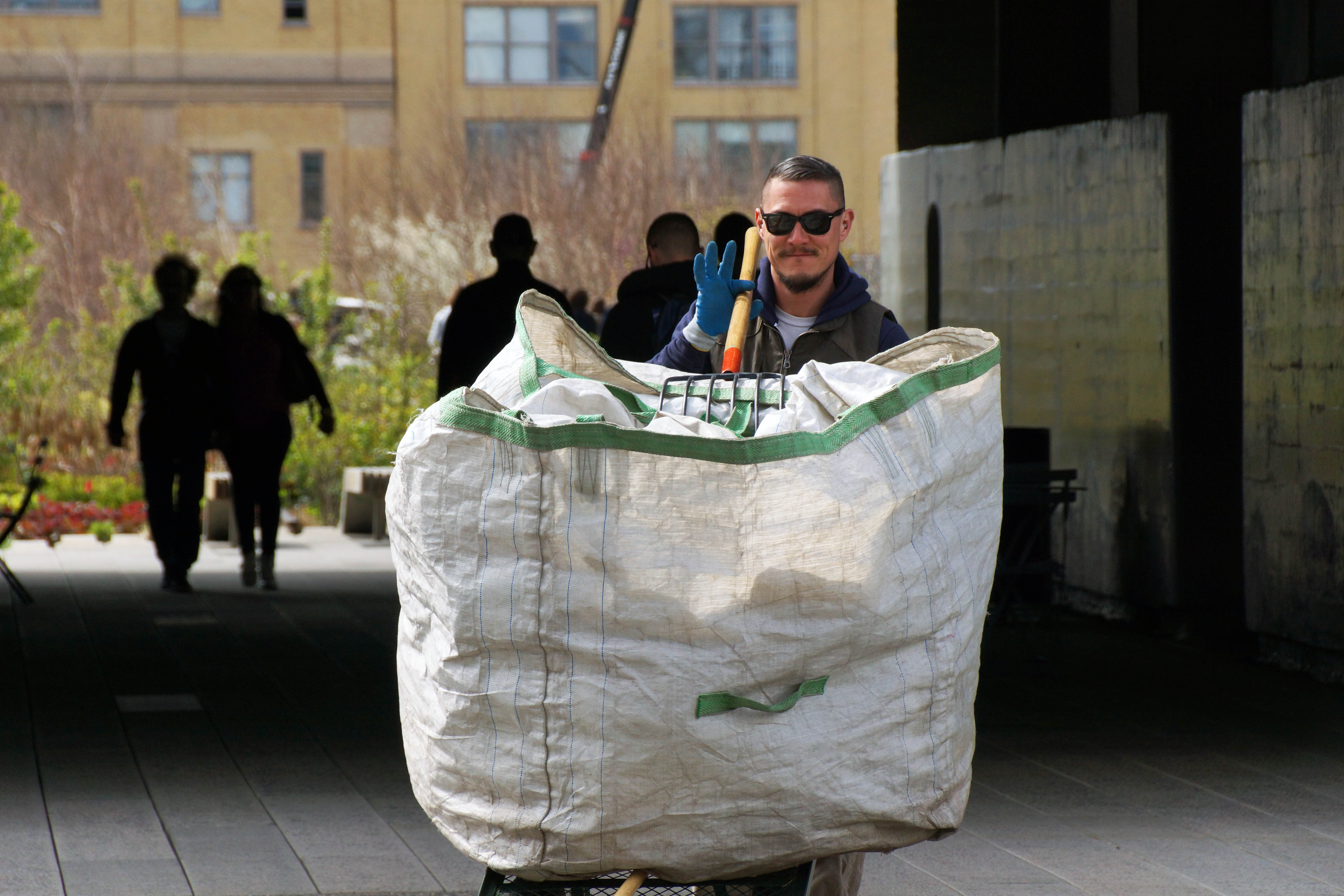
There are thousands of plants on the High Line. No one can know for sure the actual number, but every year an army of volunteers joins the park’s gardening staff for the annual March Cutback, and in our training we’re told that in the course of five or six weeks we’ll cut back 100,000 plants. Maybe more, maybe less, but here’s something I know for sure: the enormity of that number is just one measure of the sadness that has descended on the garden since the loss of Johnny Linville last week.

Johnny began working at Friends of the High Line in June 2009, the month the park opened to the public. He didn’t start his professional career in horticulture, though; he first held a more traditional office job at Lindamood-Bell Learning Processes, which runs centers around the country that help children and adults improve themselves in reading, language comprehension, vocabulary, and math. Johnny was an associate director at one of the centers by the time he realized he was more passionate about gardening than anything else. He took a flier and applied for an internship with the Brooklyn Botanic Garden, and that gave him a foundation of technical knowledge. It also launched him on a new and exceptionally successful career trajectory, beginning as a Gardener at Friends of the High Line, then moving up to Horticulture Foreman and, at the time of his death last week, Manager of Horticulture.

He was irrepressibly passionate about plants, captivated as much by their beauty as by their storylines. Last Fall I ran into him in the park at the moment when he was studying apples, trying to decide which variety to plant in the new and final section of the High Line at the Rail Yards. He was brimming with enthusiasm, telling stories about Thomas Jefferson and his orchards, clearly thrilled to be spending his day doing the research that would determine which apple variety would make it to the High Line.

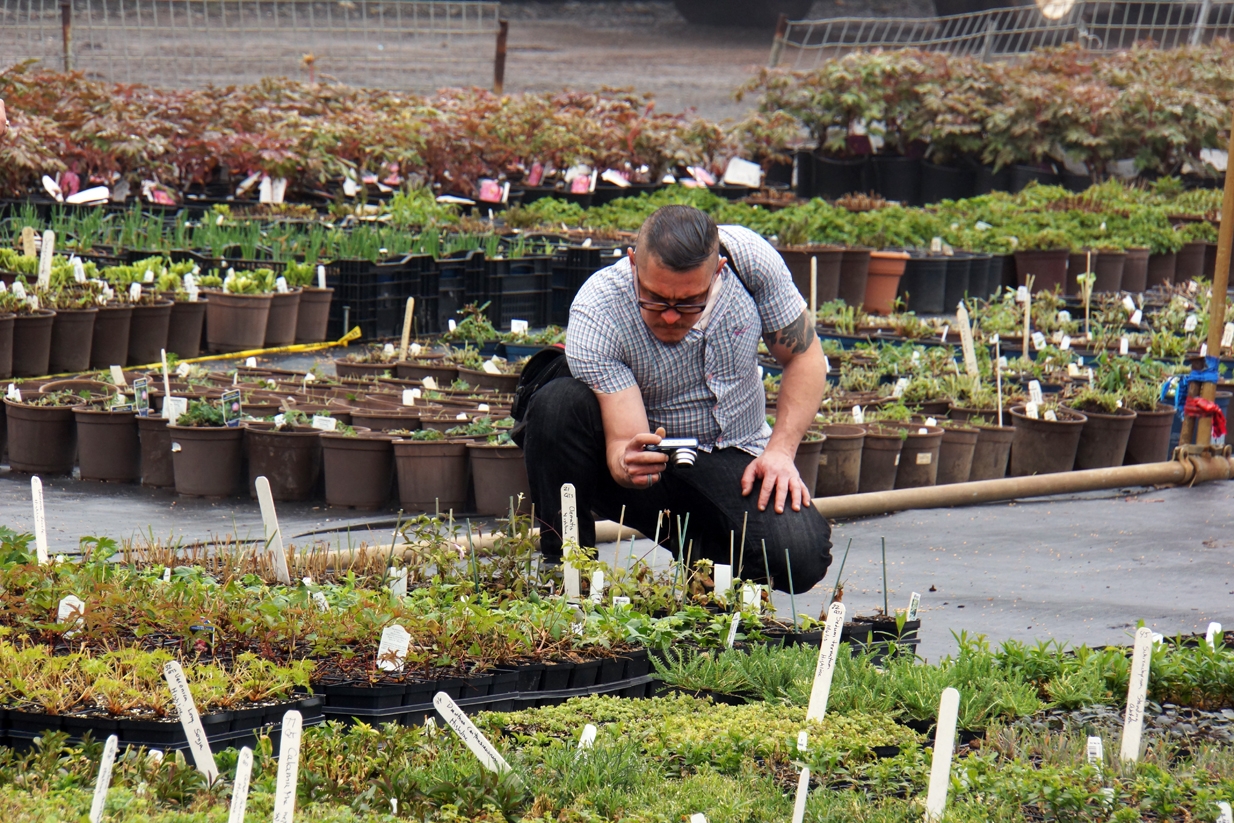
He was also a profoundly generous guy. Time after time, Johnny found ways to help me better understand the High Line and how it works, engineering a visit in 2012 to the Fresh Kills Landfill where all the cuttings from the Cutback are recycled and, more recently, to the Sunny Border Nursery in Kensington, CT, which supplied plants for the High Line at the Rail Yards. (In classic Johnny fashion, he was determined to properly prepare me for that visit, and the week before emailed a long magazine article that recounts the fascinating story of 79-year old Pierre Bennerup, who helps run the nursery that his father founded in 1938, launching a revolution in the sale of perennials.)

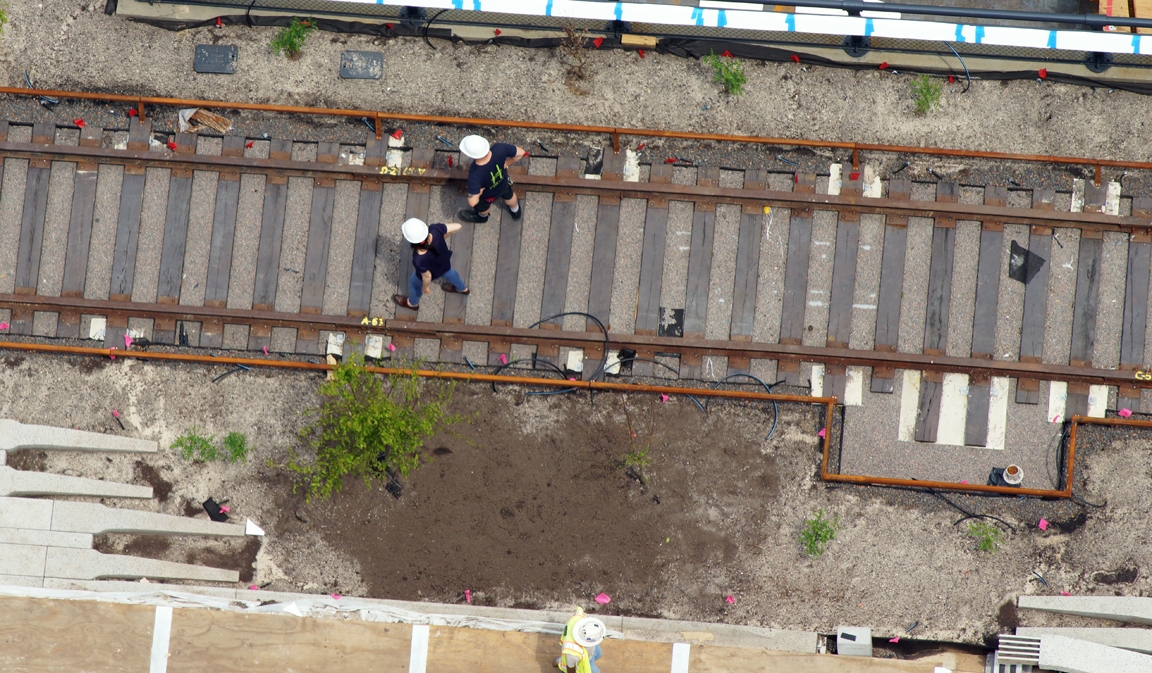
Johnny was generous with his time and his expertise, and ardently perfectionistic about getting the facts right. He was funny, patient, ripped with muscles and he loved dogs. He had a huge, contagious smile, and tattoos that were so distinctive I was able to recognize him through my camera lens from the 35th floor of the Ohm apartment building, as he strolled some 400 feet below, inspecting new plantings in the Rail Yards.

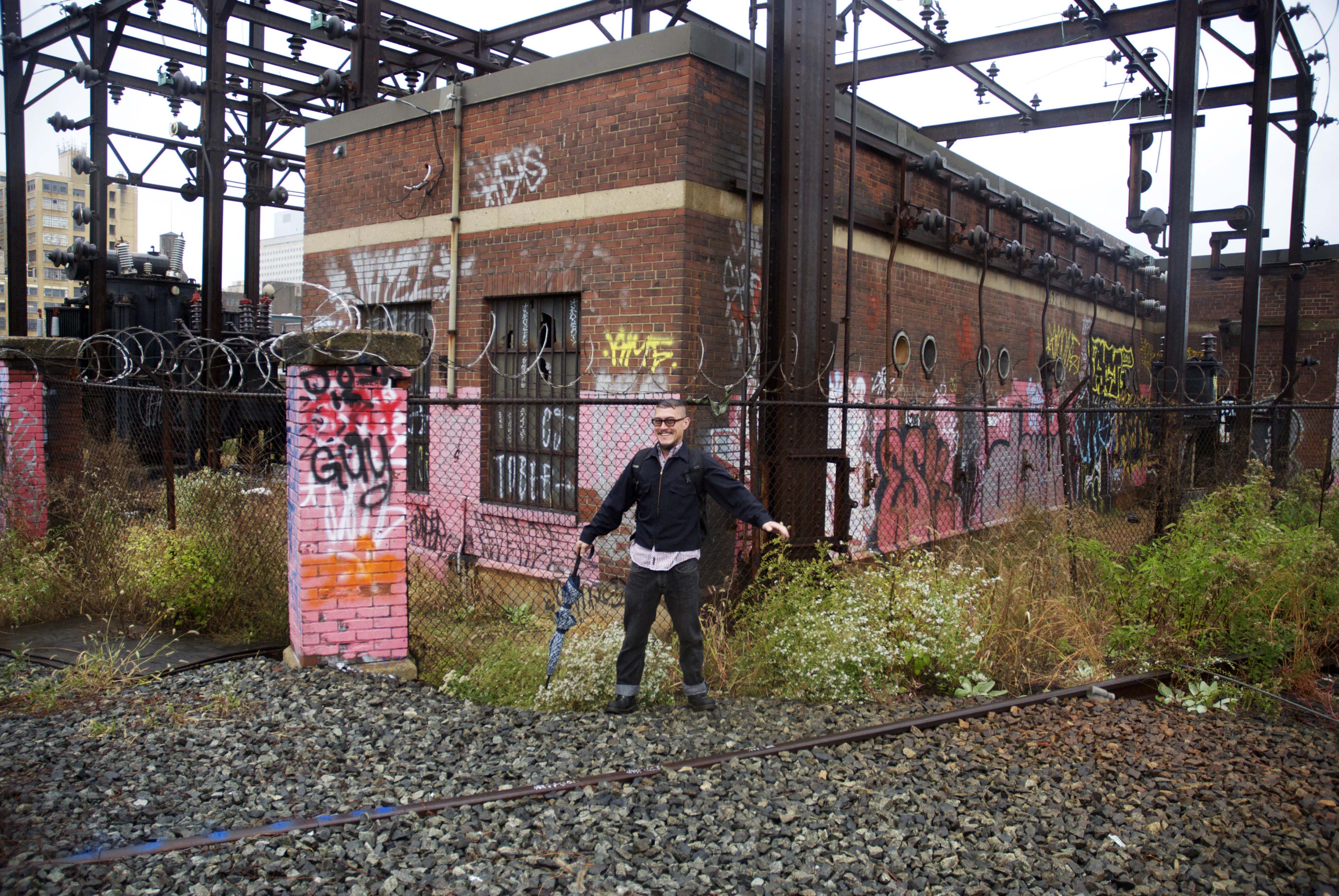
Six months ago, he accompanied me to Reading, Pennsylvania, to attend a memorial service for a mutual friend who also died too young, Paul VanMeter. Before the service a contingent of railfans and garden lovers made a pilgrimage to the Reading Blue Mountain & Northern Railroad, a place dear to Paul’s heart.  Johnny and I walked together through the yard, balancing on the rails and talking about Paul, and before we left he pulled a quarter from his pocket and laid it on the track, a gesture of remembrance. “For Paul,” he said.  Something motivated me to take a photograph, which I discovered this week as I was going through pictures of Johnny. Wonderful, bold, elfin, passionate, curious, loyal, dedicated, Johnny.

This afternoon I stopped by the High Line — Johnny’s garden — this place of reinvention and respite, and placed a quarter on one of the tracks that cuts through a cluster of prairie grasses and wildflowers. A gesture of remembrance, and also one of hope: that Johnny knew how deeply he touched so very many people, and how much we all loved him.

For a park so notoriously crowded, with its 100,000 plants and millions of visitors, it suddenly feels so empty.

Note: on Thursday, August 7, a memorial service was held in the 14th Passage on the High Line. It was a devastatingly sad and moving event, which ended in a moment of silence with “Song to the Siren” from This Mortal Coil playing in the background. It apparently was Johnny’s favorite.

Johnny Linville on the Reading Viaduct, Philadelphia, October 2011

Johnny on the Reading Viaduct, Philadelphia, October 2011

Johnny Linville at Sunny Border Nursery, May 2014

Johnny at Sunny Border Nursery, May 2014

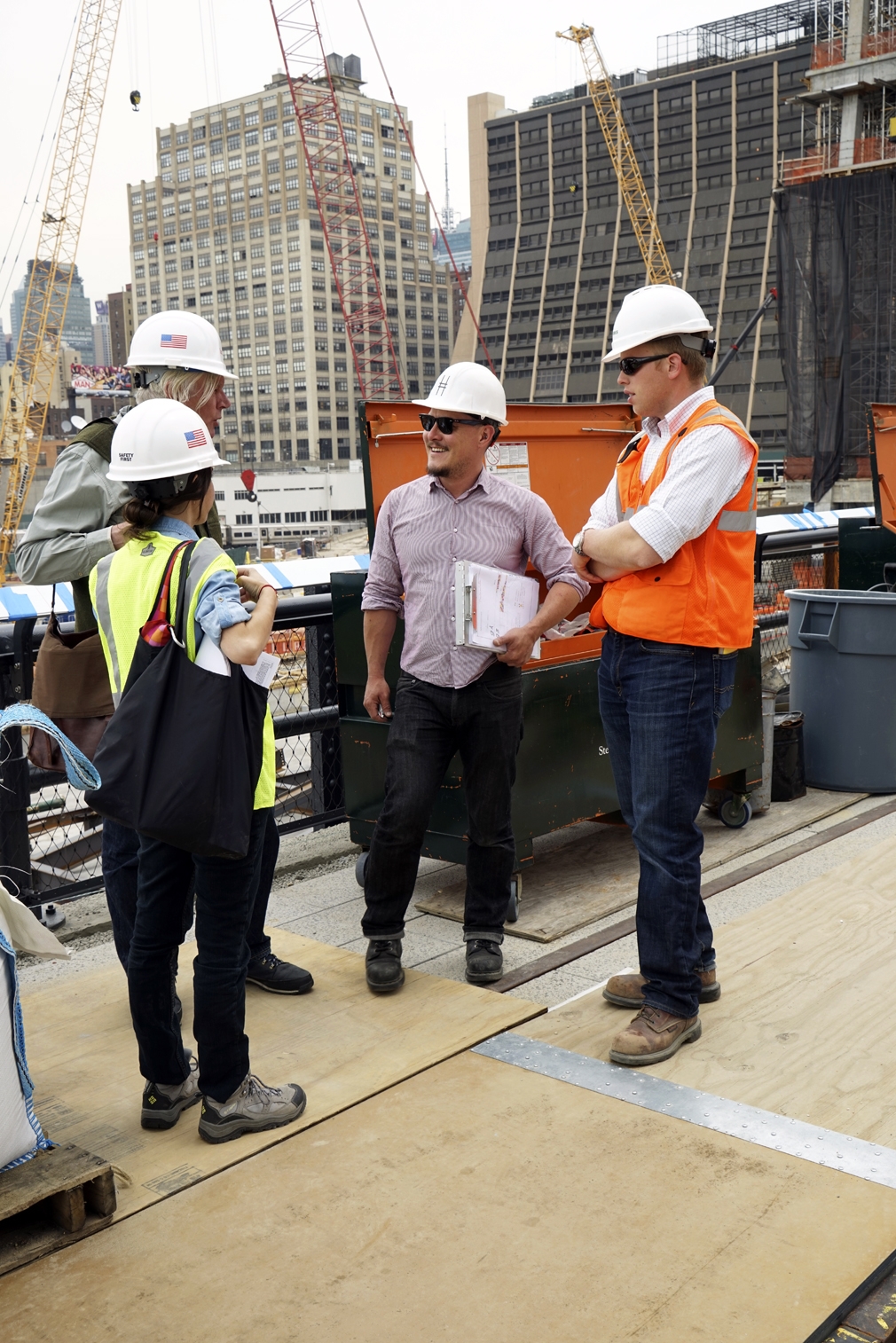
Johnny Linville with Piet Oudolf and colleagues from James Corner Field Ops, May 2014

Johnny with Piet Oudolf (left) and colleagues from James Corner Field Ops, May 2014

Johnny from 400'

Johnny from 400′, May 2014

Johnny with fellow FHL gardeners in Philadelphia, October 2011. Photo by Rick Darke

Johnny with fellow FHL gardeners in Philadelphia, October 2011. Photo by Rick Darke

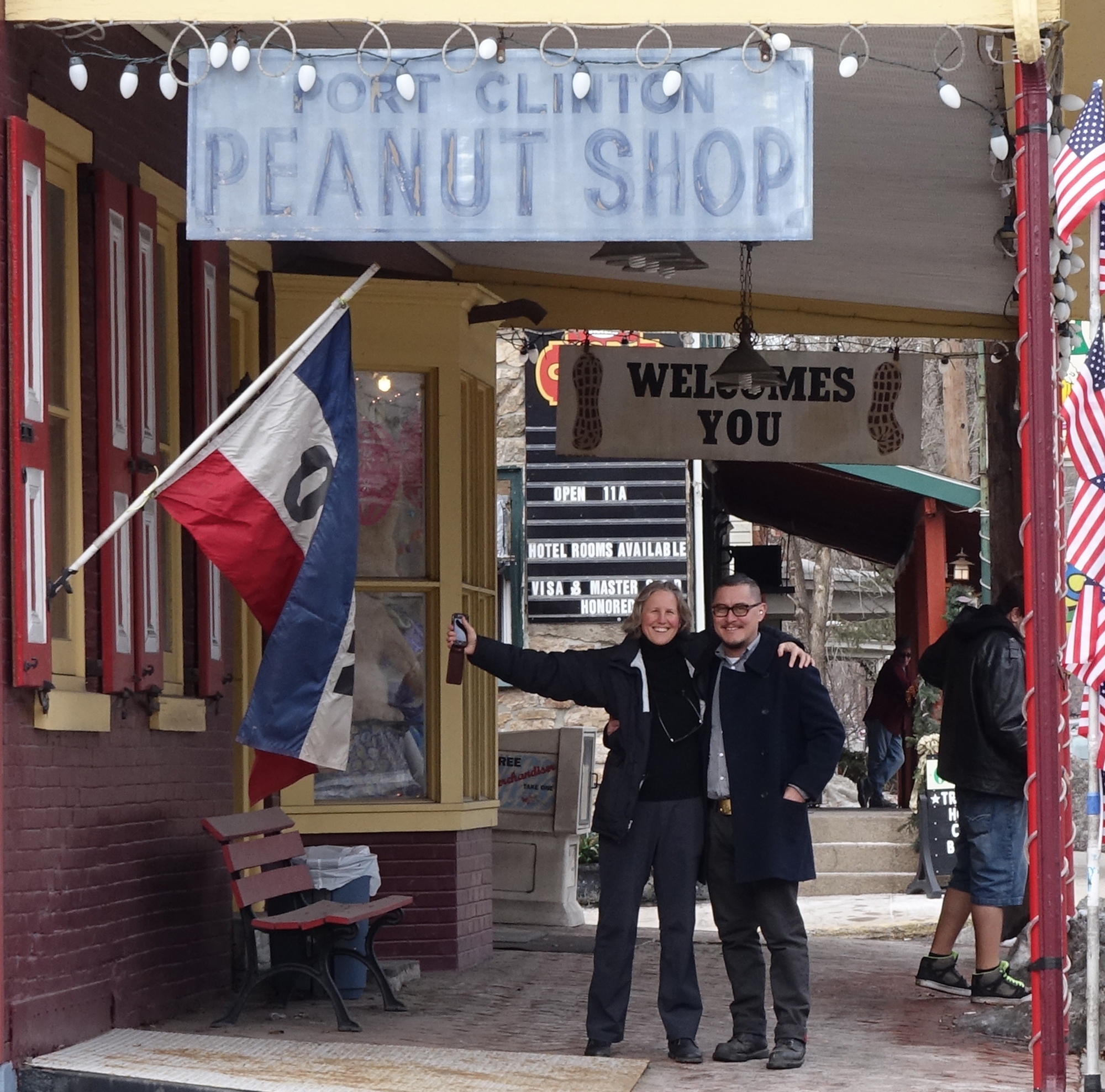
Johnny & Me, Port Clinton, PA, March 8, 2014

Johnny & Me, Port Clinton, PA, March 8, 2014. Photo by Rick Darke

Blessings on you, Johnny.

————–

Note: for more about Johnny Linville, read the brief and lovely profile by Auzelle Epeneter on TheHighLine.org.

Share
{ 6 comments }