≡ Menu

In Praise of Urban Architects & Designers

Watching and studying a great public space in progress has made me think a lot about the decisions that designers and architects make as they create the places that we will all inhabit and enjoy.

Every weekend I drive down the West Side Highway on my way home from upstate, and it’s hard not to notice (because we’re almost always stuck in traffic) the new park that snakes its way up the bank of the Hudson River in the 60s.

What you see very dramatically from the highway (and a bit less so from the walkway inside the park) is the way the ancient river structures have been echoed in the modern architecture. (Okay, “ancient” is a bit over-the-top, since these structures aren’t much more than 100 years old, but in the age of Twitter I’m going to let it stand, just this once.)

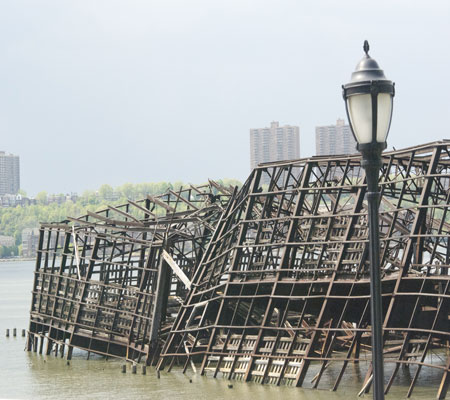
Look at the twisted wreck of Pier D….

This pier was originally built of wood in the 1880s and was angled in a particular way to enable rail cars to roll down and unload cargo from ships. It was destroyed by a fire in 1922, rebuilt with steel and then finally destroyed for good — by another fire — in 1971.

The designer who planned this section of the park along the West Side Highway (it’s at around 64th Street) paid wonderful homage to Pier D and the longshoreman who worked it by creating the benches you see here…


It’s just a suggestion, nothing heavy-handed, but it connects a passerby to the old days when this pier was a vital commercial link, providing a way for grain, milk, vegetables, and other supplies to reach the city.  (Not unlike the High Line, by the way; follow some of the links in my blogroll to learn more about the history and purpose of the original railroad.)
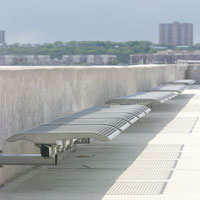
Even the small, incidental seats that line a cement wall and are clearly intended for unceremonious sitting — tying your shoe, tightening the straps on your roller blades, enjoying a quick smoke — echo the twisted wreck of Pier D.

There’s a story in the Times about how Adrian Benepe, the parks commissioner in 2003, had to race down to the waterfront to stop a crane from dismantling the pier, which he had committed to preserving. We all owe this man a debt of gratitude, as well as the designers and architects who crafted so many decisions as they were conceiving this park. They are a source of pure delight to the eye and the spirit, whether you’re strolling along on a beautiful spring day or stuck in a traffic jam on the highway above.

Share
{ 1 comment }

Paradise and Lunch

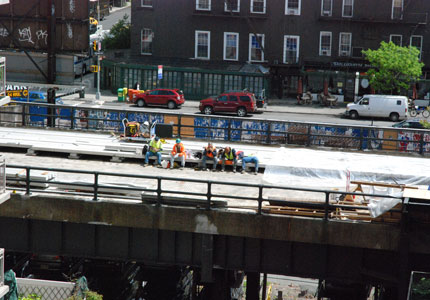
It’s probably not the first lunch that’s been had on this stretch of the High Line and it surely ain’t gonna be the last.


Share
{ 0 comments }

The Slow Dance

It’s impossible to know the slow choreography that’s involved in a building project unless you happen to witness it unfolding. Strolling through a park — take, for example, the High Line — you’d never guess at the number of steps that have been taken before the ground you walk on is complete.

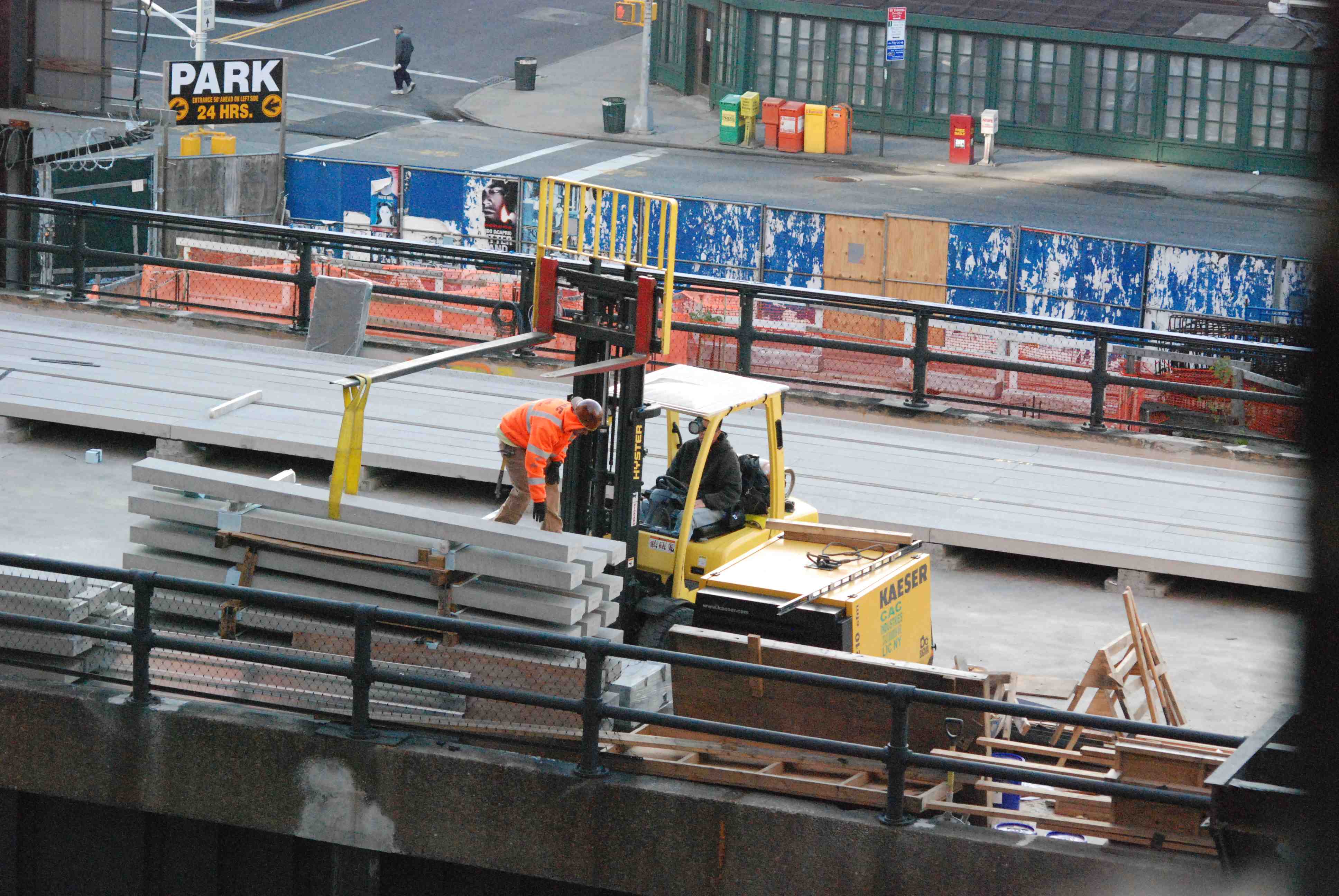
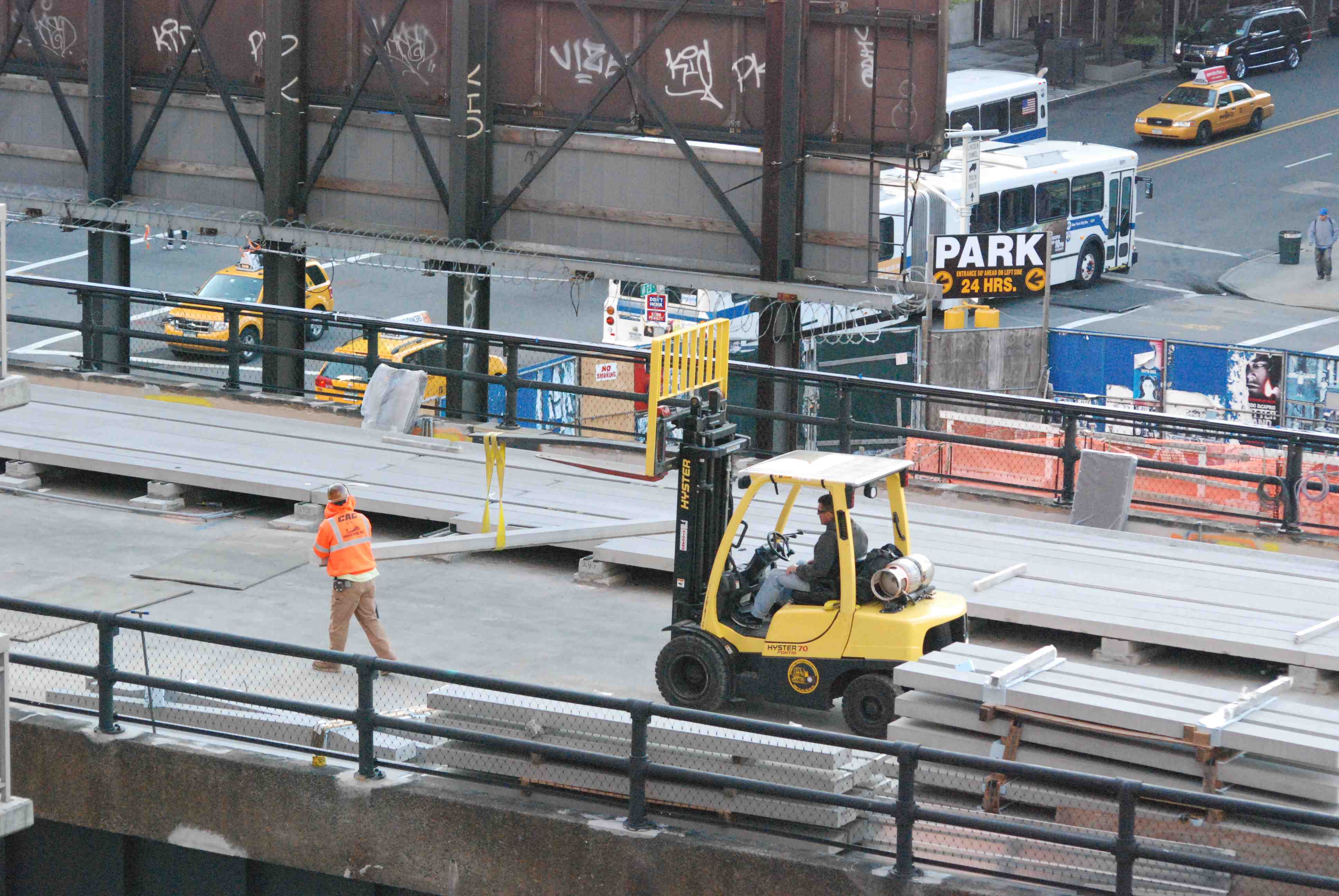
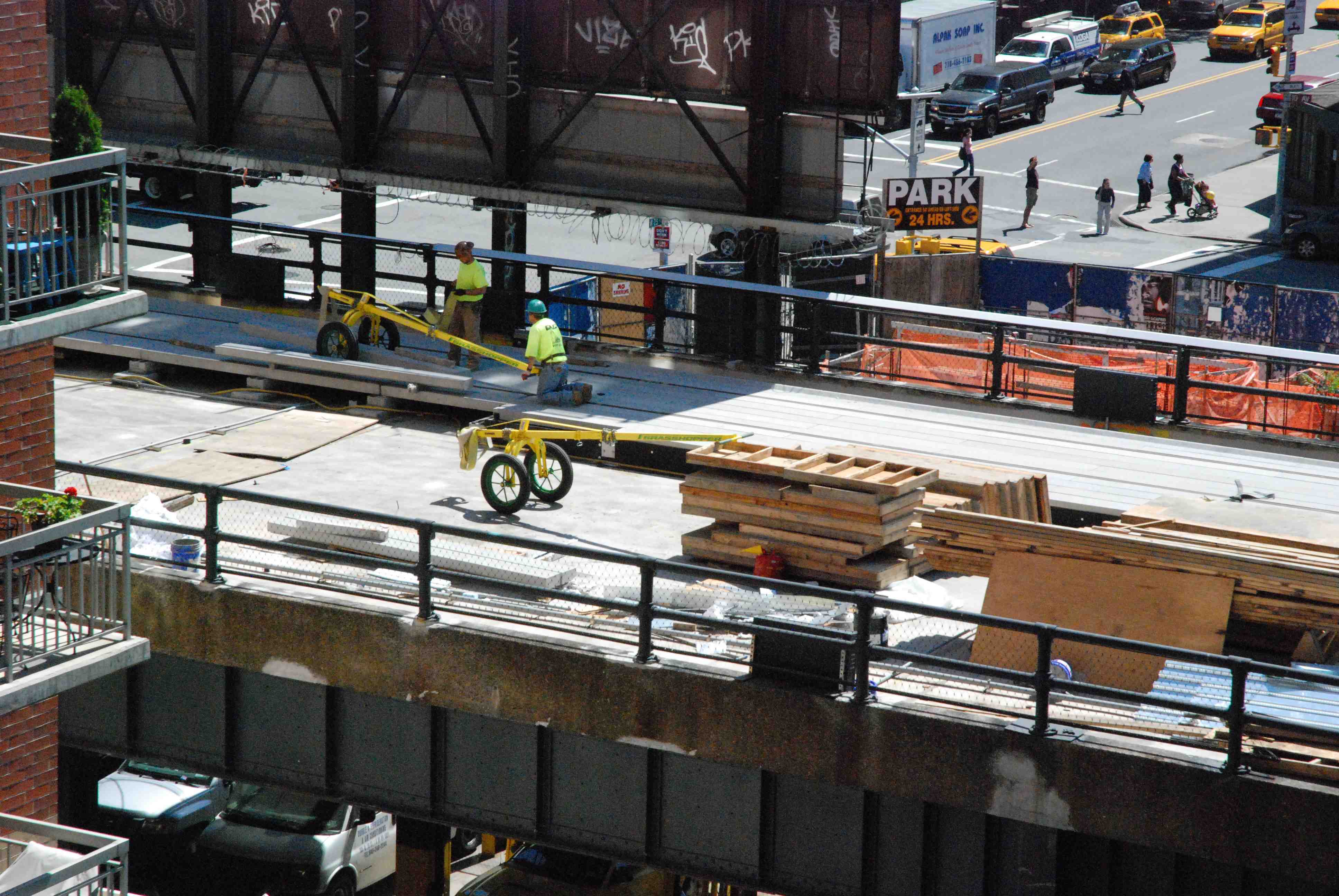
This was made manifest to me today as I glanced out the window and watched two men at work, moving pavers. Here’s what I think is going on: the large stack of pavers in the foreground has been sitting in that spot for quite some time, and was placed there — on the west side of the High Line — so the men could lay track on the east side. Now, it appears, they are moving each paver — one by one, slowly, gingerly — to get them out of the way so they can prepare the bed that the stack lies on. That bed will become the walkway that hundreds of people pass along each day once this segment of the park is opened.  The process takes about 5 minutes per paver, and unfolds thusly:

Guy #1 climbs the stack and lassos the paver that’s scheduled to move. He steps to the side and levels the concrete beam, gently steering it eastward.


Then he hops down from his pile and points the beam ahead of him, and begins to walk north along the High Line.


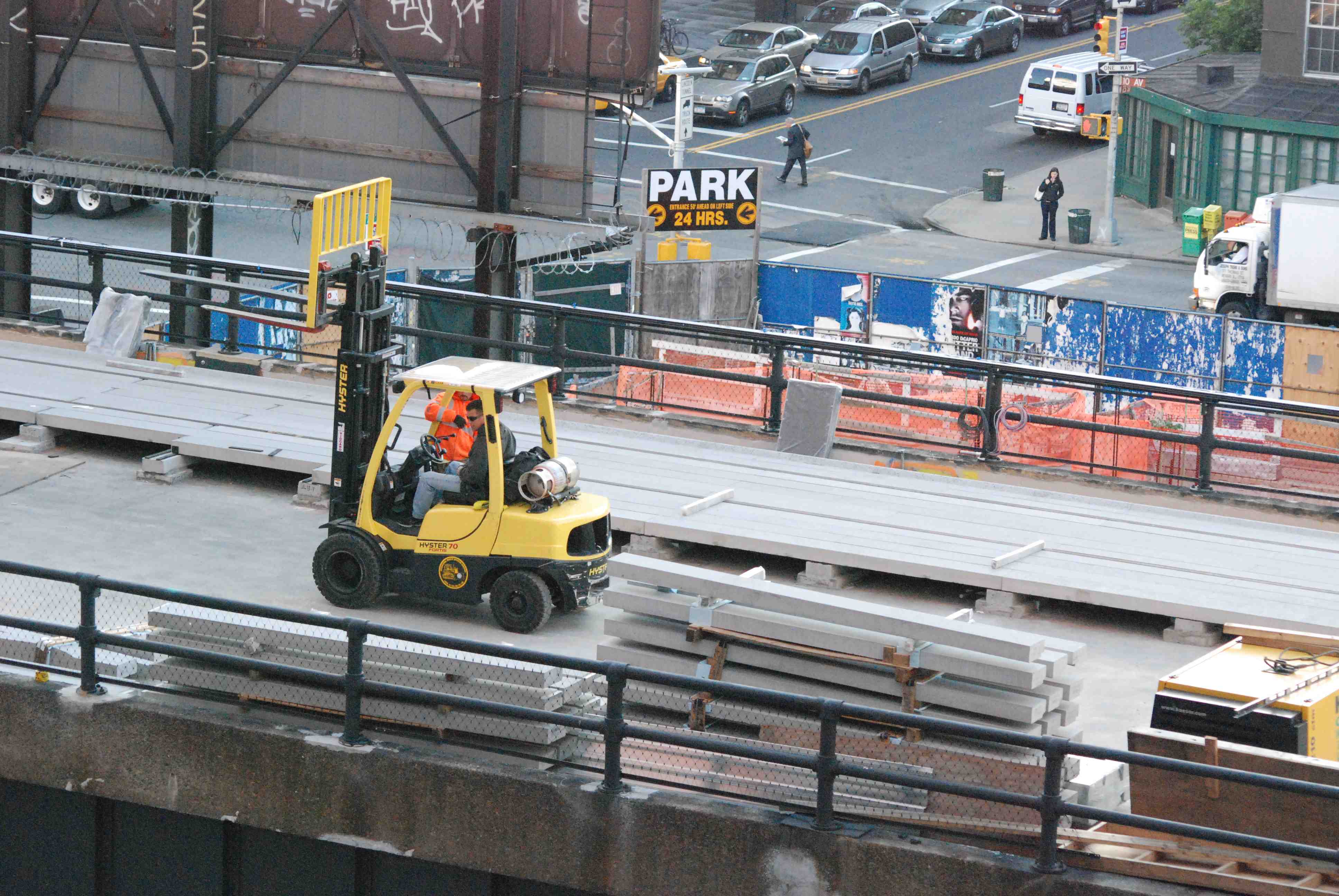
The yellow machine follows at a leisurely pace, carrying the brunt of the load. They disappear from my view pretty quickly, and I have no way of knowing where this beam and its fellows ends up.


But about 10 minutes later the two men heave back into view, this time driving the yellow machine in reverse. They repeat the process, following exactly the same steps, until the pile is gone.


Share
{ 1 comment }

The Grasshopper


I’ve been sensationally busy lately, building a website. I haven’t looked out the window in days. So I can’t say when the High Line guys moved the wonderful Grasshopper to the spot it now occupies, center stage in my evolving High Line drama. But tonight, as I was passing by the window with a nice glass of wine, I happened to glance out and there it was. It reminded me of my father once more.

Thanks again, High Line guys. Tomorrow I’ll try very hard to put myself in front of the window and watch, so I can see what this marvelous device actually does. Or maybe it’s better to let it stay a mystery. Only tomorrow will tell.

Share
{ 0 comments }

The Unfinished Nature of Life

Walking on the High Line today I discovered that there’s still an unfinished section in the part of the park that’s open to the public. I shot a paver from that section (it’s at around 16th Street) back in mid-September, and there it was, five months later, still unfinished. There’s also a wonderful contraption called a Grasshopper, which is used to lift and move heavy materials like concrete pavers. This scene has remained untouched for months. Who knows why.

But it suddenly conjured a memory of something my father said ages ago about the Cathedral of St. John the Divine on 112th Street and Amsterdam. His grandfather, C. Grant LaFarge, had been one of the architects; he designed the austere, dark, Romanesque/Byzantine section in the late 1880s. It wasn’t until 1941 that the cathedral finally opened but it wasn’t finished; World War II delayed it for another 32 years and the building remained in a state of incompleteness throughout my teenaged years. Work continued on and off for another 20 years — embracing two periods of financial distress — before Philippe Petit famously walked the high wire (from 150 above street level) across Amsterdam Avenue to deliver a silver trowel to Bishop Paul Moore, in honor of the start of the next phase of construction. My dad had died by the time a fire destroyed the north transcept of the church and the gift shop in December 2001; the scaffolding went up again and didn’t come down until 2007. (You can read the whole story on the Cathedral’s website.)

When I was a kid we used to visit the church often, and it was perpetually in a state of construction. The massive building is an odd mixture of different architectural styles that seem to have evolved over centuries, so when you walk through it you get that wonderful experience that New York City often offers of old and new, one style vs. another, all somehow unified by its New York City-ness. And you also get this other sense that I felt last week on the High Line: it’s always in medias res, not quite finished, getting a touch-up or an overhaul, “under construction,” “coming soon,” whatever. There’s always the promise of something more — even, maybe, something better.

So here on the High Line — itself in a perpetual state of construction — the finished part isn’t really finished yet. The sign makes no promises — “Area Closed — Work in Progress.” You can recline on a teak bench, gaze out at the Hudson River and enjoy one of the most beautiful views in the city. But the orange cones are there to remind you that the place is still unfinished. What my father always said, as we’d walk around the cathedral, is that the unfinished quality of St. John the Divine reminded him of the fact that he was unfinished too. He thought we all are — we’re each of us a work-in-progress. That, plus the fact that all this unfinished business reminded him of his grandfather who died long before his work was done, made the scaffolding, barricades and  construction apparatus a perfectly natural, even beautiful part of life.

I was a young grasshopper then, but I remember it like it was yesterday. Thanks, High Line.

Share
{ 0 comments }

A Railroad Emerges

4.2.10

I’ve been very busy and haven’t visited the actual High Line in a couple of weeks. Yesterday some good friends were in town so I accompanied them, and I got a real surprise when I stepped off the metal stairway of the 20th Street entrance: the crew have laid a good city block’s worth of new track, and installed pavers as well. The naked High Line is no more, at least not here (the photo above looks north from the parapet of the stairway on 20th Street).

If you look closely you can begin to see how it all fits together: the pavers (each with its individual number) and the rail ties.

Farther south, in the finished portion, I snapped this detail, which shows the layers of a paver (remember 1-2-3 Jello?) and the embedded screw that attaches (I presume) to a wooden rail tie. Or maybe to another paver.

No matter; we are seeing the underbelly of the High Line, but pretty soon it’ll all disappear and we’ll have a lovely walk on it.
Share
{ 1 comment }